A major water sampling operation along the length of the River Nidd has revealed high levels of the faecal bacteria E.coli.
Dozens of volunteers tested water quality at 45 locations on August 3 as part of an ongoing clean-up campaign.
Analysis of the results has now revealed high levels of E.coli, which can cause illnesses such as vomiting and diarrhoea, along the Nidd and “extremely high levels” at some points — especially the beck tributaries.

Volunteers conduct sampling at Oak Beck this month.
A second round of water sampling is due to take place next month before a formal bid is submitted to the government to designate bathing water status on the Nidd.
If accepted, agencies will be obliged to undertake measures to clean the Nidd, as has happened on the River Wharfe in Ilkley.
David Clayden, chairman of Nidd Action Group, which is coordinating the sampling, said:
“The results so far indicate high levels of E.coli, particularly down river. Specific locations, including some of our becks, show especially high values whose origins we need to understand better through discussions with the organisations charged with keeping our River Nidd clean.
“I’m not surprised by the findings as this is a uniquely comprehensive, citizen science led activity, aimed at exposing the true levels of pollution in the Nidd, and through rational analysis getting them improved.”

Volunteers involved in the project to test Nidd water quality.
Knaresborough bathing levels
The results showed in the upper catchment, down to Birstwith, the concentrations of E. coli were much lower than in the middle and lower catchment.
E.Coli concentrations rose below Killinghall sewage treatment works and stayed high, with the most extreme value at Nidd viaduct, below the confluence of Oak Beck and the River Nidd.
Knaresborough sampling locations had concentrations well above the levels deemed sufficient for inland bathing water. Reports of bathers around Knaresborough Lido falling ill played a major role in prompting the campaign.
The tributaries in the middle and lower Nidd catchment all had particularly high concentrations of E.coli – Ripley Beck, Oak Beck and Crimple Beck. Bilton Beck was extremely high.
Mr Clayden said besides next month’s second round of testing, “many more local actions” were being planned to provide improved information to help look after our river. He added:
“During the survey I was heartened to meet many wonderful local people, volunteering their precious free time to understand and benefit their local river.”
Read more:
- Volunteers begin testing River Nidd water quality
- Outrage over water firm’s response to concerns over quality of River Nidd
Volunteers begin testing River Nidd water quality
Volunteers lined the banks of the River Nidd and its tributaries this week to test water quality as part of a major clean-up campaign.
Nidd Action Group coordinated the activity as part of a bid to achieve bathing water status, which would require organisations to take measures to improve water quality.
It follows concerns about the state of the river and reports of bathers falling ill at Knaresborough Lido.
Nidd Action Group includes conservationists, anglers, academics and residents. Harrogate and Knaresborough MP Andrew Jones is also supporting the initiative by gathering data on the number of people using the river at the Lido.
On Thursday afternoon, 40 volunteers dipped test kits into the Nidd at various points from the upper reaches at Scar House, north of Pateley Bridge, right down to Moor Monkton, close to where the Nidd joins the River Ouse.
Volunteers learning to take samples last month.
A second round of sampling will take place late next month before a bid for bathing water status is submitted to the government.
David Clayden, chairman of Nidd Action Group, said this week’s sampling appeared to go well.
He added:
“The weather was kind to us, unlike the previous very wet day. The river was running quite high, but I’ve had no reports of any incidents.
“All the samples in their sterilised bottles have been assembled, along with the documentation and the data collected at the river.
“Samples are being analysed in the accredited laboratory in Lichfield, and further samples will be sent to another laboratory on Monday for less urgent analysis.
A second round of sampling will take place late next month in the same locations but in different weather and river conditions.
Bilton Conservation Group volunteers sampling at Oak Beck on Thursday.

Shirley Hare and Warren Considine with a sample from Oak Beck.
Mr Clayden said the results would then be shared and “we will identify any inferences that can be drawn, and discuss any actions, beneficial to the river, that might be taken”.
Sampling took place ar Scar House Reservoir, Lofthouse, How Stean Gorge, Low Sikes, Ramsgill, Wath, Pateley Bridge, Glasshouses, Summerbridge, Birstwith, Crag Hill Farm, Ripley Beck, Killinghall, along Oak beck in Bilton, Nidd Viaduct, Knaresborough, Crimple Beck, Little Ribston, Hunsingore and Moor Monkton
Mr Clayden commended the volunteers for their commitment and thanked Yorkshire Dales River Trust, a charity based in Pateley Bridge. for assembling the sampling kits and the Environment Agency staff who also undertook sampling.
Read more:
- Volunteers turn out in force to support campaign for cleaner River Nidd
- Council backs bid for River Nidd bathing water status
Knaresborough councillor accuses MP of using Nidd sewage campaign as ‘political tool’
Harrogate and Knaresborough’s Conservative MP Andrew Jones has been criticised by a Liberal Democrat councillor who claimed he is using a campaign to clean up the River Nidd as a “political tool” to help him get re-elected.
But Mr Jones has fought back and said his involvement in the campaign is about him doing his job as an MP.
The issue of river pollution caused by private water companies such as Yorkshire Water — and what is being done to stop it — is expected to be one of the battlegrounds at the next general election, which must be held in the next 18 months.
Mr Jones has won four elections in a row since 2010, but the Liberal Democrats are hopeful of taking Harrogate and Knaresborough back for the first time since the days of Phil Willis, who was MP between 1997 and 2010.
Mr Jones has confirmed he will stand for a fifth time and the Lib Dems have chosen former Wakefield councillor Tom Gordon as their candidate.
Nidd campaign
There are hopes that a section of the Nidd by Knaresborough Lido will be designated bathing water status by the government so people can swim in it without falling ill.
It currently has high levels of the bacteria e-coli, a strong indicator of sewage or animal waste.
The campaign is gathering momentum and is being led by Mr Jones who secured a debate on the topic in Parliament in November.
Last week, North Yorkshire councillors of all political stripes agreed to back a motion to support the campaign, brought by Conservative councillor for Bilton and Nidd Gorge Paul Haslam, when Cllr Matt Walker raised the topic of the MP’s involvement.
Cllr Walker said:
“People listening online and in the chamber might wonder why this motion has been brought before council.
“Perhaps it’s to do with a local MP using it as a political tool to try and get elected in the next general election?”
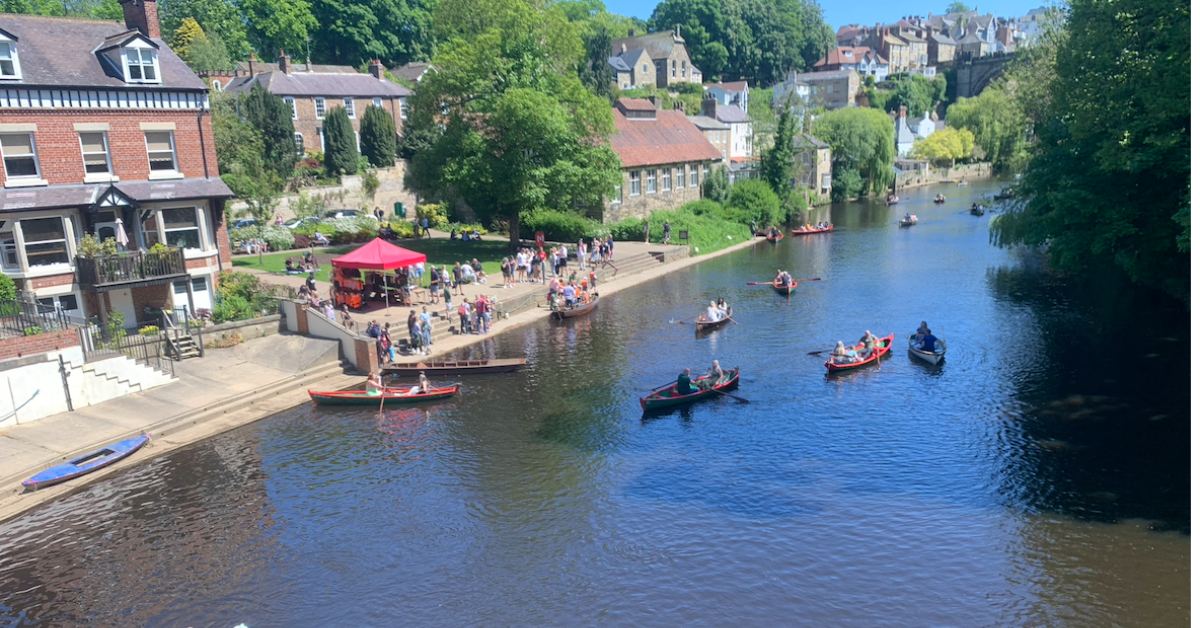
River Nidd at Knaresborough.
In 2021, Mr Jones was one of 265 Conservative MPs who voted down a Lords amendment to the Environment Bill which would have forced water companies to reduce the amount of sewage they discharged.
Instead, MPs including Mr Jones backed a government amendment to make water companies produce plans for reducing river pollution.
This has led to criticism from opposition parties, with Cllr Walker adding:
“Waters are allowed to have sewage in them because our MPs voted for it.”
Read more:
- River Nidd testing begins as clean-up campaign gathers pace
- Yorkshire Water discharged sewage into River Nidd 870 times in 2022
- Council backs bid for River Nidd bathing water status
In a statement sent to the Local Democracy Reporting Service, Mr Jones disputed that his involvement was political and listed the things he has done to raise awareness about the campaign, including securing the debate in Parliament, meeting with ministers about the topic and winning the support of the chief executive of Yorkshire Water.
Referring to the contentious votes in Parliament, Mr Jones said he voted for a “costed plan to reduce the operation of the Victorian storm overflows”.
The MP also took aim at Cllr Walker’s own political career after he stood unsuccessfully for the Lib Dems in the Selby and Ainsty by-election last week, when he came sixth.
Mr Jones said he welcomed the support from North Yorkshire Council and added that his team and a group of volunteers had been working on collecting information for the bid.
He said:
Council backs bid for River Nidd bathing water status“I have discussed the successful Ilkley bathing water application with the MP for that area and led a special debate in the House of Commons on water quality. I have voted in Parliament for a costed plan to reduce the operation of the Victorian storm overflows.
“I have delivered thousands of leaflets and letters encouraging people to get involved and written numerous articles for the local media highlighting the issue. My team and I alongside an enormous number of local volunteers are taking positive action.
“This is what Members of Parliament should be doing and most of them, from all parties, are. It is not ‘using an issue as a political tool’; it is doing my job.
“Cllr Walker has stood twice to be an MP most recently in the Selby and Ainsty by election where the Liberal Democrat vote sank by 5% and they came sixth behind the Yorkshire Party, the Greens and Reform UK. Cllr Walker lost his deposit.
“I am sure he will do better when he addresses that lack of understanding about the role of an MP in supporting and leading local campaigns.”
North Yorkshire Council has backed a proposal to designate bathing water status to the River Nidd.
The motion was brought by Cllr Paul Haslam, who represents Bilton and Nidd Gorge, which called on the authority to support the campaign.
If designation is successful, government agencies would be obliged to take action to improve water quality at Knaresborough Lido. This would also improve water quality on a much wider stretch of the river.
The campaign comes after reports of numerous bathers falling ill last summer.
Cllr Haslam said:
“Knaresborough and the Nidd are one of the many jewels that North Yorkshire is blessed with.
“Knaresborough relies on the river to contribute to the local economy and wellbeing of the population in the form of riverside cafes, recreation on the river with regular bathing at the Lido.”
He added:
“It’s important that people can swim and enjoy the river without risks to their health.”
Read more:
- River Nidd testing begins as clean-up campaign gathers pace
- Yorkshire Water discharged sewage into River Nidd 870 times in 2022
- Andrew Jones MP appeals for help at ‘critical time’ for River Nidd bathing water bid
Councillors voted to support the proposal at a meeting in Northallerton yesterday.
Nidd Action Group and Andrew Jones, the Conservative MP for Harrogate and Knaresborough, are leading the campaign.
Following the vote, Mr Jones said he welcomed the support from the council.
He said:
Conservation trust seeks public’s views on district’s rivers“I am grateful to North Yorkshire councillors for backing this campaign. Bids to designate areas as official bathing water are substantially strengthened by having the support of the local authority.
“I know some seek to make party political points about this issue. I hope that this overwhelming cross-party support brings an end to this. Positive action is what is needed and I am working with local residents, businesses, community organisations and the Nidd Action Group on the bid.
“Success is never a guarantee but I am optimistic and this support from North Yorkshire Council is an important milestone.”
A river conservation trust has launched a survey asking for the public’s views on problems facing their local rivers.
The Dales to Vale River Network (DVRN) survey is made up of seven different questionnaires, each on a different river in North Yorkshire.
The aim is to discover what the public thinks are the main challenges facing rivers across the county.
The DVRN is a partnership of interest groups, farmers, and charities that all want to improve the biodiversity and water quality of local rivers, including those running through the Harrogate District such as the Nidd and the Ure.
Charlotte Simons, senior catchment partnerships manager for the DVRN explained why the survey was created:
“We’re keen to hear how people see the rivers, what issues they are concerned about and what improvements they would like to see within the seven catchment areas.”
“We want to have a strategic approach to projects that deliver benefits to the public, the rivers, and the ecosystems that depend on these watercourses.”
The trust created a similar survey for the same purpose in 2017. This is the first time that it will be held online where it hopes to reach more people and collect at least 100 responses per river catchment.
Ms Simons told the Stray Ferret that communities in catchments along the River Nidd and Ure have voiced numerous concerns about the health of the river.
Communities near the middle and lower Nidd are particularly worried about water quality and release of raw sewage. Many have also supported the removal of man-made barriers blocking the movement of fish along the river.
Along the River Ure, environmental organisations and locals want the trust to prioritise the issue of habitat removal and rising water temperatures.
Ms Simons is hopeful that this year’s survey results will help the DVRN decide its next steps to protect local rivers
She added:
“By working together with local communities and organisations rather than independently we can achieve so much more.”
The survey is open and will close on September 8. To find out more or take part in the survey click here.
Read more
- Outrage over water firm’s response to concerns over quality of River Nidd
- Sewage discharged into River Ure near Ripon after pipe leaks
- Volunteers turn out in force to support campaign for cleaner River Nidd
Volunteers turn out in force to support campaign for cleaner River Nidd
Conservationists, anglers, academics and residents turned out in force at Knaresborough yesterday to prepare to begin water sampling on the River Nidd.
Samples will be taken along the length of the river on August 3 and then again the following month.
The results will form part of a bid to achieve bathing water status on the Nidd, which would require agencies to take measures to improve water quality.
Yesterday’s gathering near Conyngham Hall enabled volunteers to learn how to conduct accurate sampling.
It follows concerns about the state of the river, amid reports of bathers at Knaresborough Lido falling ill after entering the water.
Test kits were supplied by Yorkshire Dales River Trust, a charity based in Pateley Bridge that helped gather data for the River Wharfe’s successful bid for bathing water status.
Charlotte Simons, a senior project manager at the trust, said the volunteers would test for nutrients, such as nitrates and phosphates, as well as bacteria, such as E coli. She added:
“By testing along the whole river we can get a snapshot of what’s happening.”

Charlotte Simons and David Clayden hold a test kit above the River Nidd.
David Clayden, chairman of Nidd Action Group, which was set up to co-ordinate the clean-up campaign, said:
“We’ve had a really good response from volunteers. The real thing starts on August 3, when everyone involved will be apportioned a place on the river to carry out sampling.”
Andrew Jones, the Conservative MP for Harrogate and Knaresborough, is also supporting the campaign.
He is co-ordinating efforts to monitor how much the river is used at the Lido.
A bid for bathing water status is expected to be submitted to the government in autumn.
Read more:
- Outrage over water firm’s response to concerns over quality of River Nidd
- More than 150 Nidderdale children take part in moorland education event
Yorkshire Water discharged sewage into the River Nidd 870 times last year, according to Environment Agency monitoring data.
The discharges lasted for a total of 6,177 hours. Dacre sewage pumping station alone saw 87 spills and 1,014 hours of sewage discharged.
By comparison, there were 318 spills into Oak Beck and Coppice Beck, which lasted for 438 hours.
Water companies are legally allowed to release sewage through overflow pipes when the sewage system becomes too full, which can happen during increased rainfall.
Volunteers learn to test for E coli in River Nidd
Dozens of volunteers will be heading to the River Nidd today as part of a project to find out how much E coli bacteria is in the water.
Around 40 people will be gathering near Conyngham Hall in Knaresborough to learn how to take valid samples from the Nidd – from the bankside and from bridges over the river.
The volunteers will then turn out again in force on August 3 to put their training into action and take samples from all stretches of the river from Scar House Reservoir at the top end of Nidderdale right down to Moor Monkton, where the Nidd joins the Ouse in the Vale of York.
They will repeat the process at the end of September, in an initiative that forms the centrepiece of an iNidd project organised by the Nidd Action Group (NAG).
All the water samples will be sent for laboratory testing to find out how polluted they are, both with faecal and chemical inflows.
David Clayden, chairman of NAG, said:
“We want to find the truth. I don’t think people know enough about the river. This whole project is about understanding the chemical and biological profile of the river, including the tributaries, specifically Oak Beck, Crimple Beck and possibly also Ripley Beck.
“It will give us data from all up and down the river, all taken on the same day, under the same conditions, which has never been done here before. A lot of preparatory work has gone into this and it’s all coming together very well. It’s very exciting.”
The samples will enable NAG to establish the concentration of faecal coliforms – or E coli – associated with human and pet health, nutrient chemicals such as phosphates and nitrates, and concentrations of heavy metals – all associated with the ecological balance of the river and the richness and variety of invertebrate and plant life.
Mr Clayden said:
“If a water sample is good, that’s great. But if it’s bad, we want to know what’s upstream of it – a sewage outlet, a farm, or a caravan park perhaps? We need to gauge the relative importance of different pollution sources.”
Read more:
- Bed race entrants urged to ‘keep your head above water’ when crossing polluted Nidd
- Outrage over water firm’s response to concerns over quality of River Nidd
- 317 Olympic pools of raw sewage pumped into River Nidd, study claims
NAG hopes to be able to publish the results of the lab tests in the autumn, around the same time that Andrew Jones MP is due to submit the case for River Nidd bathing water status for consideration by Defra (the Department for Environment, Food & Rural Affairs).
NAG is also working with the Environment Agency on an “outfall safari”, which involves walking along the river bank and spotting unmapped pipes and other sources of pollution.
Mr Clayden said:
“You’d think they would know where they all are, but they don’t. A lot of these pipes have just been wrongly connected, either intentionally or by accident, and they may come from any private property along the river bank.
“So we need volunteers to spot them and report on how much pollution they’re causing. It involves investigative, observational work, and some training may be given by the Environment Agency.”
NAG was formed in September 2022 after concerns about the quality of the water in the Nidd were raised by anglers and others. It now has 100 volunteers.
Mr Clayden said:
“It’s a nice community, and one thing they all have in common is that they all love the river.”
Anyone wanting to join them and get involved with research on the River Nidd should use the Get Involved page on the NAG website.
Knaresborough could get country’s first water-powered EV charging stationKnaresborough is in line to receive the country’s first water-powered electric vehicle charging station.
North Yorkshire Council plans to install a hydro turbine to power vehicles parked at Waterside Car Park, alongside the River Nidd.
The council successfully bid to the government’s Local Electric Vehicle Infrastructure scheme, which funds schemes by local authorities in England to install charge point infrastructure for residents without off-street parking.

The River Nidd is within metres of the car park.
A council spokesperson said:
“The reason it has been chosen is to pilot rolling out EV charging points in areas with high grid connection costs.
“While Waterside car park in Knaresborough is not as grid-constrained as some, it is the ideal site to pilot due to the weir, flow rate of the river and landownership with that stretch of the river and car park belonging to the council.”
Read more:
- Knaresborough businesses criticise ‘ludicrous’ empty electric vehicle charging bays
- Free walking tours of Knaresborough get underway
- Gallery: Knaresborough’s midsummer party in the castle
The spokesperson added:
“Hydroelectric power should be able to reliably provide power throughout the year except in extreme droughts and each site is looking to have a secondary renewable generation capability, either solar or wind if appropriate.
“The renewable sources will provide power to a large battery system and which will then be able to charge up to five vehicles at once.
“Full costs are to be determined once the procurement process has been completed.”
They added “as far as we are aware it will be the first one in the country” and the likely installation date was next year.
Traders fear lost revenue

Empty electric vehicle charging stations in Chapel Street Car Park.
The roll-out of electric vehicle charging stations has proved controversial in Knaresborough
Ten bays have been installed in Chapel Street Car Park in the town centre but there is rarely more than one or two in use.
This has infuriated some traders, who say they are losing business on Wednesday’s busy market day because customers in non-electric vehicles struggle to park.
They have called for some electric vehicle bays to be available to all vehicles until demand for the charge points catches up with supply.
Twelve EV bays have been installed at Conyngham Hall Car Park but are not yet active and the bays have been coned off to all motorists. None of the five bays planned for Waterside Car Park have yet been created.
Matt Walker, a Liberal Democrat who represents Knaresborough West on North Yorkshire Council, said hydro turbine-powered charging bays at Waterside Car Park were “really positive” but he shared concerns about the allocation of parking bays in the town.

Cllr Matt Walker
Cllr Walker said:
“The council needs to make sure these spaces can be used by people if they are not being used by people with electric vehicles.
“If they are sat empty it benefits nobody. Businesses are losing out on customers and the council is losing out on thousands of pounds of revenue.”
Cllr Walker said he had been told by the council the situation would be reviewed.
Gallery: Huge crowds bask in sun at Knaresborough bed raceKnaresborough was a sea of colour and joy today as huge crowds turned out for the annual bed race.
The event was first staged in 1966 and appears to be going stronger than ever, judging by the turnout and enthusiasm displayed today.
Ninety teams of seven took part in the 2.4-mile route through the town, which culminated in crossing the River Nidd.
A team representing builders merchants GH Brooks stormed to victory in the men’s race once again, but were pushed close by Ripon Runners. It was the fourth time in succession GH Brooks has taken the title.
Ripon Runners, however, took first place in the women’s race.
Competition was equally fierce in the Best Dressed Team competition just before the race.
A team called The Rocketmen took the accolade for a Jurassic Park-themed bed that featured animatronics.
They then led the parade from the castle through town to Conyngham Hall where the race started and finished. The parade had only just got underway when it had to be temporarily halted due to a person falling ill.
Organised by Knaresborough Lions, a large army of volunteers helped to keep things running smoothly on a day of unbroken sun.
Here are some photos from the day.
Read more:
- Staff sent home as Knaresborough housebuilder seeks urgent investment
- Police alerted after travellers set up camp at Ashville College

The winning GH Brooks team

The Best Dressed Team award winner

Dad’s Army

The theme this year was ‘That’s Entertainment’

Having fun at the castle before the race

GH Brooks had two outstanding teams

Harrogate Symphony Orchestra patriotically-attired.

Ripon Runners gave another strong performance

Crossing the Nidd

One of the day’s most creative efforts
Great Knaresborough Bed Race competitors crossing the polluted River Nidd this weekend have been urged by organisers to keep their heads above the water.
Last week a young child was reported to have been taken to hospital with an E. coli infection after playing in the river at Knaresborough.
It came after a report by Professor Peter Hammond, a retired professor of computational biology, last month revealed the equivalent of 317 Olympic pools of raw sewage were discharged into the river at four sewage treatment works in 2020.
Nidd Action Group and Harrogate and Knaresborough MP Andrew Jones are campaigning for a stretch of the Nidd at Knaresborough Lido to be granted bathing water status, to ensure the river is cleaned up.
Saturday’s bed race will see hundreds of competitors crossing the river as part of the course.
Bed Race chairman Martin Brock, of Knaresborough Lions, said:
“It goes without saying that we wish the youngster a speedy recovery from their infection. We know for our teams and the crowds that the river crossing is an integral part of bed race and one that they look forward to every year. The teams recognise when signing up for the event that they are participating at their own risk.
“We will flag at the team briefing about the Nidd, although it is local knowledge that the water isn’t perfect, and that when crossing, you keep your head above water.”
Safety measures
Last year, the Nidd saw 870 sewage dump incidents, according to Environment Agency figures, and recent water testing by researchers from the University of Leeds has shown the harmful bacteria E. coli is at unusually high levels.
E. coli is a bacterial infection that can cause severe stomach pain, bloody diarrhoea and even kidney failure. It is found in the gut and faeces of many animals, particularly cattle. Its presence at such high levels in the River Nidd is thought to be caused by either sewage dumps or by run-off from livestock farmland – or both.
Mr Brock added:
“Ultimately, no one is forced to go through the river and we do implement safety measures if teams choose to cross including limiting the number of beds in the river and having divers from the Upper Wharfdale Fell Rescue Association in the Nidd.
“The final decision to cross the river is taken on the morning of the race and if advice is given that it is unsafe, we would cancel the crossing. However, as things stand, with the recent spate of fine weather and a low river level, we are planning for the traditional river crossing on Saturday 10th.”
Read more:
- Details of 2023 Knaresborough Bed Race revealed
- BedFest to add festival feel to Knaresborough Bed Race
Harrogate and District Green Party said today the bed race was “an incredible event… being put at risk by Yorkshire Water’s cavalier approach to their sewage problem”.
It accused the government, supported by local MP Mr Jones of “putting profits before people”.
Mr Jones replied by saying recent data showed E. coli levels had drastically dropped and urged the Greens to join the Nidd clean-up campaign. He added:
“Politicians laying blame at one another’s door for a situation that has existed ever since the Victorians built our sewerage system is not constructive.”
The annual bed race was first held in 1966, and sees 90 teams of seven complete a 2.4-mile course around the town. This year’s theme for the pre-race fancy-dress parade is “That’s Entertainment”.
Read more:
- Outrage over water firm’s response to concerns over quality of River Nidd
- BedFest to add festival feel to Knaresborough Bed Race
- Details of 2023 Knaresborough Bed Race revealed