Key parts of Ripon’s military past could be demolished to make way for the proposed 1,300-home development at the city’s barracks.
Homes England is seeking outline planning permission for the Clotherholme housing scheme, which would be the biggest single residential development in Ripon’s history.
Ripon Civic Society has now highlighted the potential loss of rare items that are part of Ripon and the UK’s military heritage.
The vital role Ripon’s military establishment played in both world wars and the Cold War has been highlighted in new research by the society.
Christopher Hughes, its chairman of the society, said:
“The site at Laver Banks is important in the history of Ripon’s past and in the defence of Britain in World War II and since.
“We have done detailed work on the Homes England proposals for the whole of the army camp site. We encourage them, and Harrogate Borough Council, to take a revised look at proposals for demolition of some of the structures our research has identified, and to protect them for the future.”
The society has been closely engaged in the planning process and has been keen to stress the importance of the last remaining remnants of the city’s vast World War I camp, in which the poet Wilfred Owen was stationed.
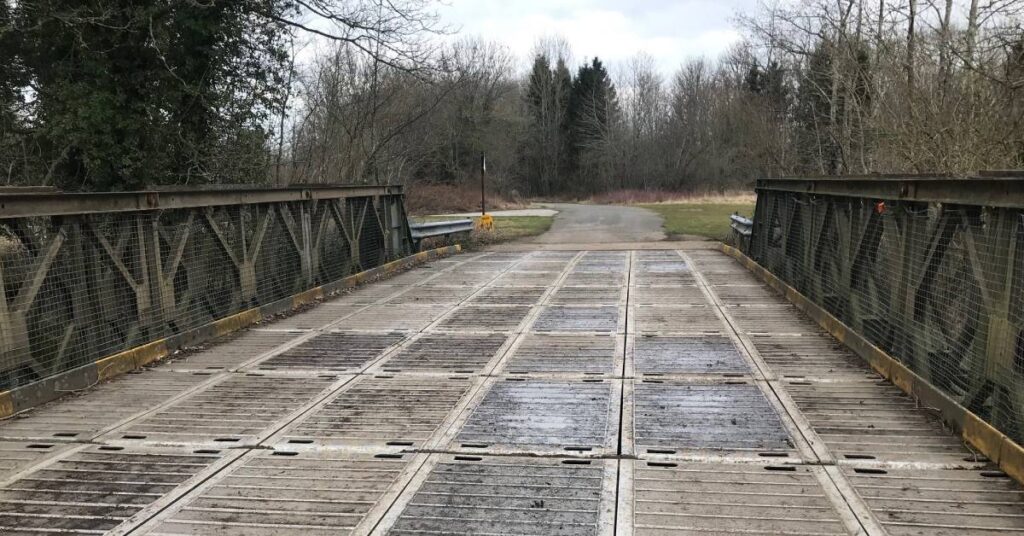
The heavy girder bridge, which crosses the River Laver on the Barracks site, was the next generation of the bridge designed by Sir Donald Bailey.
Setting up Ripon Military Heritage Trust to aid further research, it has now discovered that from the start of World War II the remaining site was the test-bed for developing and trialling demountable bridges, including the world-famous Bailey bridge.
The School of Military Engineering was evacuated from Chatham in Kent to Ripon at the start of the war.
Military heritage structures
Ripon architectural historian, lecturer and writer, David Winpenny, who is a vice-president of the society, said:
“As well as providing training for engineers on the Bailey bridge, the school also developed the massive Bailey Suspension Bridge, capable of spanning up to 400 feet.
“It was tested in Ripon at the Laver Banks site of Ripon Camp by British, Canadian and American troops before being deployed in Burma and other theatres of war.
“From 1946 a new heavy girder bridge was developed; by 1955 60 had been ordered. The first to be put in place was over the River Ure in Ripon. It was mainly used in West Germany as well as in Malaya.
“Development continued in the following decades. The only surviving heavy girder bridge was installed in Ripon as late as 1992.
“Ripon also has the larger of only two surviving k‘demolition’ training bridges, designed with cavities in which explosives could be packed to eliminate the bridges before an enemy assault.
Read more:
- Consultation on 1,300-home Ripon Barracks site closes on Wednesday
- Artworks honour Ripon’s military past
Mr Winpenny added:
“As well as these rare survivals, and the still-extant infrastructure of the testing site, the Ripon Camp also has the last four Twynam Huts remaining; these were the successors to the Nissan Huts and were developed in 1959 for use as accommodations for personnel, offices and stores.
“They were deployed worldwide, including in Cyprus, Aden and Libya, as well as on Ascension Island during the Falklands War and at Long Kesh Camp in Northern Ireland.”
‘Amazing how significant Ripon was’
The society has shared its findings with Homes England, which is responsible for the transition of the site from army camp to housing and employment site, and with Harrogate Borough Council, which will determine the planning application.
It has said that these significant but vulnerable remnants of Ripon’s military past require special protection as part of the planning process. The society wants to work closely with all parties to establish a community legacy for Ripon and the wider area by promoting and interpreting the site.
Guy Wilson, creator of the Royal Armouries museum in Leeds, and one of the Ripon Military Heritage Trust trustees, said:
“It is amazing how significant this quiet part of North Yorkshire was in the Second World War. What was happening in Ripon helped us to win the war and our research has discovered how important Ripon was in the development and perfection of the Bailey bridge and its successors.
“It is a story hitherto unknown but one very worth telling and remembering.”
Artworks honour Ripon’s military past
Soldiers from Ripon were involved in an art installation yesterday that provides an echo of the city’s military past going back 107 years.
Members of 21 Engineer Regiment helped with ground preparation before three metal silhouettes, depicting soldiers of World War I, were put in place at Hell Wath.
The works, created by artists Dan Metcalfe and Jeanne Mundy, in collaboration with Ripon Cathedral’s visual media artist and photographer Joe Priestley, replicate pieces from previous installations produced by the trio for the project ‘Fields of Mud, Seeds of Hope’
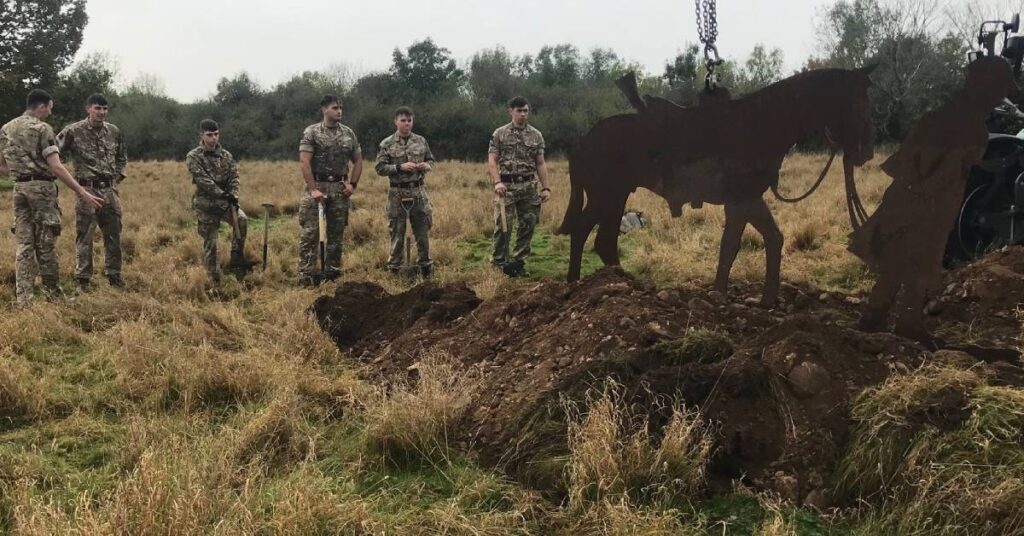
Members of the 21 Engineer Regiment did the spade work
Figures from that project can be seen near the cathedral and around the city as part of the Wilfred Owen memorial walk, created in honour the famous war poet who was based briefly at Ripon Army Camp from March 1918 and died in action in northern France just seven days before peace was declared.
Mr Metcalfe told the Stray Ferret:
“During World War I, this area was the southern half of a huge camp that at any time was providing temporary accommodation for upwards of 30,000 troops.
“When you consider that the population of the city was around 8,000 before the camp arrived, it makes you realise how dominant it was and the impact it would have had.
“I hope that these works serve as a permanent reminder for generations to come of the part that Ripon played in the war and those who never returned.”
The logistics of the installation have been led by Ripon Community Poppy Project, which is also involved in producing the annual remembrance displays in the city centre.
Councillor Stuart Martin, who was one of the founders of the project, said:
“This has happened thanks to a massive collaborative effort, with support from Econ Engineering, Ripon Farm Services, Harrogate Borough Council, the Royal Engineers and Tarmac, which owns the land.
“Thanks to their assistance, combined with donations of materials, time and labour, they have enabled the creation of this stunning installation that underlines the historical significance of Ripon’s military roots, which go back many years.”
The photograph shows artist Dan Metcalfe (front, left) with Councillor Stuart Martin, of Ripon Community Poppy Project, and soldiers from the 21 Engineer Regiment.
Read more:
Tribute to Ripon’s deputy mayor for 20 years’ service to the city
At Cllr Charlie Powell’s 80th birthday party this week – celebrated with a handful of fellow councillors and his wife and deputy mayoress Jill – there was a special surprise.
Cllr Peter Horton read out a document prepared by his family detailing his lifetime of achievement – including serving more than a quarter of his life on Ripon City Council.
Over more than 30 pages it covered the highlights in the councillor’s story of service and business success.
During 15 years in the Royal Engineers, he was posted to Germany, Northern Ireland, Aden, Libya, Borneo and Singapore.
After leaving the Army, in which he rose to the rank of sergeant, Cllr Powell served for two years as a fire fighter in Ripon.
He spent 18 years in Saudi Arabia, where he worked for the military aircraft division of the British Aircraft Corporation (BAC), then moved on to become a senior administrator with Waste Management International Ltd in Jeddah.

Cllr Powell played a key role in negotiating Curzon Cinema’s opening in Ripon
This was a role in which Cllr Powell represented his company as a guest of the Queen on the Royal Yacht Britannia.
He said:
“That was a remarkable honour and once-in-a-lifetime experience.”
Although Army service and private sector work took him worldwide, Cllr Powell’s roots have remained firmly planted in Ripon, where his military career began.
At the age of 15, he attended the Army Apprentices School in Harrogate (now the Army Foundation College) and qualified as a carpenter, before joining the Royal Engineers.
He told the Stray Ferret:
“Ripon is my home and a city I take great pride in.
“It’s a special place with a long history, unique character and traditions that make it stand out – such as the nightly Hornblower ceremony at the obelisk.”
He has served for 21 years as a city councillor and has been deputy mayor since 2017.
There have been many highlights during his political career, including successful negotiations with Curzon, which led to the cinema operator opening in the city in 2013.
Cllr Powell’s business acumen also proved crucial in guiding the development of Quarry Moor Park and Nature Reserve as a place for public enjoyment.
He has also been a stalwart supporter of Ripon in Bloom.
Read more:
A job reference prepared by Mr K J Parfit, manager of support services for BAC at King Faisal Air Base, succinctly sums up the business capabilities that have subsequently been put to good use for the people of Ripon.
It read:
“I have no hesitation in recommending Mr Powell for any position requiring tact, intelligence and judgment.
“He has displayed all of these qualities in full measure.”