Homes England earmarks £10m for major Ripon housing site contributionsA total of £10 million has been budgeted to cover items in a Section 106 agreement being drawn up by Homes England for the 1,300-home Clotherholme development at the Ripon Barracks site.
The money will fund a number of areas, including off-site highway adjustments and contributions towards primary and secondary education provision and primary healthcare.
In addition, under the legally-binding agreement, the government’s housing and regeneration agency, is required to put a strategy in place to “secure military heritage within the site”.
On Monday, Homes England project manager Martin Wilks and senior planning and enabling manager David Rowlinson, met with city councillors to provide a progress report on the major scheme, that will eventually increase Ripon’s population by 20%.
In February, Harrogate Borough Council planning committee said it was minded to grant planning consent for the Clotherholme scheme and Mr Wilks, pointed out:
“The next stage on the planning process is to present the Section 106 agreement to North Yorkshire Council for approval.”
He added:
“The Section 106 monies have been set at £10 million to cover areas including off-site traffic interventions and contributions to education provision,”
The 21 Regiment of the Royal Engineers is scheduled to vacate the site by March 2026 and enabling works for the homes development will start in 2025.
In the meantime, Homes England is drawing up a sustainable drainage plan for the scheme with Yorkshire Water and working on a design guide for the development with Ripon Civic Society.
Meetings have been held with Ripon Military Heritage Trust regarding the protection and preservation of historically-important buildings and bridges on the site and a further meeting with them is planned for November 7.
Matters raised by councillors included the significance of the site’s rich military Heritage, increased traffic generation and the impact it will have on the city’s roads infrastructure and the additional strain that an increase in population will put on healthcare provision.
In view of the number of issues put forward, it was agreed that Mr Wilks and Mr Rowlinson will hold further meetings with councillors to focus on specific concerns that they have in relation to the development.
Read more:
Ripon memorial bench is dedicated to an outstanding Royal EngineerThe name of Major Bill Rudd MBE, a much loved and highly respected Royal Engineer, will live on in Ripon following a dedication and remembrance service during the regiment’s Freedom Weekend.
Veterans, serving soldiers, friends and family gathered in Spa Gardens on Saturday afternoon for the unveiling of a bench installed in his honour.
The installation was made possible with support from the Ripon Commando and Airborne branches of the Royal Engineers Association.
Facing onto the city’s War Memorial, the bench is a fitting tribute to the retired major who died six years ago following a distinguished army career.
This included service with both the 9 Parachute Squadron and 59 Independent Commando Squadron of the Royal Engineers.

Former and serving men and women came from far and wide to attend the dedication and remembrance ceremony led by the Revd Stephen Wilson.
Prior to becoming a commissioned officer, Major Rudd served as the Regimental Sergeant Major of 38 Engineer Regiment based at Claro Barracks.
He maintained his connection with comrades through setting up the Yorkshire Branch of the Airborne Engineers Association with fellow Sappers Dave Edmonds and Charlie Dunk and was made a lifetime vice-president of the association.
Major Rudd lived across the road from Spa Gardens and was a regular visitor to the parkland area, where the Ripon War Memorial is the focal point for annual Remembrance services.
Royal Engineers’ veteran Jim Phillips. who was involved, with his wife Trudie in raising money for the installation of the bench, said:
“Whenever there is a service in Ripon, I am sure Bill’s bench will serve as a meeting place for old comrades to sit, laugh and remember our friend.
“Thanks to all who contributed to this memorial and very special event.”
Our main picture shows members of the Yorkshire Branch of the Airborne Engineers Association who were among those present for the dedication ceremony
Read more:
Freedom march caps a day of civic celebrations in RiponIt was a day of tradition, ceremony and civic pride in Ripon, with the Royal Engineers’ freedom march and the installation at the cathedral of councillor Sid Hawke as city mayor.
Among those in attendance for both of yesterday’s events was Major-General Eldon Millar who, as Defence Services Secretary, played a key role in the organisation and delivery of this month’s coronation celebrations for King Charles and Queen Camilla.
Involving more than 6,000 armed forces members, it was the UK’s largest military ceremonial operation in 70 years.

Major-General Eldon Millar, Defence Services Secretary, in Ripon yesterday
Although the freedom march was on a much smaller scale, hundreds of soldiers from 21 Engineer Regiment accompanied by the British Army Band from Catterick ensured a spectacular display as they marched to the beat of a drum with bayonets fixed.

The regiment was awarded Freedom of the City status in 1949 and Major-General Millar, who earlier in his army career served as adjutant at Claro Barracks, said:
“I’m delighted to be back in Ripon to share in this wonderful and significant tradition.”
The Royal Engineers and musicians marched to the cathedral for the sung Eucharist service, which included the installation of Cllr Hawke as mayor.

The mayor and mayoress on their way to the cathedral with sergeant at mace David Coates and hornblower Allison Clark.
The service, led by the Dean of Ripon the Very Revd. John Dobson, was also attended by members of Ripon City Council (pictured below) and other invited civic dignitaries.

On Saturday, the Royal Engineers staged a display on Market Square designed to give members of the public a close-up view of equipment, engineering techniques and construction skills, including bridge building, bricklaying, concreting and plumbing, employed by the regiment, at many different locations.
In recent years, 21 Engineer Regiment’s main focus has been on providing support to UN peacekeeping operations and has included deployments to Afghanistan, Cyprus, Poland, Somalia and South Sudan.
Read more:
Ripon military heritage campaigners to hold public launchAn organisation fighting to save forgotten but nationally important military heritage will hold its public launch in Ripon on Saturday.
Members of Ripon Military Heritage Trust (RMHT) will be on hand at Market Square from 10am to tell people about the campaign to protect and preserve structures and buildings currently threatened by demolition as part of a redevelopment of MoD property by the government agency Homes England.
The redevelopment area at Clotherholme is currently occupied by Claro and Deverell Barracks and the Laver Banks Training Ground.
Trust chairman Guy Wilson, former Master of the Royal Armouries (RA) who played a leading role the creation of the RA museum in Leeds, said:
“Ripon has a long and rich military heritage but its key role in helping secure the liberation of Europe in the Second World War and then maintain it has been largely forgotten.
“The redevelopment site at Clotherholme contains a number of unique and very rare military buildings and structures, worth preserving on their own account, but even more so when what was happening in and around them is understood.”
The relocation of the Royal School of Military Engineering to Ripon in 1940 meant the city played a huge part in training combat engineers.
It was here that the famous Bailey bridge, in its many varieties, was tested and perfected before seeing use in theatres of war across the world. So important was bridge building and the other engineering activities in Ripon that the US Army formed its own ‘American section’ to train its key engineers.
Early in the war British army bomb disposal training was centralised on the site and in the aftermath of Japan’s attack on Pearl Harbour, a secret delegation of US Army personnel, led by Major Thomas Kane, came to the city to train.
On completing the course they were presented with Royal Engineer ‘Bomb Disposal’ patches and given the unique honour of being able to wear them on their US Army uniforms.
Kane returned to the Unites States where, with British help, he set up his own version of the Ripon School. He is regarded as the father of US Army Bomb Disposal.
Saving some of the remaining structures at Clotherholme that tell this story and its continuation into the Cold War is the RMHT’s first important task. But it has a wider remit and is dedicated to researching and preserving Ripon’s long and varied military heritage.
The trust aims to preserve a number of the surviving structures on a site at Laver Banks and develop a military heritage centre alongside countryside trails which will interpret the city’s unique military heritage.
Pictured above are members of the trust on the Heavy Girder Bridge at Laver Banks. From the left: Lt Col Bob Lisle (ret’d), Jane Furse, Stuart Martin MBE, Guy Wilson and Michael Furse. Picture: Ripon Military Heritage Trust.
Read more:
Ripon man returns Falklands War letter to Argentinian soldierA handwritten letter found in the aftermath of the Falklands War 40 years ago has been reunited with the Argentinian soldier who wrote it, following the intervention of the Argentinian ambassador to the UK.
As previously reported by The Stray Ferret, the blue-coloured airmail letter – known in the armed forces as a “bluey” – was found around a year after the end of the Falklands War by Jim Phillips, who was posted to the Falkland Islands’ capital, Port Stanley, as a lance corporal in the Royal Engineers.
It had been written by an Argentinian soldier during the war but had never found its way to the intended recipient.
Jim said:
“The letter was actually posted in Port Stanley during the war, but it never got out because we’d bombed the runway.”
Jim, who now lives in Ripon, kept the letter but mislaid it during a house move. It came to light again just before Christmas 2022, and he immediately contacted the Argentinian Embassy in the hopes of reuniting the letter with its writer.
Jim, now 64, met the Argentinian Ambassador, Javier Figueroa, in March and handed him the letter over lunch at Grantley Hall, near Ripon.
Mr Figueroa, who has long taken a special interest in the Falkland Islands and last year said the war had been “a tragedy”, promised to do everything he could to ensure the letter got back to its rightful owner, named as a Corporal Balbuena, a conscript in Argentina’s 3rd Mechanised Infantry Regiment.
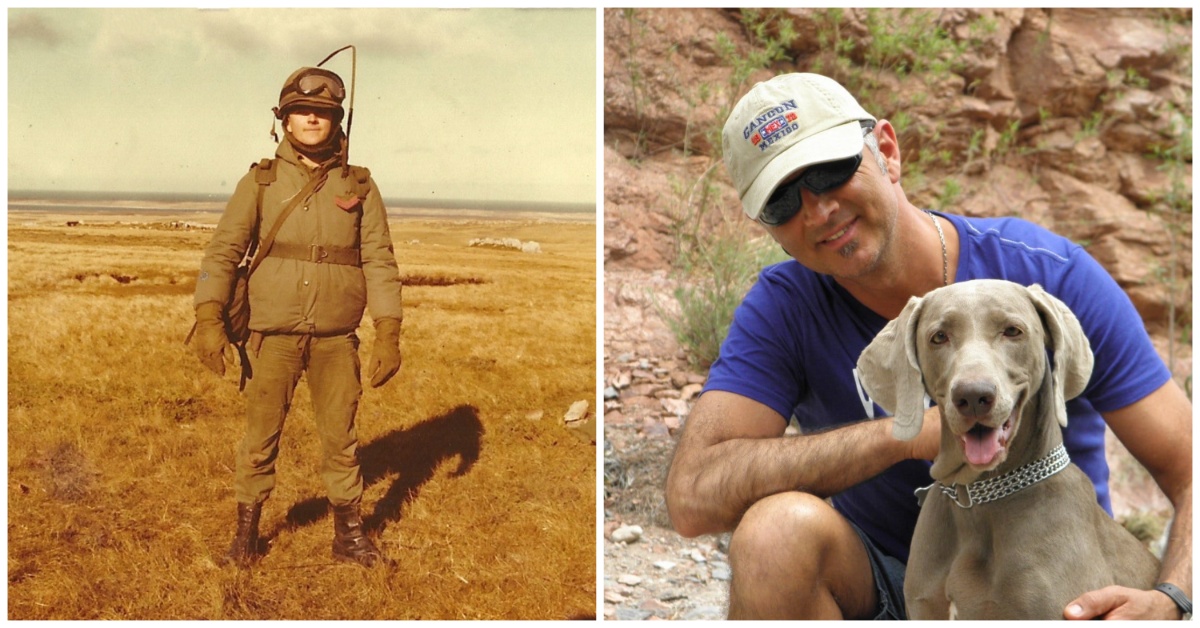
Then and now: Corporal Danny Balbuena on Sapper Hill in the Falkland Islands in 1982, and today in Buenos Aires with his dog. PHOTOS: Danny Balbuena.
And now, after a “postal delay” of 40 years, the letter has finally been returned to Mr Balbuena, who is now retired and lives in Buenos Aires. In a message last week, Mr Figueroa wrote:
“We hereby want to inform you that the original letter written by the Argentine soldier has reached its original hands in Argentina.
“This has been possible thanks to the honorable gesture of Jim Phillips, deployed in the area between January and June 1983 after the Malvinas conflict.
“At a time when many soldiers’ personal items are being auctioned and sold online, we want to publicly express our gratitude to Mr Phillips and, on behalf of Mr Balbuena, his happiness to be reacquainted with this part of his personal history.”
Jim has since regularly exchanged Whatsapp messages with Danny Balbuena, 60, and has even found out the identity of the letter’s intended recipient. He said:
“Danny was only 19 at the time, and he’d written the letter to his girlfriend. Sadly, she died a few years ago, so he’s absolutely over the moon to be reunited with the letter he wrote to her. It means a lot.”
Jim said he and Danny “are striking up a good friendship” and intend to carry on their correspondence. He added:
“I’d really like to thank the ambassador for all his work on this. He’s been so helpful in this matter, it’s been untrue. He’s really gone above and beyond.”
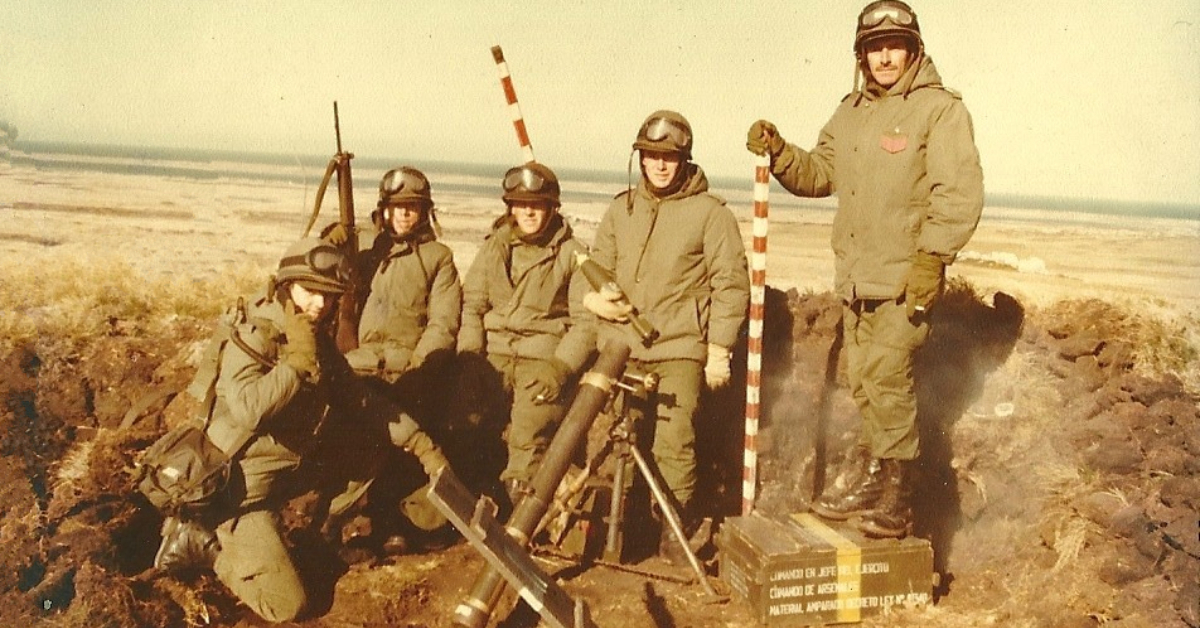
Radio operator Corporal Danny Balbuena (far left) of Argentina’s 3rd Mechanised Infantry Regiment, with comrades on Sapper Hill, East Falkland, in 1982.
The Falklands War was fought over 10 weeks in 1982 and began when the right-wing military government of Argentina sent a surprise invasion force which took possession of the Falkland Islands and South Georgia on April 2.
The UK, then led by Prime Minister Margaret Thatcher, dispatched a task force of ships, aircraft and soldiers to take the islands back. The armed conflict, which ended on June 14 with a British victory and the capture of more than 11,000 Argentine soldiers, claimed more than 900 lives, over 70% of them Argentinian.
Read more:
Priceless military heritage to be protected at Ripon development siteFears that priceless elements of Ripon’s rich military heritage could be flattened to make way for the 1,300-home Clotherholme scheme have been allayed.
Jane Furse, a trustee of the Ripon Military Heritage Trust, which has plans to create heritage trails on the development site, told the Stray Ferret:
“We were concerned that some extremely rare huts on the Deverell Barracks part of the site, and other historically important structures, would be demolished, but I’m relieved to say that this will not be the case.
“These huts are among the few surviving of their kind in the UK and help to tell the story of the vital national and international role that Ripon’s Royal Engineers played in just about every aspect of World War II and subsequent conflicts.
“This included training British and allied troops in the erection and use of Bailey Bridges in theatres of war such as Sicily and France and bomb disposal, that saved the lives of civilians and military personnel around the world.”
Minutes of Harrogate Borough Council’s February 23 planning meeting at which Homes England was seeking outline approval to progress development of the huge Clotherholme scheme, confirm that the huts and other structures will have protection.
Under the provisions of a Section 106 agreement the developer is required to put in place a strategy to ‘secure military heritage within the site.’

Jane Furse of Ripon Military Heritage Trust pictured at the barracks site
The planning meeting minutes also say:
“Prior to the commencement of works to each phase of development, a record (including photographs, drawings and summary of historic analysis) shall be made of a representative selection of buildings with military heritage on site and shall be submitted to and approved in writing by the local planning authority. Copies of this record shall be placed on the North Yorkshire Historic Environment Record.”
Ms Furse, an architectural historian and former inspector of historic buildings with English Heritage (now Historic England) pointed out:
“Inclusion within the S 106 agreement means that the significance of military heritage assets at the site has been formally recognised and that is very welcome news.
“It means that we can go forward, in liaison with Homes England and other parties, to progress plans for military heritage trails at Clotherholme that alongside other heritage attractions, will add to the city’s development as a tourist destination.”
Bomb disposal and the American connection
The wooden huts at Deverell Barracks are of heritage importance, because they are identical to ones that were located at the nearby Harper Barracks which became the home of the Royal Engineers’ School of Bomb Disposal in 1941.
Setting up of the national school in Ripon, soon saw Royal Engineers based in the city providing vital training and passing on know-how to the Americans, in the wake of Japan’s attack on Pearl Harbour, the USA naval base.
Ms Furse said:
“The Royal Engineers sought out examples of every known enemy bomb and developed countermeasures to defuse them. The School developed a rigorous training programme in bomb identification and disposal methodology.
“The Americans, although aware of the threat of unexploded bombs, had no proper procedures for safe disposal and the aftermath of the bombing of Pearl Harbour on December 7 1941, meant that for the first time, they were faced with unexploded bombs scattered throughout their bases and the harbour.
“On December 9, the British Military Attache’s office in Washington received a request for a joint personnel exchange – an early example of the ‘special relationship’ between ourselves and the USA.
“A group of eight hand-picked American soldiers headed by Major Thomas J Kane, travelled to Ripon to train with the Engineers, arriving on February 1 1942.
“After six weeks of attending lectures and demonstrations, all of the U.S. Army ordnancemen passed the course and were made honorary Royal Engineers – they were even given official RE patches and allowed to wear them on the sleeves of their American uniforms.”
The expertise gained from the Royal Engineers in Ripon subsequently saw Major Kane set up the USA’s first Bomb Disposal School in Maryland.
Read more:
Ripon’s Royal Engineers enjoy freedom of the city
Rousing military music resounded on city streets yesterday morning as Ripon’s Royal Engineers held their annual freedom march.
Members of the 21 Engineer Regiment based at Claro Barracks, who returned to the UK in September from postings in Cyprus and Poland, were joined by a band from the Royal Corps of Army Music, as 300 uniformed men and women marched past the town hall and down Kirkgate for a service held in their honour at the cathedral.

Eyes right as the Royal Engineers march past Ripon Town Hall and take the salute from city Mayor Councillor Sid Hawke and other civic dignitaries.
In line with tradition the Engineers, who were awarded the freedom of Ripon in 1949, exercised the rights bestowed on them 73 years ago, by marching in step to the sound of the band with drums beating and bayonets fixed.

The march down Kirkgate.
In addition to the six-month United Nations peacekeeping role in Cyprus that the Engineers took up in March and the detachment to Poland, Ripon-based sappers have served on operations in Northern Ireland, Kuwait, Bosnia, Iraq, and Afghanistan, providing light role close support that enables the army to live, move and fight.

The Royal Engineers attended a service at Ripon Cathedral
Read more:
Thousands pay their respects as Ripon remembers the fallenThousands of people gathered at Spa Gardens and on nearby streets, as Ripon remembered the dead of two world wars and other conflicts this morning.
Services were held at the war memorial and in Ripon Cathedral, with both attended by the Bishop of Ripon the Rt Revd Dr Helen-Ann Hartley, the Dean of Ripon the Very Revd. John Dobson (pictured below) and clergy from the cathedral.

Spa Gardens, which like all other parts of the city has been decorated with thousands of red hand-knitted poppies created by the Ripon Community Poppy Project, provided a fitting backdrop for the ceremony at the memorial.
It was here that Andrew Cowie, president of the Ripon branch of the Royal British Legion, read out almost 400 names that appear on memorials at the gardens and in the cathedral.
Following a two-minute silence, wreaths were laid, including one on behalf of Ripon City Council, put in place by the Mayor of Ripon Councillor Sid Hawke (pictured below).
Wreaths were also laid by other dignitaries and representatives of all branches of the armed forces and the emergency services.

The service included hymns accompanied by Ripon City Band and the Last Post and Reveille played by Linda Graham, while lone piper Peter Spencer, of the North Yorkshire Fire and Rescue Service Pipe Band played the lament Flowers of the Forest. which preceded the two-minute silence.
Royal Engineers from Claro Barracks, were present, alongside retired service men and women and members of the Ripon Branch of the Royal British Legion.

Following the service in Spa Gardens 60 soldiers based at Claro Barracks led a march to the cathedral, passing Ripon Town Hall, where the mayor took the salute.
Read more:
Firefighters put up poppies as Ripon prepares for services of RemembranceKey locations in Ripon are being decked with thousands of knitted poppies ready for this year’s remembrance events.
Over the weekend, members of Ripon Community Poppy Project were given a helping hand from city firefighters as displays were put in place at the town hall.
Hazel Barker, who founded the project in 2018 with former mayor Cllr Stuart Martin, told the Stray Ferret:
“We have knitted thousands of new poppies to replace some of the ones that have been used in previous years.”
She added:
“We are grateful, as ever, to the fire brigade for the tremendous help they have given us in putting up the town hall display.”
To support the work of the Community Poppy Project, a Concert of Remembrance featuring Ripon City Band, The Dishforth Military Wives Choir and the Duchy Belles, will be held at Ripon Cathedral on November 10, starting at 7.15pm.
Tickets are £12 and available from Stuff 4 Offices on Fishergate and the Wakeman’s House Cafe on Market place.

Hazel Barker and Councillor Stuart Martin of Ripon Community Poppy Project, are pictured with the crew Ripon’s Red Watch, from the left: Firefighters Turner, Harvey and Foster and crew managers Fagg and Thwaites.
Meanwhile, the Ripon Branch of the Royal British Legion (RBL) has confirmed details of services to be held on November 5 and 13.
On Saturday November 5, the Garden of Remembrance created by the Ripon branch of the Royal British Legion in 2018, following donations from the public, authorities and the business community, will be blessed by the Dean of Ripon, the Very Revd John Dobson.
The blessing ceremony, followed by a two-minute silence at 11am, will be attended by the Mayor of Ripon Cllr Sid Hawke, serving officers, members of the RBL and standard bearers.
Guests and other attendees will have the opportunity to place a poppy cross in remembrance of the fallen who died, not only in the first world war, but all war and conflicts since.

Remembrance Sunday Service
Ripon’s Remembrance Sunday service will be held on November 13 at the war memorial in Spa Gardens, where there will be a two-minute silence before wreaths are laid in honour of the fallen, by civic dignitaries, members of the armed forces, the RBL and representatives of other organisations. Those planning to attend are asked to arrive by 10.30am.
On completion of the service at the war memorial, the civic party will proceed to the town hall where there will be a march past and salute.
The march past, including members of the Royal Engineers, standard bearers, veterans, Ripon City Band, cadets, scouts and guides and representatives of other organisations, will head down Kirkgate to the cathedral, where a service will be held.
Jeet Bahadur Sahi, chair of the RBL Ripon Branch, said:
“We remember those who lost their lives on active service in all conflicts, from the beginning of the First World War right up to the present day. We also remember all those who have served and their families.
“Remembrance events encourage communities to come together to honour those who served and remember their sacrifices.
“We unite across faiths, cultures and backgrounds to remember the service and sacrifice of the Armed Forces community from Britain and the Commonwealth.”
Read more:
‘Reckless’ Royal Engineers ‘putting lives at risk’ on a Ripon roadRoyal Engineers, driving recklessly at high speeds on a stretch of road near their Ripon base, are ‘putting lives at risk’ claim local residents.
Fears that there will soon be a human fatality, if urgent traffic calming measures are not put in place, have heightened following reports on social media that pet cats have recently been killed on Clotherhome Road.
The family pets join a mounting casualty list that also includes a Labrador puppy hit by a car.
Fears of a human fatality
Claire Charlton, who lives opposite the playing fields and within sight of two 15mph speed limit signs (pictured below) said:
“It’s only a matter of time before we will have a human fatality – things are getting out of hand.”

The mother of four and owner of two small dogs, pointed out:
“A lot of school-children use the cut through between the Doublegates estate and Clotherholme Road as a short cut on their way to and from school and it would be dreadful if it took the death of a child, to make speeding motorists realise what a danger they pose to children, other road users, dog walkers and family pets.”

Students of both Ripon Grammar School and Outwood Academy, use this short-cut from the Doublegates estate and onto the busy Clotherholme Road
Mrs Charlton, added:
“A few weeks ago, I was reversing out of my drive onto Clotherholme Road and was nearly hit by a white car that must have been going at more than 60 miles per hour.
“I followed the driver as he turned into Chatham Road, but when I came to the barrier at the entrance to the barracks, I was stopped by by camp security, who told me it wasn’t their problem.”

Batty was found dead on Clotherholme Road and his owner says the extent of his injuries indicate he was hit with considerable force by a vehicle
The loss of a family pet
On the Doublegates estate, the distraught owner of Batty, a black cat killed on the road a week ago, was tearful as she told the Stray Ferret:
“He came to us as a stray and was a beautiful, home-loving cat, who very rarely went out of our garden.
“But he didn’t come in when we called for him at bedtime and my partner found him with terrible injuries, dead on the road the following morning.”
She, added:
“Some people say, ‘what’s the fuss, it’s only a cat’ but to us Batty was a member of our family.”
Concerns have been raised by people living in the urban area and adjacent residential streets, who say that the finger of blame points clearly at soldiers traveling to and from Claro Barracks at the far end of Clotherholme Road.
‘Letting the regiment down’
Neil Divine, who served in the Royal Engineers for 23 years – four of them in Ripon – told the Stray Ferret:
“As a former member of the regiment, I regret to say that the weight of blame rests squarely on the shoulders of some soldiers, based at the barracks, who are letting the regiment down.
“They are seen in their uniforms driving recklessly to and from the barracks, at ridiculously high speeds.”
The section of road on the approach to the barracks has a speed limit of 15 miles per hour, but Mr Devine said:
“Not only is this regularly ignored, by most drivers, but they also speed in the 30mph section that goes past homes where there are families with children and pets – all of whom are being put at risk because of this reckless behaviour.”
The Stray Ferret has asked the Ministry of Defence for a response to the claims but did not receive one at the time of publication.
Read more:
