Great Knaresborough Bed Race competitors crossing the polluted River Nidd this weekend have been urged by organisers to keep their heads above the water.
Last week a young child was reported to have been taken to hospital with an E. coli infection after playing in the river at Knaresborough.
It came after a report by Professor Peter Hammond, a retired professor of computational biology, last month revealed the equivalent of 317 Olympic pools of raw sewage were discharged into the river at four sewage treatment works in 2020.
Nidd Action Group and Harrogate and Knaresborough MP Andrew Jones are campaigning for a stretch of the Nidd at Knaresborough Lido to be granted bathing water status, to ensure the river is cleaned up.
Saturday’s bed race will see hundreds of competitors crossing the river as part of the course.
Bed Race chairman Martin Brock, of Knaresborough Lions, said:
“It goes without saying that we wish the youngster a speedy recovery from their infection. We know for our teams and the crowds that the river crossing is an integral part of bed race and one that they look forward to every year. The teams recognise when signing up for the event that they are participating at their own risk.
“We will flag at the team briefing about the Nidd, although it is local knowledge that the water isn’t perfect, and that when crossing, you keep your head above water.”
Safety measures
Last year, the Nidd saw 870 sewage dump incidents, according to Environment Agency figures, and recent water testing by researchers from the University of Leeds has shown the harmful bacteria E. coli is at unusually high levels.
E. coli is a bacterial infection that can cause severe stomach pain, bloody diarrhoea and even kidney failure. It is found in the gut and faeces of many animals, particularly cattle. Its presence at such high levels in the River Nidd is thought to be caused by either sewage dumps or by run-off from livestock farmland – or both.
Mr Brock added:
“Ultimately, no one is forced to go through the river and we do implement safety measures if teams choose to cross including limiting the number of beds in the river and having divers from the Upper Wharfdale Fell Rescue Association in the Nidd.
“The final decision to cross the river is taken on the morning of the race and if advice is given that it is unsafe, we would cancel the crossing. However, as things stand, with the recent spate of fine weather and a low river level, we are planning for the traditional river crossing on Saturday 10th.”
Read more:
- Details of 2023 Knaresborough Bed Race revealed
- BedFest to add festival feel to Knaresborough Bed Race
Harrogate and District Green Party said today the bed race was “an incredible event… being put at risk by Yorkshire Water’s cavalier approach to their sewage problem”.
It accused the government, supported by local MP Mr Jones of “putting profits before people”.
Mr Jones replied by saying recent data showed E. coli levels had drastically dropped and urged the Greens to join the Nidd clean-up campaign. He added:
“Politicians laying blame at one another’s door for a situation that has existed ever since the Victorians built our sewerage system is not constructive.”
The annual bed race was first held in 1966, and sees 90 teams of seven complete a 2.4-mile course around the town. This year’s theme for the pre-race fancy-dress parade is “That’s Entertainment”.
Read more:
- Outrage over water firm’s response to concerns over quality of River Nidd
- BedFest to add festival feel to Knaresborough Bed Race
- Details of 2023 Knaresborough Bed Race revealed
Yorkshire Water chief executive apologises for sewage failures
The chief executive of Yorkshire Water has apologised today for its record on sewage and said she will refuse any bonus this year.
Nicola Shaw admitted the company has not done enough to tackle storm overflows, which release raw sewage into rivers at times of high rainfall.
Yorkshire Water has been widely criticised for its record on storm overflows and was fined £233,000 in January for discharging 20 million litres of raw sewage into Tong Beck at Bradford.
Ms Shaw joined the company in May last year and has yet to receive an annual bonus. Her predecessor Liz Barber’s last bonus was £679,000 in the 2021/22 financial year.
In a letter to customers, Ms Shaw said:
“There has been a huge amount of criticism of, and anger at, the water industry over recent months.
“I get why people are angry – seeing sewage in our rivers and seas isn’t right. We should have a system that befits the 21st century. So, on behalf of Yorkshire Water, I am sorry.
“We should have acted more quickly to change the situation. That’s why I have decided to refuse any bonus this year as I want us to make progress.”
Read more:
- Council leader backs River Nidd bathing water campaign
- Yorkshire Water discharged sewage into River Nidd 870 times in 2022
Ms Shaw pledged the company would “up its game” by improving the 190 storm overflows “that we know are operating much more than they should” and by “delivering our largest environmental investment ever”.
Yorkshire Water will spend £180m on storm overflow improvements in the next two years, which it said would help to reduce discharges by at least 20%.
The £180m investment will be spent on:
- Increasing storage within Yorkshire Water’s wastewater treatment works
- Preventing surface water entering the sewer system
- Reducing infiltration into sewers
- Small changes to the operation of treatment works.
There is no shortage of concern about the state of the River Nidd, as a busy public meeting in Knaresborough demonstrated this week.
About 70 people turned up at Gracious Street Methodist Church on Tuesday to listen to academics, anglers, environmentalists and politicians and to find out how they could get involved in the attempt to achieve bathing water status.
Just two rivers in England — the Wharfe in Ilkley and Wolvercote Mill Stream in Oxfordshire — currently have bathing water status, which obliges the Environment Agency to put plans in place to monitor and protect the water.
Nidd Action Group has been set up to coordinate the initiative.
James McKay, a Knaresborough resident and manager of the Water-Wiser centre at the University of Leeds, told the Stray Ferret at last week’s meeting Nidd sampling had begun and the campaign had the funds and expertise to achieve its goal.
Mr McKay said the group needed to demonstrate enough people used the river recreationally for the campaign to be successful.

James McKay speaking at the meeting
He said the process of achieving bathing water status wasn’t easy but “it’s the only thing we can do to make a real difference to water companies”.
Mr McKay said water companies were obliged in 2023 to update their water resource management plans for the next five years and the goal was to achieve bathing water status by then. He added:
“If we succeed it won’t have an immediate effect. The first thing that would happen is Yorkshire Water would have to do its own sampling. But over the next couple of years it could start to make a big difference.”
Untreated sewage
Although Knaresborough Lido is the focus of the campaign, if bathing water status is achieved it would bring improvements to the upper reaches of the 56-mile Nidd, including around Pateley Bridge, which flow into the Lido.

Alan Paterson addressing the meeting
Alan Paterson, of Nidd Action Group, told the meeting the three main causes of river pollution were sewage, agricultural contaminants and urban run-off. He said the first two were the main issues affecting the Nidd.
In 2021, Yorkshire Water pumped untreated sewage from 81 locations into the River Nidd 2,552 times – for 18,346 hours, or 764 days.
Mr Paterson said Yorkshire Water’s plans to clean-up the Nidd were “good but would take far too long” and bathing water status would oblige it to act sooner.
Andrew Jones, the Conservative MP for Harrogate and Knaresborough, has led on the campaign to achieve bathing water status and has been looking for volunteers to undertake surveys before he can submit an application. He has also raised the matter in Parliament.
Mr Jones wasn’t at the meeting but Stephen Culpin, a member of his office, was. Mr Culpin said afterwards the intention was to finalise and submit the application by the end of October.
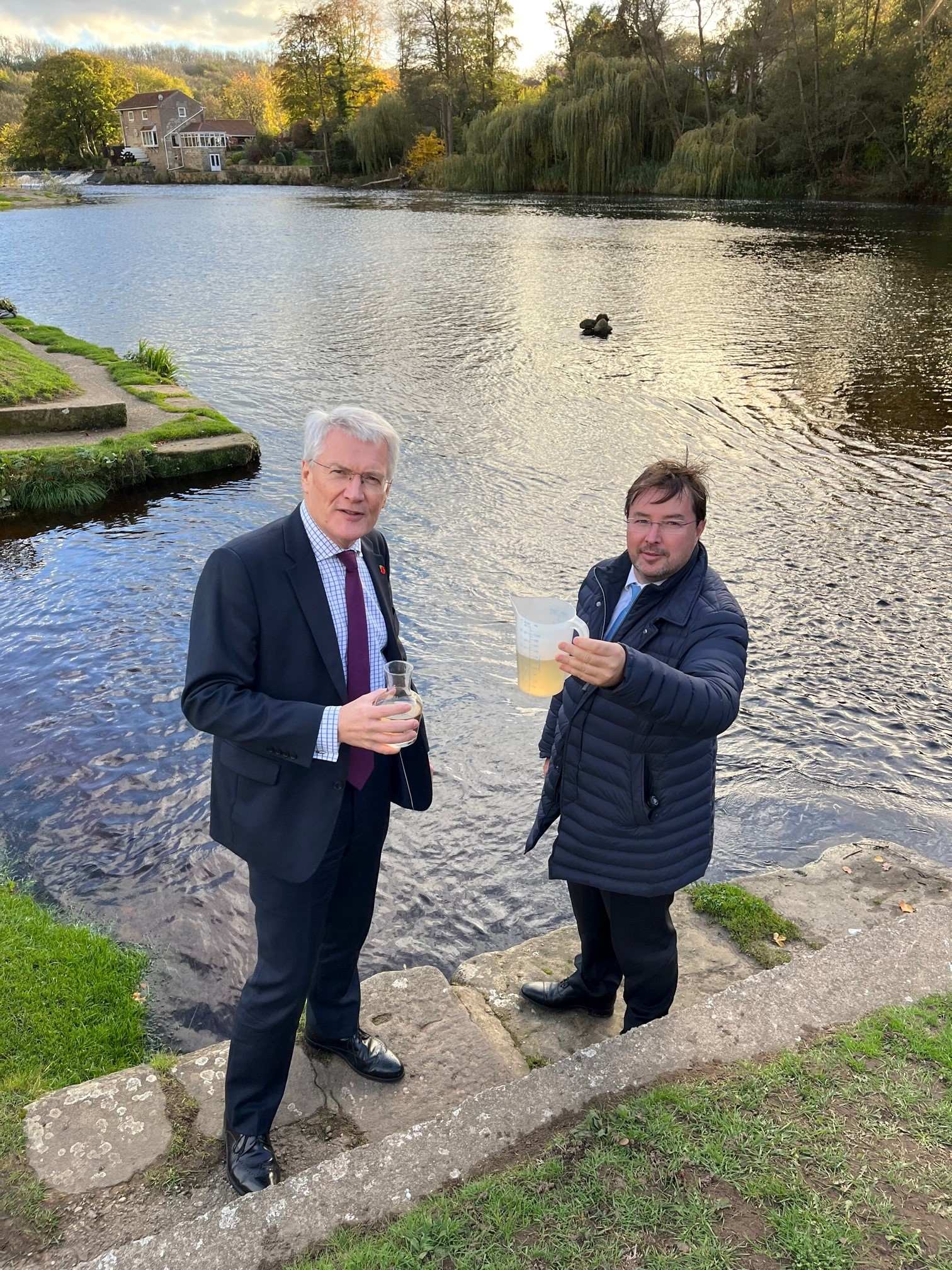
Mr Jones (left) with Frank Maguire, the owner of Knareborough Lido.
The government’s record on sewage discharge has been fiercely debated. Mr Paterson said declining funding to key regulators such as the Environment Agency suggested ministers did not take the issue that seriously but he added that although the action group was “entirely apolitical”, Mr Jones deserved praise for his efforts.
“If he gets some brownie points then fair play to him because we need that bathing water status to improve the quality of water Yorkshire Water is discharging. I’d be deliriously happy if my MP, Julian Smith (the Conservative for Skipton and Ripon) got involved but he hasn’t.”
Mr Paterson added “rivers should be safe and clean to play and bathe in — it’s a right, not a privilege” and people attending the meeting were encouraged to volunteer by undertaking roles such as counting river users.
Wild swimming
Numerous groups attended the meeting but some river users, such as wild swimmers and kayakers, weren’t and some felt the campaign still needed joining-up more.
But the turnout and enthusiasm generated widespread optimism that people might soon be able to swim in the Nidd without a high risk of falling ill, as happened last summer.

Tuesday’s meeting at Gracious Street Methodist Church
Shan Oakes, a Knaresborough town councillor and member of Harrogate and District Green Party said:
“It was a hugely successful event and I feel confident that more like it will follow, bringing the community together to try to stop the pollution and bring back life to our lovely river.”
Yorkshire Water ‘keen to work in partnership’
Two days after the meeting, councillors on North Yorkshire County Council’s Harrogate and Knaresborough area constituency committee questioned a representative of Yorkshire Water as the issue of bathing water status was aired again.
Monika Slater, the Liberal Democrat councillor for Bilton Grange and New Park, told the meeting Leeds University researchers were now taking Nidd samples monthly and this would increase to fortnightly in May.
But she added the samples had so far discovered the harmful bacteria E. coli was at “concerningly high” levels.
Bilton Conservation Society is also sampling at Oak Beck, which empties in the Nidd at Bilton.
Sarah Robinson, from the corporate affairs team at Yorkshire Water, told the meeting:
“There are lots of influences on bathing water quality. It isn’t just about our assets — in some ways that would be easier because we could control that. “
The big issue for the Nidd, Ms Robinson added, was going to be agriculture, such as chemical run-off caused by farmers’ sprays. Dogs running in water also had “a massive impact”, she added. But she said the company was “very keen to work in partnership” to address problems.
The next six months will determine whether the good intentions, and the disparate interests, can be harnessed to achieve real change for the Nidd.
Developer apologises for debris in River Crimple at SpofforthA housing developer has apologised after debris from its site near Harrogate entered a nearby waterway.
Polystyrene and plastic from the 72-home Yorkshire Housing site at Spofforth was floating in the River Crimple in the village over the weekend.
Yorkshire Housing was granted permission to build the homes at Massey Fold in October 2021 after a long-running campaign by some villagers against the development.

Litter strewn across the river and the nearby area. Pic: @spofforthmark
The organisation, which owns and manages about 20,000 homes, said in a statement:
“On Friday, some insulation blew open in the high winds and broke up. The contractor notified the Environment Agency straight away to let them know what had happened.
“Because of the stormy weather over the weekend it wasn’t safe to retrieve and clear-up the debris until this morning. We’re working quickly to do this.
“Windy weather isn’t an excuse and this shouldn’t have happened. We’ve discussed this with the contractor who will ensure any loose materials are secure to prevent this happening again.”
Signs on site say the development, known as Bridgewell, will consist of two, three and four-bedroom homes built in partnership with construction company the Jack Lunn Group and the non-departmental housing agency Homes England.
Villager Mark Lee raised concerns about the incident on social media.
Devastating pollution in Spofforth today, waste and debris from the new development by @JackLunnGroup @HomesEngland @yhousing @EdwardArch the river Crimple is actually blocked by your mismanagement and carelessness! @ClimateDesk @thestrayferret @Harrogate_News @UnderwaterMedia pic.twitter.com/IiszgX96hV
— mark lee (@spofforthmark) February 19, 2023
Conservationist Keith Wilkinson, who is chairman of Nidd Gorge Advisory Partnership and honorary secretary of Bilton Conservation Group, said the incident reinforced the need to look holistically at problems associated with Harrogate’s three rivers — the Nidd, Crimple and Oak Beck.
Mr Wilkinson said contamination from the Nidd tributaries inevitably impacted on the Nidd itself and therefore it would be better to adopt a more strategic view to managing water quality.
Read more:
- New Harrogate homes could trigger more pollution, warns conservationist
- Harrogate’s Rachel Daly scores twice as England beat Italy
Stray Views: Concerns about housing scheme for Harrogate’s Knox Lane
Stray Views is a weekly column giving you the chance to have your say on issues affecting the Harrogate district. It is an opinion column and does not reflect the views of the Stray Ferret. Send your views to letters@thestrayferret.co.uk.
The report compiled by the case officer for Harrogate Borough Council about the proposed Knox Lane housing development ignores many facts.
It appears the application submitted in April 2020 is a Stonewater Housing Association/Jomast joint venture.
In the application for 73 homes, only 10 were open market. Fifty homes, including 10 open market ,were proposed on the allocated site, 80% affordable, the remaining 23 affordable homes were on adjacent unallocated land. The number of affordable (86.3%) is more than double Harrogate Borough Council’s HS2 Policy, despite pre-application discussions having taken place with council officers in September 2019. The following statements were included in supporting documentation with the application:
It is important to note that it was the applicant’s aspiration to provide a full affordable housing scheme on the site. However, an element of market dwellings has been introduced at the request of the council based on their reasoning that it would provide a more balanced scheme.
Due to the uncertainty in respect to the length of any lockdown and the fact that the scheme has already been consulted upon and the site is now an allocation, it is considered appropriate to submit the application rather than delay until some form of meaningful consultant can be carried out at some undetermined point in the future. There is a clear and pressing need for the delivery of housing of all forms within Harrogate.
Despite the application not being compliant with Harrogate Borough Council Local Plan policies it remained on the planning portal with consultees being contacted.
The revised application submitted in December 2021 excluded the 23 affordable homes on the unallocated land but included 30 (56.6%) in the new plan, still in excess of Harrogate Borough Council affordable homes policy and contrary to NPPF 47.
Consultations with residents were held in February and March 2018 when the land agent advised a proposal for 100% affordable homes on behalf of Wakefield and District Housing Association. It is now almost five years since these consultations were held yet no further consultations have been.
The link to Knox Country Park was requested by the case officer. He apparently has not considered the impact this will have on the newly planted habitat for wildlife. The extract from the ecological report submitted on behalf of the developer suggests the increase in footfall would.
Knox Lane comprised a single-lane road and associated footpath. It was lined on both sides by tree lines (including that one the western site boundary) and grass verges, with managed agricultural land beyond to the west. The tree lines may offer some nesting habitat for birds and foraging and commuting habitat for bats, but Knox Lane itself offers negligible suitable habitat for wildlife, comprising impermeable, artificial surfaces that are disturbed by human activity on a regular basis. As such, this area was assessed to be of low ecological value.
Catherine Alderson, Harrogate
Pollution and the River Nidd
I have today received a newsletter from the Conservative Party promoting our local MP Andrew Jones. The lead story covering the front page concerns the River Nidd, highlighting the work he is doing to improve the quality of the water in the river.
More memories of Hotel St George
Further to Kathleen Mitchell’s letter last week. Bill Pritchard and Eddie Jack were still working at the hotel when my husband John Abel and Peter Pointer bought the hotel in 1970.
Do you have an opinion on the Harrogate district? Email us at letters@thestrayferret.co.uk. Please include your name and approximate location details. Limit your letters to 350 words. We reserve the right to edit letters.
New Harrogate homes could trigger more pollution, warns conservationistA conservationist has warned that Harrogate’s “creaking sewerage infrastructure” needs investment to cope with all the new homes.
Keith Wilkinson, who is chairman of Nidd Gorge Advisory Partnership and honorary secretary of Bilton Conservation Group, said more pollution was likely without improvements.
His comments come as investigations into last weekend’s pollution of Oak Beck are ongoing.
The Environment Agency, which previously said it was unable to comment during the Queen’s mourning period, gave a brief update today in which it said it had investigated “several” reports of dead fish and pollution and it was “identifying the source of what caused the fish deaths”.
Oak Beck, which rises at Haverah Park and empties into the River Nidd at Nidd Gorge, is classed as a main river by the Environment Agency even though it is narrow.
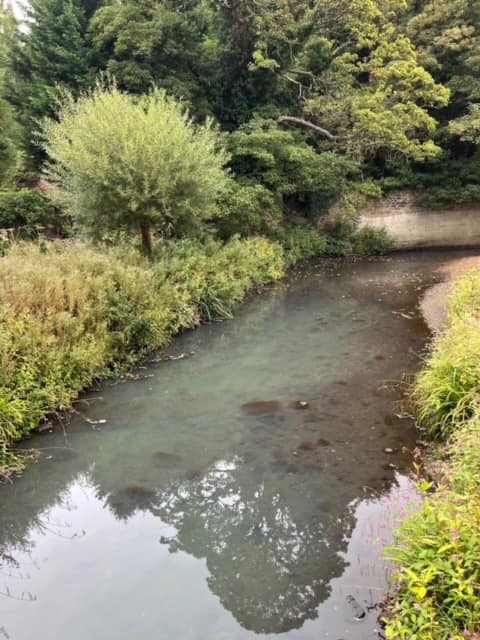
Oak Beck looking discoloured this week.
Mr Wilkinson said long-recognised problems with broken and wrongly connected Victorian pipes near The Hydro remained unresolved.
This, along with new housing developments in the area, would exacerbate the issue further, he said.
Mr Wilkinson said:
“North Harrogate’s sewerage system has been operating on optimum-to-overload capacity for at least a decade — before we see the aggravating grey water outputs of the excessive housing expansion on the A59 and Penny Pot Lane.
“In other words ‘we ain’t seen nothing yet’.”
Mr Wilkinson, who was awarded an MBE for services to conservation, also said he wasn’t aware of any plans to develop the northern outfall sewage works at Bilton to cope with the anticipated increase of sewage caused by new homes. He added:
“Their site has many spare acres of unused land — it occupies 56 acres in total — but I detect no suggestion that there will be significant investment in new infrastructure to increase its capacity to receive and process more inputs.”
Oak Beck fish deaths still a mystery
Contaminated water on Oak Beck stretched from The Hydro to Bilton this week. Mr Wilkinson said the watercourse would take three years to recover.
A Yorkshire Water spokesman said yesterday it was “still on site, trying to investigate possible sources” of the contamination. He added initial tests had shown the cause was not sewage.
Read more:
- ‘Hundreds’ of fish killed by pollution on Harrogate’s Oak Beck
- Oak Beck will take three years to recover from pollution, says Harrogate conservationist
Northern Gas Networks said the pollution is unconnected to work it is carrying out on the site earmarked for a new Tesco.
Mark Johnson, senior project manager at NGN, said:
“We’re currently undertaking work to safely dismantle the gas holder on Skipton Road and all of our discharge takes place into the main sewerage system, as is required.
“Following reports of a possible contamination at Oak Beck, we’ve been liaising closely with the Environment Agency and Yorkshire Water, both of whom have confirmed that there is no connection with our work. We will continue to monitor the situation closely.”
Oak Beck will take three years to recover from pollution, says Harrogate conservationist
A leading Harrogate conservationist has said Oak Beck will take three years to recover from this week’s pollution.
Hundreds of fish are believed to have died when the water turned brown over the weekend. The cause is unknown.
Keith Wilkinson has called on Yorkshire Water and the Environment Agency to join efforts to prevent further pollutions in the beck, which he said occur too frequently.
He said:
“Pollution events along the Oak Beck — which is classed as a ‘main river’ by the Environment Agency — destroy wildlife and have implications for public health.“As chairman of the Nidd Gorge Advisory Partnership I would like to invite representatives from the EA and Yorkshire Water to join the partnership and coordinate efforts to eliminate illegal discharges along the Oak Beck and the River Nidd.“One toxic spill such as that experienced on 10th September sets back all our conservation efforts for at least three years.”
Oak Beck looking discoloured.
Read more:
- Hundreds of fish killed by pollution on Harrogate’s Oak Beck
- Meeting called to hear concerns about state of River Nidd
Oak Beck rises at Haverah Park and empties into the River Nidd at Nidd Gorge.
Dead fish were first spotted in the watercourse at Oak Beck retail park this morning.
The discolouration appears to have affected the stretch from the Hydro to the far side of Knox Lane.
The Stray Ferret met Mr Wilkinson, who is also honorary secretary of Bilton Conservation Group, at Spruisty Bridge on Knox Lane today.
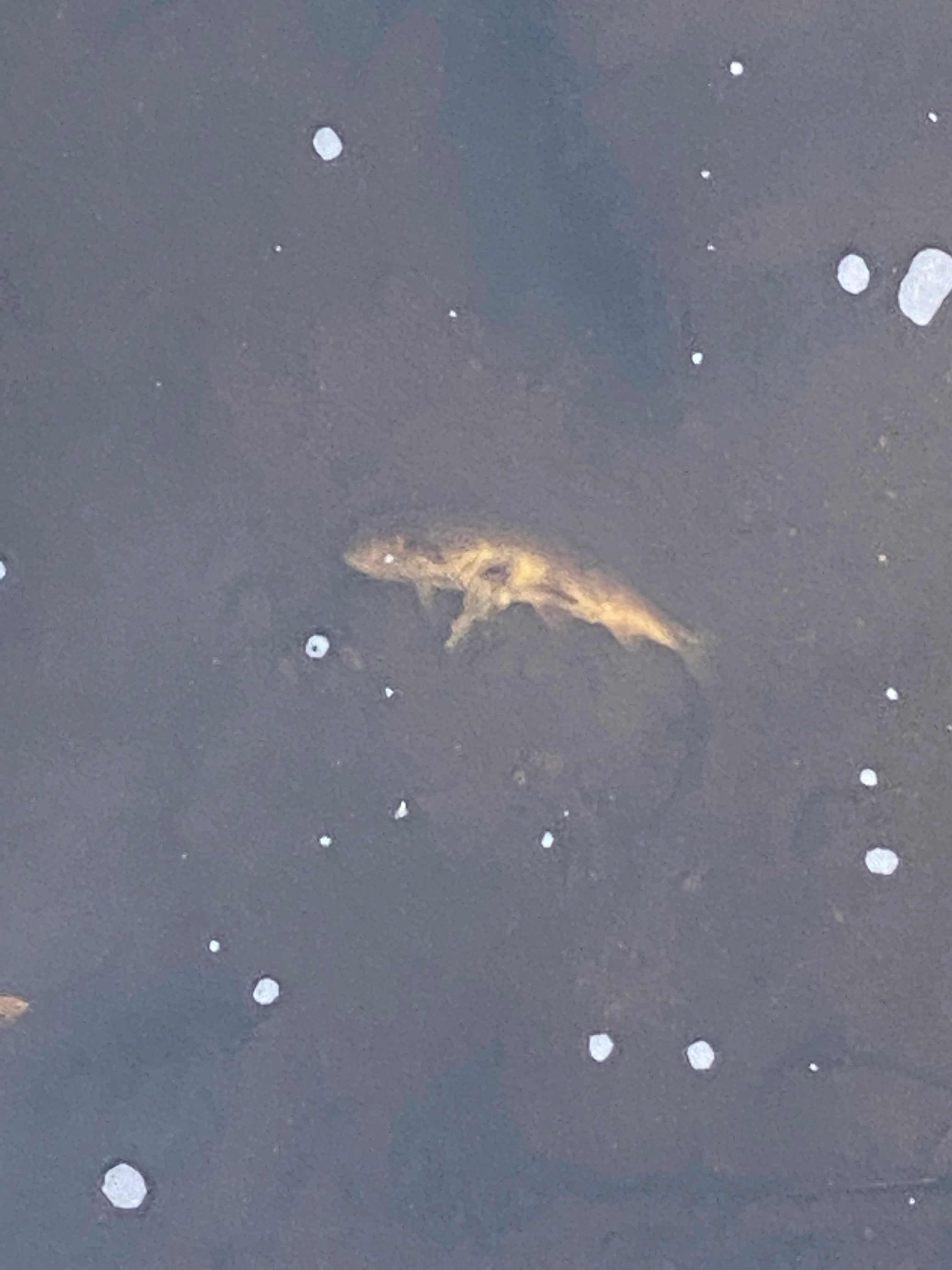
A dead brown trout in Oak Beck today.
Several residents told us they were concerned about the pollution and how seriously it was being investigated.
One person said dog walkers had been keeping their pets on leads to prevent them entering the water. There have also been reports of dead ducks but none were evident during our visit.
Harmful discharges
Mr Wilkinson said a good year for spawning fish on the beck had been ruined.
He said water quality often suffered from the impact of the number of new homes built, as well as harmful discharges entering the drains.
The beck contains brown trout up to several inches long, as well as minnows, bullhead, stone loach and sticklebacks.
Mr Wilkinson said invertebrates on the bed of the beck were also killed and their numbers needed to recover before fish levels could return to normal.
He added that kingfishers and otters had kept away from the river since the incident.
An Environment Agency spokeswoman said yesterday she was unable to comment on what, if any, action it had taken because it was not responding to media inquiries about non life-threatening incidents during the Queen’s mourning period.
A Yorkshire Water spokesperson said yesterday:
“Our teams, along with the Environment Agency, have conducted initial investigations after reports of a pollution at Oak Beck over the weekend.
“Our tests have indicated the substance entering the beck is not sewage. We are continuing to investigate and will also be visiting local businesses to try and trace the source.”
‘Hundreds’ of fish killed by pollution on Harrogate’s Oak Beck
Hundreds of fish are believed to have died in a pollution incident at Oak Beck, Harrogate.
The cause of the incident, which occurred at Oak Beck Park, close to the retail park, is not yet known.
A Yorkshire Water spokesperson said:
“Our teams, along with the Environment Agency, have conducted initial investigations after reports of a pollution at Oak Beck over the weekend.
“Our tests have indicated the substance entering the beck is not sewage. We are continuing to investigate and will also be visiting local businesses to try and trace the source.”
The beck flows into the River Nidd.
Councillor Paul Haslam, who represents Harrogate Old Bilton on Harrogate Borough Council and Bilton and Nidd Gorge on North Yorkshire County Council, informed Yorkshire Water of the incident after being notified by a resident yesterday.
Cllr Haslam posted some images, which we have published, that were sent to him by the resident.
They show fish floating on the surface and the water looking extremely brown.
Cllr Haslam said the only way to get over the seriousness and upsetting nature of what had happened was to quote the person who reported it, who said:
“There are hundreds of dead fish in the water. I am presuming it’s sewage by the colour and presence of foam. No smell though.“I could have cried this morning at the scale of the disaster. As I took my first photo evidence, from the bridge on Oak Beck Road, a kingfisher flew under the bridge heading downstream.”
Read more:
- Sickness outbreak prompts concerns River Nidd is not safe for swimming
- Harrogate council agrees sale of land next to Oak Beck retail park
Kingsley residents suffering construction dust call on council to tackle developers
Residents in Harrogate’s Kingsley ward say construction traffic has left them worrying about harmful dust and air pollution — but a “weak” Harrogate Borough Council has done little to clamp down on developers.
Over 700 homes will eventually be built in the ward by five different developers but Kingsley Road and Kingsley Drive are accessed off the busy Knaresborough Road.
This has led to lorries and trucks driving through residential roads to get to the building sites.
Residents say the construction traffic has resulted in vast amounts of dust and dirt from lorries ending up on roads, cars and houses. They say it’s so bad they worry they’ll have to wear masks to protect themselves.
Gary Tremble, from Kingsley Ward Action Group (KWAG), said:
“We have complained for over three years yet to this day the wagons travel down our residential street spewing out dust in summer and dirt in winter, we now even have fully laden uncovered wagons taking dirt into the developments.”
Mr Tremble believes the dust is made up of PM10, an air pollutant typically seen on building sites. When breathed in, it can penetrate deep into the lungs.
Exposure to high concentrations of PM10 has been linked by scientists to asthma attacks, high blood pressure, heart attacks and strokes.
‘We’ve been ignored’
When a development receives planning permission from HBC, conditions are attached that stipulate how housebuilders will minimise the impact of issues including dirt and dust.
This sometimes involves making sure there are onsite wheel cleaners and covering wagons that are carrying materials or waste.
Mr Tremble added:
“We’ve made hundreds of complaints to Harrogate Borough Council but enforcement but are weak. They don’t do anything and we’ve been ignored.”
Read more:
- Calls to tackle construction vehicles who cause ‘misery’ in Harrogate
-
Residents criticise key Harrogate planning document as ‘incoherent’
The issue of how effective the council’s planning enforcement team was raised at a council meeting this week.
Conservative councillor for Old Bilton, Paul Haslam, said he and other councillors had received complaints from KWAG accusing the council’s planning enforcement team of not ensuring that conditions were being upheld.
Conservative councillor for the Washburn ward, Victoria Oldham, asked Cllr Haslam if he thought HBC’s planning enforcement team was acting on complaints from residents “in a timeous manner”.
Cllr Haslam said he was concerned that enforcement officers “don’t have enough support”. He said:
“Quite clearly, guidelines are being flaunted [sic] by the developers. We need to make sure we are seen to protect our residents.”
‘Addressing the concerns’
In response to KWAG, a Harrogate Borough Council spokesperson said:
Environment Agency called to investigate potential Ripon pollution“We are aware of concerns relating to dust from HGVs entering and exiting the development(s) on Kingsley Road and have allocated a case officer to address these concerns.
“We have discussed the matter with the county council and the developer and have reminded them of actions they must maintain as per the conditions of the planning permission.
“These actions have been actioned – as well as some further recommendation, including road sweeping – by the developer and we will continue to closely assess this situation to ensure they continue to do so.”
The Environment Agency and Yorkshire Water are being called upon to investigate a foaming discharge into the River Ure in Ripon.
There are fears the discharge could be potentially harmful to humans, aquatic life and water fowl.
The Stray Ferret contacted the EA incident line after seeing the discharge yesterday and understands that the stretch of river near the Duchess of Kent Bridge on the A61 Ripon bypass has been affected since the weekend.
James Thornborough, an internationally-recognised authority on spillage on land and water, reported the incident to YW and said it would be normal practice for them to share the information with the EA.
The expert, who lives in nearby Sharow, told the Stray Ferret:
“I pass this part of river, which can be seen from the Dishforth Road, on a regular basis and on Sunday noticed the foaming on the water coming from a drainage outlet that feeds into the Ure.
“In my opinion this is not normal occurrence for this part of the river and that is why I reported it.
“It certainly warrants scrutiny by the EA to find out what exactly is being discharged and whether it is benign or potential harmful to people and animals.
“If it is discovered to be harmful, urgent remedial action will need to be taken.”
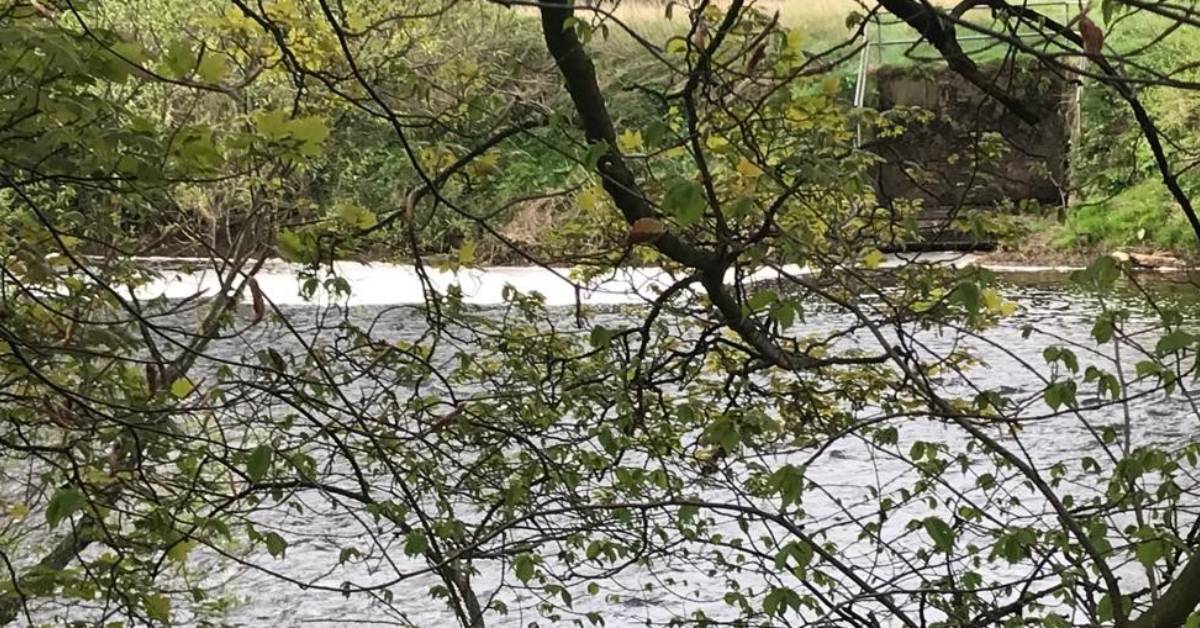
The drainage outlet (top right on the photograph) has been the source of the white foaming substance.
Mr Thornborough added:
“The EA, as the national competent authority for protecting the natural environment of the UK, is bound to assess any reported pollution incident and I would urge anybody who witnesses something like this, that looks out of place, to report it as soon as possible.
“Rivers collect water naturally from the atmosphere (rainfall), surface drainage (run off), ground waters, and underground aquifers.
“Unfortunately rivers must also cope with Industrial waste. Controlled industrial discharges are subject to license conditions. Uncontrolled industrial discharges occur due to operating controls failures, accidents or deliberate intention (criminal behaviour).”
What can the Environment Agency do?
Mr Thornborough said he expected the EA to analyse water samples. He added:
“Industrial pollution can reduce the concentration of bio dissolved oxygen in the water phase which can cause fish kills.
“At the very least, the biodiversity of the River Ure in the surrounds of this foaming event, has likely been impacted and microscopic marine organisms will have been killed upsetting the food chain.
“With this in mind, all stakeholders – from business operators, to the public and compliance organisations such as the EA, have a role to play in ensuring that our precious water resources are safeguarded.”
Read more:
- Major photography exhibition puts Fountains Abbey in the frame
- Ripon California keenly awaits the memoirs of former Ripon mayor