Harrogate Borough Council has revealed it spent £45,000 on outside help when it put together its failed bid for government Levelling Up money.
Last year the council bid for £20 million that would have gone towards a proposed £49 million redevelopment of Harrogate Convention Centre.
But the bid was refused by the government last month, throwing into doubt the future of the venue it has owned and run since opening in 1982.
Following a freedom of information request by the Local Democracy Reporting Service, the authority said it spent £45,000 on “legal, design and financial input and guidance” related to the bid proposal.
A council spokesperson said this was to “ensure the best possible chance” of it being successful.
Despite Harrogate being in the lowest priority area for Levelling Up funding, convention centre director Paula Lorimer told councillors at a meeting last week it would likely bid again when a third round of funding worth £1 billion opens.
Ms Lorimer warned Harrogate would “wither on the vine” if the facility closed because of its importance to the town’s business and leisure sectors.
The ownership of the venue will be handed over to the new North Yorkshire Council on April 1.
Read more:
- Government rejects £20m levelling up bid for Harrogate Convention Centre
- Harrogate council pays out almost £20,000 in compensation to tenants due to damp
Andrew Williams, North Yorkshire independent councillor for Ripon Minster and Moorside on North Yorkshire County Council, said he didn’t begrudge Harrogate Borough Council bidding for Levelling Up money but the refusal should show the council “that the government doesn’t think the redevelopment is worthwhile.”
Cllr Williams said:
“The conference centre is going to be a millstone around anybody’s neck.
“There needs to be serious thought put into what commercial uses it can become so that it will not be a drain on the public purse. I don’t support spending £50 million on a business that’s still losing money. Enough is enough when resources is tight.”
A Harrogate Borough Council spokesperson said:
North Yorkshire Police strip searched 90 children in three years, figures show“The costs associated with our bid for the government’s Levelling Up Fund included significant legal, design and financial input and guidance.
“This was required to ensure the best possible chance of the Harrogate Convention Centre’s £20m submission being considered.
“We were disappointed not to be award a grant in this round of funding. But we remain hopeful and have everything we need to submit a bid for any future rounds or other opportunities for government funding.
“We have not yet received any feedback from the Department of Levelling Up, Housing and Communities as to why we were unsuccessful.”
North Yorkshire Police carried out strip searches on 90 children over the last three years, figures show.
Figures obtained by the Stray Ferret through a Freedom of Information request show 34 children were searched in custody in 2019 alone. Twenty-seven were searched in 2020 and 29 last year.
The force said the searches involved removing jacket, overcoat and gloves and carrying out a procedure known as a “more thorough search”.
None of them involved an “exposing intimate parts” search, which the force said has not been conducted on a child under 18 in the last three years.
While the figures show the number of individuals who have been strip searched by officers following an arrest, they do not reflect whether the child had been searched on multiple occasions.
North Yorkshire Police also revealed it had conducted a total of 43 strip searches as a result of stop and search on children since 2019.

Table showing strip searches carried out by North Yorkshire Police. Data: NYP.
Officers have the power to order an individual to remove clothing as part of stop search, if they have reasonable grounds to suspect they have a dangerous or prohibited item.
The figures come as the Children’s Commissioner for England criticised the Metropolitan Police in August this year after it was revealed the force strip searched 650 children over two years – the majority of which were found to be innocent of the suspicions against them.
Iryna Pona, policy manager at The Children’s Society, said the Home Office and police forces should investigate the practice.
She said:
“Strip searches are intrusive and traumatic for children, and we are urging the Home Office and police leaders to investigate the concerning scale of this practice.
“Guidance and training for officers needs to be reviewed to ensure strip searches only happen when absolutely necessary, and that children and young people are treated with dignity and respect. Nationally, we’ve heard examples where safeguards like an appropriate adult being present, are not followed, and we see an over-representation of black children in strip search figures.
“When police officers arrest or stop and search children this should be a golden opportunity to identify risks like exploitation to courier drugs and work with other services to offer protection and help.”
Police response
In response to the figures, a North Yorkshire Police spokesperson said:
“Alongside our partners, we work hard to engage with and educate children and young people about the consequences of crime.
“Our dedicated anti-knife crime operation, Operation Divan looks to reduce the number of young people carrying weapons by challenging misconceptions and educating them on the consequences of doing so. Working in partnership with education, social care and youth justice any young person identified as potentially carrying a weapon or being involved in county lines, drug or child exploitation is invited to take part in the scheme, which has recently been recognised by the Howard League for Penal Reform in their community awards.
“Thanks to our preventative approach and our close partnership working, the number of children arrested has also fallen year-on-year since 2018, as reported by the Howard League – The Howard League | Child arrests in England and Wales reduced by 74 per cent in a decade
“Sadly though there are some children who do become involved in criminal activity and in order to safeguard them and keep the public safe, at times it is necessary to conduct searches. Stop and search is a valuable tool in preventing and detecting crime and we recognise it is essential that its use is legitimate and proportionate, in order to maintain public trust.
“We follow guidance from the College of Policing regarding the use of stop and search and we have a number of measures in place to ensure that decisions around its use are recorded and scrutinised. We believe transparency is important to maintaining public trust, so our stop and search figures are published to our website on a monthly basis. Stop and search | North Yorkshire Police”
Read more:
- Police plea to call out drink drivers amid increasing Harrogate district incidents
- Impartiality concerns over crime commissioner’s plan to share office with Harrogate police
A spokesperson for the children’s charity the NSPCC said:
Harrogate district remains the county’s cannabis farm hotspot“Like all forces, North Yorkshire Police must fully acknowledge that safeguarding should be at the heart of their policies and procedures when it comes to searching children.
“National guidance on the use of these searches would provide clarity and help to ensure young people’s rights and needs are paramount in these situations.”
The Harrogate district is still the place in North Yorkshire with the highest number of cannabis farms, data from North Yorkshire Police has revealed.
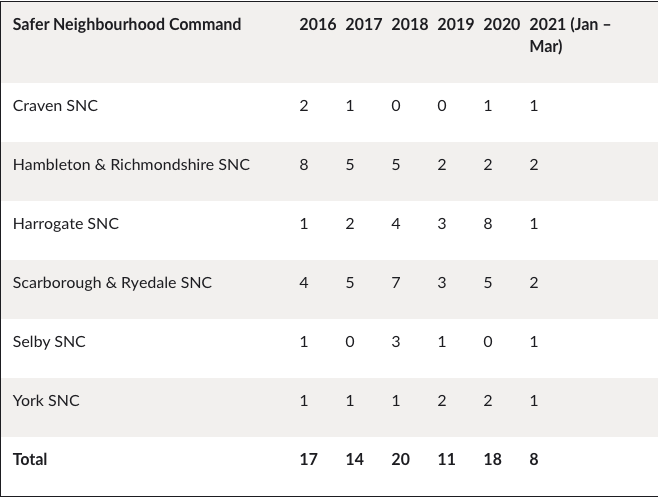
A Freedom of Information (FOI) request showed that between 2016 and 2021, nine major farms with more than 25 plants were discovered in the Harrogate district.
That was almost double the amount found in the Selby district, which was the next highest with five.
This marked a continuation of a trend highlighted two years when an FOI request from the Stray Ferret found that the Harrogate district also had the highest number of cannabis farms then.
Between 2017 and 2020, officers made 22 arrests of people involved with cannabis farms in North Yorkshire.
Read more
- Ex-Harrogate guest house owner Yoko Banks given court ultimatum
- Drug pushers jailed after £140,000 cannabis seizure in Boroughbridge
Countywide issue
In total over the five-year period between 2016 and 2021, Police recorded 25 crimes relating to cannabis farms across North Yorkshire.
Only two crimes were recorded in 2016/17 and there were three each in 2018/19 and 2019/20.
However, there were nine in 2017/18 and eight in 2020/21.
On average, 323 plants were seized from farms. The largest number recorded was 2,797.
Since the available data ended in 2021, North Yorkshire Police has continued to deal with the issue of large-scale cannabis production in the Harrogate area.
Earlier this year, seven people were jailed for a combined 22 years after Police discovered £450,000-worth of cannabis spread across farms at three properties.
In February, two men were stopped on the A1(M) with 14 kilos of cannabis in their car. They were jailed for two years.
North Yorkshire Police was approached for comment about the latest statistics and why the Harrogate district is so popular with cannabis growers but did not respond.
Is Harrogate council leader using misleading statistics to justify £47m spend?Harrogate Borough Council leader Richard Cooper has been accused of using a misleading statistic to support a £47 million redevelopment of the town’s convention centre.
Cllr Cooper has claimed 88% of conference delegates to the centre return to the area for leisure. However, the Stray Ferret has not been able to find the statistic he refers to -— only one that says, when asked, delegates said they were likely to return.
The statistics matter because the soon-to-be-abolished council wants to fast-track the start of what would be one of the biggest public spending commitments in its 48-year history.
It says Harrogate Convention Centre needs the investment to continue attracting visitors — and to boost the economic impact on the entire Harrogate district.
What is Cllr Cooper claiming?
Cllr Cooper, the Conservative council leader and chair of the convention centre board, told a council meeting this month:
“The purpose and vision of the convention centre is to deliver high quality conferences, exhibitions and events that bring maximum economic impact and prosperity to the district.
“It is important to emphasise that this is for the district and this is not a noose around the district’s neck.
“And I can demonstrate that by saying almost nine out of 10 people — 88% — an astonishing statistic — who come to Harrogate Convention Centre for business return to the district for leisure. This is streets ahead of other venues.”
Read more:
- Major redevelopment of Harrogate Convention Centre could start in October
- Council refuses to say if jobs at risk at Harrogate Convention Centre
Kirk Hammerton resident Alex Smith has submitted a freedom of information request asking where this information was from. Neither he nor the Stray Ferret has been able to find it.
Mr Smith told the Stray Ferret he was not a member of any political party but was interested in transparency and standards.
The Visit Britain Statistics
His FoI suggests Cllr Cooper may have been referring to 2018 research by Visit Britain on how much delegates to business events spend.
This research said 88% of delegates to Harrogate Convention Centre, from a sample of 98, said they were ‘likely or very likely’ to return to the area. Of those, 62% said they were ‘very likely’ to return.
But it does not say how many actually do and neither Mr Smith nor the Stray Ferret is aware of any research that does so.
Mr Smith’s FoI request says:
“Residents are used to Cllr Cooper’s robust approach to political point-scoring.
“But, as chairman of the Harrogate Convention Centre, he is obliged to give out accurate information; and as a councillor, he is bound by a code of conduct not to mislead the Mayor and council.
“He is not free to invent ‘astonishing’ statistics to suit his argument.”
The FoI then asks for Cllr Cooper’s source, adding:
“If there is no other source than the one I’ve quoted I’d be grateful if you could inform me when and how Cllr Cooper will correct his wilful misinformation.”
The Stray Ferret asked Cllr Cooper last week where the statistic he quoted was from but has not received a response.
Previous claim
In July 2020, Cllr Cooper told a council meeting that 75% of Harrogate Convention Centre delegates returned. He said:
“75% of 150,000 is 112,500 visitors that come to our district because of the convention centre who we would never see here otherwise.”
Again, it is not clear where this information is from — or why the figure appears to have grown to 88%.
Harrogate Borough Council will be abolished next year as part of a shake-up of local government that will see a new North Yorkshire Council formed.
Cllr Cooper has said he does not intend to seek re-election in May’s local elections for the new council.
North Yorkshire Police pledges to improve dire freedom of information response
North Yorkshire Police has pledged to improve its freedom of information performance after the amount of responses handled on time fell as low as 9%.
The Information Commissioner’s Office included the county’s force in a list of police forces whose FOI responses was deemed under-performing.
Now the force has referred itself to the ICO over its timeliness of responses, its backlog of requests and its low performance.
Organisations are required to respond to requests promptly and within 20 working days. North Yorkshire Police has a target of meeting this 95% of the time but its performance in recent years has fallen woefully short.
It fell as low as 9% in April 2020 and the highest it has reached is 59% in August the same year.
The ICO said in a report dated October 2020:
“Although significant progress has been made to improve NYP’s performance, the Commissioner’s analysis of the performance statistics has led her to issue this practice recommendation to ensure that the trend of improvement continues and NYP achieves satisfactory levels of timeliness.”
Read more:
- ‘God help us!’ — fears over need for £31m to fund North Yorks fire service
- Chief constable says maximum council tax rise will enable crime prevention
A total of 365 FOI requests were outstanding in April 2020. Of that figure, 309 requests were overdue and 193 were over six months old.
North Yorkshire Police revealed last week it had created an action plan to tackle the problem.
It said the reason for its lack of response was “mainly caused by increased volumes of FOIA requests, subject access requests and Family Court Order request”.

North Yorkshire Police’s FOI response performance as submitted to the Information Commissioner. Table: ICO.
The police action plan has set a target to respond to 85% of requests within 20 working days by September 2022.
The plan recognised its compliance rates had not been met. It said that this was down to “reduced staff resources” and “continued demand for disclosure”.
Dog thefts more than double in Harrogate districtThe number of dog thefts in the Harrogate district more than doubled in 2020 compared with 2019, according to police statistics.
The figures were released after a member of the public made a Freedom of Information request to North Yorkshire Police.
They show there were eight thefts in 2020 compared with three in 2019. The three previous years saw just seven thefts in total.
Although the numbers are small, the 2020 figure represents a significant increase.
The Harrogate district also had the highest number of thefts in North Yorkshire in 2020, with Scarborough and Ryedale the closest with five.
The figures also revealed only two thefts ended in a person being charged. Most reports didn’t lead to court action either because no suspect was identified or there were evidential difficulties.
A table showing the number of crimes where a dog has been recorded as stolen. Photograph: North Yorkshire Police
Border Collies and Pugs were the most commonly stolen breeds in North Yorkshire, with 10 and eight thefts recorded respectively between 2016 and 2021.
Read more:
- Ripon dog owners want to maintain a cycle-free area
- Warning for dog walkers after four sheep killed near Pinewoods
The police recently appointed its first officers dedicated to dealing specifically with pet theft.
Amongst other duties, the officers will conduct reassurance visits, in which they accompany pet theft victims on walks to help them feel more confident when walking their dogs.
11 fly-tipping fines issued in Harrogate district despite almost 3,000 reportsHarrogate Borough Council has issued just 11 fines for fly-tipping in the last five years, despite receiving 2,845 reports from the public.
The figures were obtained through a freedom of information request and posted on the website What Do They Know.
The council has the power to fine fly-tippers £400, which is reduced to £240 if paid within 10 days.
A council spokesperson blamed the low number of fines on needing “substantial” evidence before it can take action.
Read more:
- Family moves to Rudding Park to escape minus one degree home
- Major setback for Kirkby Malzeard pub campaigners
The figures also reveal that fly-tipping has cost the council £190,985 in clean-up costs since 2017.
The most commonly dumped items were household waste, construction waste and white goods.
The council spokesperson said:
“Fly-tipping is a selfish crime that blights the landscape and spoils everyone’s enjoyment of our towns and countryside.
“In order to prosecute we need to carry out thorough investigations and provide substantial evidence. This can be a challenge as not all fly-tipping contain personal or business details we can investigate.
“But we will not give up tackling fly-tippers and bringing them to justice.“

Councils across the country can restrict reports on committee agendas, if they feel it would adversely affect the financial affairs of a business or person.
Report writers have discussions with the legal service at a council to decide which information should be kept out of the public eye.
The authors of the report may be challenged on why information should be exempt before it goes to committee.
A decision as to whether to restrict information is down to council officers and their interpretation of the reports.
The authority must make clear on the public agenda why a report is restricted by quoting the relevant paragraph of the Local Government Act.
Read more:
- Harrogate council U-turn reveals Flaxby legal costs
- Harrogate Borough Council accused of ‘behaving like a secret state’
For example, paragraph three relates to commercial grounds and paragraph one is information relating to a specific person.
However, exactly how they arrive at that decision is not revealed to taxpayers and can lead to the press or members of the public using the Freedom of Information Act to try to force councils to release the information.
Freedom of Information Act
The Freedom of Information Act was introduced in 2005 to make government more open with the public.
Its sole purpose was based around peoples’ right to know what public bodies were doing with their money and to make institutions like councils more accountable.
How does the act work?
Anyone can submit a request for information to a public body, such as Harrogate Borough Council, under the freedom of information act.
The council must then respond to that request within 20 working days.
When someone requests information, there is a presumption in favour of the council disclosing information under the act.
This is because the principle behind the legislation is that people have a right to know about the activities of public authorities, unless there is good reason for them not to.
The council must justify under what exemption it refuses information and why.
For example, it can refuse a request on the grounds of commercial confidentiality under section 43 of the act.
But it must show that it factored in the presumption of disclosure into its reasons for refusal.
Guidance from the Information Commissioner’s Office says:
“The main principle behind freedom of information legislation is that people have a right to know about the activities of public authorities, unless there is a good reason for them not to.
“This is sometimes described as a presumption or assumption in favour of disclosure.”
If the council does refuse a request and the person submitting the request is not satisfied, they can ask for an internal review.
The review is carried out by a senior officer who was not involved in the initial freedom of information request.
The council reviews its original decision and decides whether it feels the information should be disclosed.
If it decided not to hand over the information after the review, the person can take the matter further to the Information Commissioner.