Consultants’ fees for the £12.1 million Harrogate Station Gateway scheme have risen to £2.1 million, the Stray Ferret can reveal.
We have also discovered Conservative transport chief Cllr Keane Duncan wanted to share the latest gateway plans with the Stray Ferret to avoid “public discontent” but was advised against it by a council director.
The findings are contained in a North Yorkshire Council response to a Freedom of Information (FOI) request submitted to find out who made the decision to keep the latest plans secret.
Work on the watered down scheme is due to start in September.
Cllr Keane Duncan, the council’s executive member for highways, revealed some details in January, as reported here. But the full plans have not been released, despite considerable public interest in the scheme.
Our FOI request asked for details of correspondence relating to the decision not to release the plans — and for the latest spending on consultants.
The council gave the following breakdown of consultants’ costs to global consultancy firm WSP to November 2023.
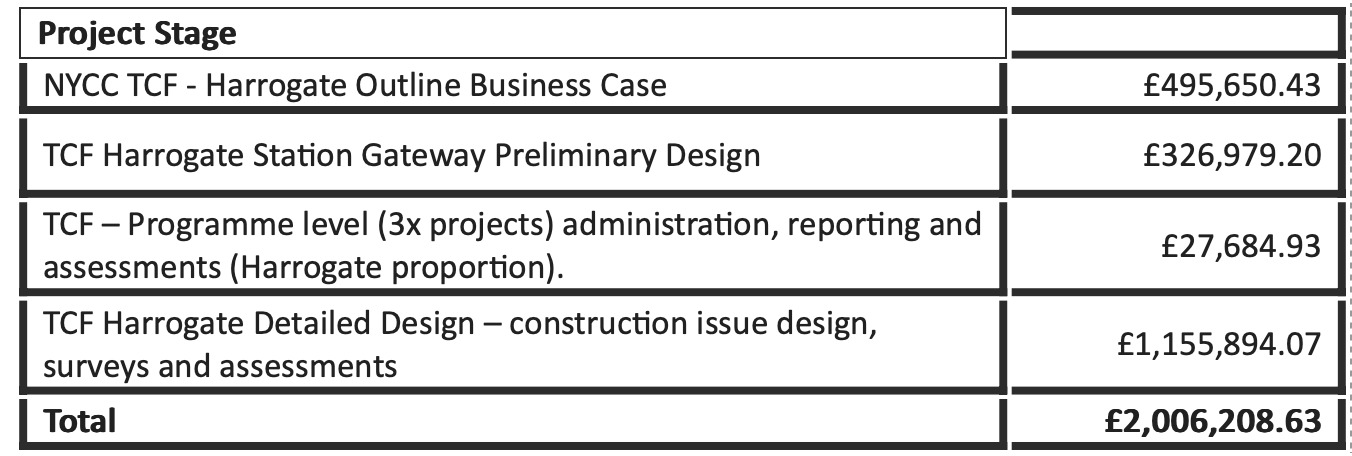
It said since then it had spent a further £82,358.64, making a total of £2,088,567.27.
‘Public discontent’
Emails reveal Cllr Duncan was unaware the cost of the gateway had risen to £12.1 million when reported by the Stray Ferret.
He emailed Karl Battersby, the council’s corporate director of environment on March 8 asking for clarification and suggesting the council request a correction.
Mr Battersby pointed out the £12.1 million figure was contained in a report by West Yorkshire Combined Authority, which was overseeing the funding allocation from the Department for Transport, even though North Yorkshire Council is leading on the scheme.
Richard Binks, head of major projects and infrastructure at the council, then said the full business case now included £1,489,442 for risk/inflation/contingency. Details of the other costs of the scheme were redacted in the response to us.
Cllr Duncan then referred to requests to see the revised plans by the Stray Ferret, which is referred to as ‘SF’ in the correspondence:
“On another point, do we have plans we can share now or in the near future?
“I feel like we need to do some sort of explanation piece as the lack of information is just creating public discontent.”
In a further email he says “I am thinking I connect the SF and share these plans?”
Cllr Duncan then said:
“Just spoken to Carl [council leader Carl Les], and we were wondering if we could get any impressions together of what the revised scheme would look like?”
But Mr Battersby replies:
“The plans will shortly be available as part of the TRO [traffic regulation order] consultation. I wouldn’t provide the SF with anything over and above what the public will see.”
Cllr Duncan replies to say “OK, I agree”.
Two months on from the exchange, the plans remain secret.
New update
The council is progressing gateway schemes, which are mainly funded by the government’s Transforming Cities Fund, for Selby and Skipton as well as Harrogate.
In an update report to next week’s full council meeting, Cllr Duncan says it “continues to make progress on work on transformative gateway schemes to improve access to three of North Yorkshire’s rail stations”.
It adds:
“Full business cases have been submitted to West Yorkshire Combined Authority and Department for Transport for all schemes and all three have now been approved with conditions.
“Final works pricing is currently in progress by contract partners prior to a final approval stage, with work expected to commence in Skipton in the summer and Harrogate and Selby later in the year.”
Read more:
- Plans approved to convert ex-Harrogate shop and nightclub into flats
- Floral trail to be installed in Harrogate this summer
- Forestry England to create 35-hectare woodland near Harrogate
Exclusive: Council spent £1.9m on consultants for scrapped Harrogate Convention Centre plans
Almost £2 million of taxpayers’ money has been spent on consultants to come up with plans to upgrade Harrogate Convention Centre that have now been scrapped.
North Yorkshire Council and its predecessor Harrogate Borough Council have hired various consultants since 2016 as part of the long running saga to redevelop the convention centre.
So far none of the work has been carried out and last month North Yorkshire Council revealed it had abandoned previous plans drawn up by Harrogate Borough Council and recruited another firm of consultants called 31ten to carry out ‘soft market testing’ on the future use of the events and exhibition complex.
North Yorkshire Council refused to reveal at the time how much it had paid the 31ten — prompting the Stray Ferret to submit a freedom of information request.
We asked not only how much had been awarded to the London firm but also how much had been spent on consultants for all work involving the possible upgrade of the convention centre.
The response said 31Ten had been paid £23,000 plus VAT for work that is expected to be concluded by ‘late spring’. This figure pales in comparison to the overall sum awarded to consultants since 2016.
The freedom of information response said besides funding awarded to 31Ten “the remaining £1,948,590 relates to historic spend committed by Harrogate Borough Council”.
Harrogate Borough Council was abolished a year ago and succeeded by North Yorkshire Council.
The response added:
“It is North Yorkshire Council’s intention to use internal resource to support future proposals for Harrogate Convention Centre, and minimise spend with external consultants, wherever possible.”
‘More affordable’ way forward
North Yorkshire Council’s Conservative-controlled executive agreed last month to scrap a two-phase development plan for the building drawn up eight years ago after being told the cost of the first phase had soared to £57.2 million.
Instead it agreed to come up with a “more affordable” way forward. Centre director Paula Lorimer, who last year called for the refurbishment, said she had now changed her mind and agreed with the new approach.
The way forward will be guided by 31ten’s findings. The freedom of information response said:
“The aim of the soft market testing is to assist North Yorkshire Council in assessing the options for the future development and operation of Harrogate Convention Centre. Options may include, but are not limited to, alternative delivery and funding models, partnership working, alternative uses for parts of the site, and asset ownership.”
North Yorkshire Council currently subsidises the convention centre to the tune of £2.7 million a year.
The centre opened in 1982 and has a 2,000-seat auditorium and 13,000 square metres of exhibition space.
Read more:
- Council predicts positive future for Harrogate Convention Centre despite scrapping £57m redevelopment
- Council declines to reveal consultants’ fees on Harrogate Convention Centre
- Consultants to look at alternative uses for Harrogate Convention Centre
Council said Knaresborough wall was safe three times before it collapsed
North Yorkshire Council assessed a wall in Knaresborough to be safe three times in the weeks before it collapsed, the Stray Ferret has discovered.
The wall on Briggate crashed on to the highway during the afternoon of September 14. Although it is one of the main routes in Knaresborough, nobody was hurt.
It has now emerged the council had received three complaints about the state of the wall in the weeks leading up to the incident.
The complaints said the wall was crumbling, damaged by weeds and plants and was leaning with mortar fallen out.
Highways officers inspected it on June 5, July 25 and August 10 — just five weeks before it fell. On each occasion they deemed it to be safe.
Here are some photos of the wall taken by the council shortly before it gave way.


The Stray Ferret submitted a freedom of information request to the council on October 18 asking how many members of the public had complained about the wall after Briggate resident Catherine Rogerson told us concerns raised by her and others had been ignored. The response was received yesterday (December 20) — well outside the 20 working days target.
In addition to the complaints by the public, Cllr Hannah Gostlow, a Liberal Democrat who represents Knaresborough East, told the council in June last year the wall “could potentially be a risk to life”. Yet no remedial work was conducted.
The council even undertook a safety report into the state of the wall on September 11, just three days before it caved in.
Based on the findings of a senior engineer and bridge manager, the report — released with redactions following our freedom of information request — assessed all areas of work required to be low or medium priority, except for a leaning seven-metre section.

The wall as it looks now. Pic: Knaresborough and District Chamber
The report said this section should be taken down and rebuilt as “high priority and should be completed as soon as is reasonably practicable”. It added the “wall should be monitored weekly at a minimum to identify any further degradation or change in condition”.
Three days water the wall collapsed and the rubble remained on the road for about three months, which caused traffic lights.
Repair work finally began at the end of November and the collapsed section has now been restored and the traffic lights removed. but they are expected to return in January when the rest of the wall undergoes repair.
Read more:
- Briggate wall repair brings Christmas respite to Knaresborough
- Council silent on claims it ignored safety warnings on collapsed Knaresborough wall
- Knaresborough man issues puddle warning after dog dies
Any vehicle can park in Knaresborough electric vehicle bays, says council
Petrol and diesel cars can currently park in electric vehicle charging bays in Knaresborough’s Chapel Street car park, North Yorkshire Council has confirmed.
The Stray Ferret submitted a freedom of information request to the council amid confusion about the status of the 10 bays, which appeared in the town centre car park shortly before Christmas last year.
The bays are frequently empty while non-electric vehicle drivers struggle to park in Chapel Street car park, particularly on Wednesday market days and at weekends.
This has infuriated some traders, who claim it is costing them money, and they have been unable to determine the precise rules surrounding the bays.
A petition this year called for some of the bays to be made available to all vehicles until more electric cars used them.

Traders Steve and Kelly Teggin launching the petition.
We asked the council what consultation it held on having the bays in Chapel Street car park, whether it was legal for non-electric vehicles to park in the bays and how many vehicles had received parking tickets for using the bays.
The council replied it hadn’t carried out any consultation and added:
“At present it is not illegal for a non-electric vehicle to park in an electric vehicle bay in Chapel Street car park (this is not the case for all electric vehicle car park bays in the Harrogate borough).
“There is currently no Traffic Regulation Order for electric vehicle charging in Chapel Street.
“Any vehicle can park in the electric vehicle bays at Chapel Street and will not receive a penalty charge notice as long as the user has paid the fee to park in the car park; in Chapel Street you must pay to park between 8am and 6pm.”
The response also said electric vehicles would not be fined just for parking in the bays “as long as the user has paid the fee to park in the car park”.
The council agreed to pay £280,000 to the company Connected Kerb in March 2022 to install electric vehicle charging bays across the county.
It is currently conducting an internal review into off street car parking orders across North Yorkshire, which it said will “enable us to align definitions for electric vehicle charging across the county”.
This would enable it to fine petrol and diesel vehicle owners parked in an electric vehicle bays, as well as electric vehicles drivers that use the bays for parking rather than charging.
Read more:
- Knaresborough’s first pop-up shop to open tomorrow
- Knaresborough survey calls for phased introduction of electric vehicle chargers
Cllr Matt Walker, a Liberal Democrat who represents Knaresborough West on North Yorkshire Council, said he supported electric vehicle charging to reduce pollution but “charging point installation has been poorly implemented in Knaresborough due to inadequate engagement and communication with local residents, business, visitors and the town council”.
The decision to install slow charging bays in a busy town centre car park has proved particularly contentious.
Cllr Walker was part of the council’s Harrogate and Knaresborough area constituency committee that recommended the Conservative-controlled executive conduct a full review of all parking in Knaresborough within the next six months to ensure spaces, pricing and locations are in line with the needs of the town for both residents and visitors.
The committee also recommended the council develop a strategy for EV charging that is supported by residents and introducing a park and ride scheme that links the York Place long stay car park and the town centre.
Council spends £478,000 on halving number of litter binsAlmost half a million pounds of taxpayers’ money is being spent on halving the number of litter bins in the Harrogate district.
Council staff are replacing 1,500 old bins with 775 new, larger bins.
Some dog walkers are upset because bins on popular routes have been taken away and replaced by ones alongside main roads that are easier to empty.
A freedom of information request by the Stray Ferret to North Yorkshire Council revealed the new bins cost £478,000.
The council said the cost of replacing the old bins would have been £339,000.
It estimated it will save £16,000 a year by no longer having to buy 240,000 bin liners because the new receptacles don’t require them.
It also expects to save between £17,000 to £19,000 a year because the new bins can be handled more efficiently by bin wagon. The council also expects to save an unspecified sum on fuel, because there are fewer bins to empty.

A new bin in Knox.
The freedom of information response by North Yorkshire Council said the management board at the now-defunct Harrogate Borough Council signed off the new system.
A spokesperson from the council’s environment directorate said:
“The main aim of the project was to reduce the number of duplicate journeys between different services.
“This does provide a level of savings, coupled with a benefit to the environment, through a reduction in annual mileage and almost eradicating the need for the 240,000 single-use liners used on the smaller bins.”
They added:
“It provides further benefits by allowing the streetscene team to provide a more proactive service in regard to littering, fly tipping, and the clearance of detritus.
“To achieve this, the old infrastructure, totalling close to 1500 bins, is being replaced with 775 new bins. With the greater capacity, fewer bins are required which helps reduce street furniture, particularly in locations where two bins may have been placed close together.”
Dog walkers in Knox, Jennyfields and Knaresborough have contacted the Stray Ferret with concerns about the new system.

A new bin on Jenny Field Drive.
In Jennyfields, where new bins have been sited on main roads rather than in the field near the leisure centre, Elizabeth Horner said “the amount of rubbish from having no bins in the area has got disgusting”.
Another dog walker, Diana Salama, said there was now “nowhere to easily dispose of poo”.
Under the new system, dog waste is no longer classified as hazardous waste and can be placed in any bin. This means dog waste can be placed in owners’ general waste bins.
Read more:
- Call for urgent review of new bins after dog poo bags litter Jennyfields
- Harrogate’s ‘inner-city school’ is improving, says headteacher
Government says council’s £20m bid for Harrogate Convention Centre lacked ‘evidence and rationale’
Harrogate Borough Council’s bid for £20 million of government money to upgrade the town’s convention centre lacked evidence and rationale and may have over-stated the economic benefits.
Government feedback on the bid, released following a freedom of information request by the Stray Ferret, revealed several areas of concerns with the bid.
This is despite the fact the council, which was abolished at the end of March, paid consultants £45,000 as part of its submission to ministers.
More than 100 projects were awarded a share of £2.1 billion from round two of the Levelling Up Fund in January.
But the Department for Levelling Up, Housing and Communities, led by Michael Gove, rejected Harrogate’s application.
The decision was a significant blow to the council’s plans for a £49 million upgrade of the ageing centre and cast further doubt on the facility’s future.
The feedback described the bid as “relatively strong” and listed stakeholder engagement and deliverability as strengths. But the economic case was widely criticised.
The feedback said:
“There were some key areas that could have been enhanced, particularly in the economic case relating to the analysis of monetised costs and benefits, and the appropriateness of data sources and evidence.”
The rejection was a blow to plans for a £49m upgrade to Harrogate Convention Centre.
It went on to say although the bid “evidenced the need to revitalise the visitor economy”, it “could have been strengthened by drawing on a broader range of socioeconomic indicators to demonstrate the multifaceted nature of the problems that the intervention had been designed to address”.
It added:.
“There was a lack of supporting evidence and rationale. The bid could have been strengthened by incorporating more evidence to support the assumptions linking outputs to outcomes and impacts, e.g., it would have been good to understand whether there was unmet demand for this type of space, and how the increased capacity of the centre would address the problems identified.”
Benefits ‘may have been overstated’
The feedback also said the council’s economic case was not based on government guidance. Citing one example of this, it said:
“There was no justification for the 40-year appraisal period (typically it would be 30 years) and so benefits may have been overstated. More detail and discussion in relation to the counterfactual could be provided too – for example, the application mentions that they could borrow money and it also states that £115m of investment would be required in the ‘Do Nothing’ scenario, without any further explanation.
“There were only environmental benefits monetised; with no attempt to monetise other categories of benefits that would be typical for this type of proposal, e.g., wider land value uplift, potential wellbeing benefits from arts/culture, etc.”
In a section on deliverability, the council was praised for its “strong, coherent bid with a high level of detail and explanation throughout”.
Read more:
- Consultants paid £45,000 for failed Harrogate Convention Centre bid
- Government rejects £20m levelling up bid for Harrogate Convention Centre
- Warning that Harrogate would ‘wither on the vine’ without convention centre
The feedback also recognised the bid’s “strong levels of engagement with most of the relevant stakeholders”.
North Yorkshire Council, which succeeded Harrogate Borough Council on April 1, provided the feedback following our freedom of information request.
Richard Cooper, the Conservative leader of Harrogate Borough Council at the time of the bid, has said he will not comment on any council issues relating to his time in charge of the local authority.