Harrogate College will turn green in March for a series of environmentally-focused events and activities.
For its first Green Month, the college on Hornbeam Park will offer wildflower planting, an art exhibition, a climate café and educational webinars.
The activities will kick off with a business presentation on sustainable technology, plus a litter pick, on March 8.
Last year the college hosted the launch event for the Harrogate district’s’s first climate action festival.
Holly Hansen-Maughan, partnerships and development manager at the college, said:
“The festival proved to be a real catalyst for environmental action both for ourselves and the wider community, and our Green Month is the latest example of that.
“We have worked hard to put together a schedule that includes something for everyone and a number of events that are open to residents as well as our students and staff.
“We hope to see lot of people taking part, both to make a difference and to find out more about how we can all work together to secure a more sustainable future.”
Read more:
- Green Shoots: Boroughbridge heat pump engineer on his environmental ‘obsession’
- Green Shoots: The Harrogate wind farm that powers 8,000 homes
The college has also teamed up with several local businesses and organisations for Green Month.
They include Techbuyer and Ortial, who will be holding a discussion on sustainable technology.
Social impact company Too Good To Go, will explain how they connect businesses with people in need so they can put their surplus food to good use, instead of going to waste.
Harrogate District schools, colleges and sixth forms will also be involved as pupils and students are being invited to design a poster, or piece of art, that will inspire positive environmental action.
For dates, times and more details on all of Harrogate College’s Green Month activities visit harrogate-college.ac.uk/partners/green-agenda/.
Future of Ripon’s Hell Wath nature reserve generates heated discussionMore than 100 people with passionate but different views about the future of Hell Wath Nature Reserve attended a meeting in Ripon last night.
The meeting, at Ripon Bowling Club, was organised by Keep Hell Wath Natural, a group concerned about clearance and other work at the reserve, including removal of a large area of hawthorn and blackthorn, the felling of trees and draining/de-silting of a pond.
The work is being done as part of the National Lottery-funded £2.5m Skell Valley Project, which involves work on a 12-mile stretch of the River Skell between Dallowgill Moor and Hell Wath.
Members of Keep Hell Wath Natural, along with local residents, dog walkers and people who have been visiting the area for up to 55 years joined representatives from the Friends of Hell Wath, the Skell Valley Project, and Harrogate Borough Council leader Richard Cooper at the meeting. It was chaired by independent city councillor Peter Horton.

Meeting organisers Janet Anderson (centre) and Brian Don, pictured in January in an area of Hell Wath where clearance works have taken place
Project partners include the National Trust, Nidderdale Area of Outstanding Natural Beauty and Harrogate Borough Council, which has a 99 year lease on Hell Wath negotiated at a peppercorn rent with landowner Tarmac.
Objectors say ‘brutal’ clearance has gone too far
Speaker after speaker said they wanted Hell Wath to remain as they have known it for decades — as a natural and largely un-touched area with trees, shrubs, grassland, riverside paths and pond.
They were critical of the clearance activities that have already taken place as part of the Skell Valley Project.
Fears were also expressed about possible longer-term plans to create a cycle path, which they believe would be hazardous for owners who take their dogs to exercise at Hell Wath and let them off the lead.
They believe that the clearance ‘went too far’ removing areas of bushes, trees and water that sustain wildlife ranging from frogs and newts to birds, rabbits and hedgehogs.
The removal of trees and scrub, was described by two speakers as ‘brutal’ and ‘creating a mess.’
Sheila Boyd summed up the feelings of many present, when she said:
“We are talking about an area that has been completely cleared and destroyed, taking away the habitat for hedgehogs, butterflies, birds and other creatures.
“There are four large and open fields at Hell Wath, with barely a tree in sight, so why couldn’t these pockets of bushes and woodland be left as they were?”
What was the response from the Skell Valley Project?
Project manager Nabil Abbas explained the reason for the clearance works. He said
“Historically, in a wild landscape like this, there would have been large herbivores like wild boar, wild cattle, elk, beavers etc living and naturally managing the land.
“Regular catastrophic events such as flooding or wildfires would also take place, all of which remove trees and shrubs and help to maintain a mosaic of open habitats suitable for a broad range of different species.”

Nabil Abbas
He added:
“Cattle did graze at Hell Wath for a long period, however it is not appropriate to reintroduce them given the way the community now use and enjoy the space.
“Due to the absence of these natural processes which would keep them in check, trees and shrubs are spreading through these precious open areas.
“As a result, we risk losing the diversity of species such as rare orchids and wildflowers, bees, butterflies and other pollinators, and the birds and animals that feed on them, if we do not actively manage these remaining habitats.
“In summary, our landscape is no longer ‘natural’ since key ecological processes are no longer operating, and therefore human intervention is needed to conserve the diversity of habitats and species which depend on them.”
Council leader ‘shocked’
Cllr Cooper, said he was ‘shocked’ by the hostile reaction to some of the points made by Mr Abbas and claimed there had been an attempt to ‘shout him down and heckle’ him.
In response, a member of the audience, said:
“You should understand the strength of feeling in this room and that is why people are getting heated about what is happening at Hell Wath.”

‘Shocked’ Harrogate Borough Council leader Richard Cooper. Picture: Tyler Parker Photography
‘No plans for a cycle path’ – Friends of Hell Wath
Both the secretary of the Friends of Hell Wath, Jeremy Dunford and committee member Carol Leo, were categoric in saying that a cycle path is not planned as part of their work or that of the Skell Valley Project.
Mr Dunford, who is also chair of the Ripon Disability Forum, confirmed there are plans to improve paths and access for people who, like himself, are wheelchair users, or families with children in pushchairs. He said:
“There will be no cycle paths, no tarmac, no concrete, but we want to ensure that Hell Wath is accessible to everybody. We all have a right to visit this area.”

Jeremy Dunford, spoke about improving accessibility
Ms Leo, added:
“There will also be no bridleways and there will be signage on all entrances saying ‘no cycling’.”
Read more:
Invitation to join the friends
At the end of the meeting, Ms Leo, said:
“It is clear that people here are passionate about Hell Wath and I hope that we can all work together.
“I ask those of you who are not already members of the Friends of Hell Wath to come and join us.”
Plans approved for 264 solar panels at Bilton caravan park
Plans have been approved to install 264 solar panels at Bilton Park Village Farm to produce green electricity for its park homes and caravan.
The owner of the site lodged an application to Harrogate Borough Council for the solar panels which would be capable of producing 90,471 kWh of electricity a year.
The site, on Bilton Lane, is a popular holiday location for people wishing to explore Harrogate and Knaresborough.
Now, the borough council has approved the installation of the panels.
Read more:
- Parish council slams ‘fast track’ planning rules after latest Dunlopillo proposals passed
- Another error spotted on Otley Road cycle path
Planning documents submitted to the authority say the park wants to improve the environmental impact of the business and the solar panels would reduce its carbon footprint by around 31 tonnes of carbon dioxide each year.
The panels would cover 454 square metres of field next to the park.
The documents say that around 30% of the electricity generated will be exported back to the National Grid so it can be utilised by the public.
It adds:
Harrogate council awards £280,000 electric vehicle contract to London firm“This means that the public can also utilise electricity which has been generated by renewable energy, further reducing the reliance on fossil fuels and power stations.
“The installation of the solar PV system would not solely serve the applicant but would also benefit other households.”
A London company has been awarded a £280,000 contract to install 34 electric vehicle charging points across the Harrogate district.
Connected Kerb, which installs charging points across the country, has been appointed to oversee the project.
The company has already overseen electric vehicle charging point projects in Kent and Swindon.
Harrogate Borough Council has commissioned the company on a contract due to start this month.
The company will be tasked with installing, maintaining and managing charging points at:
- Victoria Multi-Storey Car Park, Harrogate
- Hornbeam Park Car Park, Harrogate
- Civic Centre Car Park, Harrogate
- Claro Depot, Harrogate
- Ripon Cathedral Car Park
- Masham Market Place
- Knaresborough, Chapel Street Car Park
- Pateley Bridge Southlands Car Park
Cllr Phil Ireland, Harrogate Borough Council’s cabinet member for carbon reduction and sustainability, said previously:
“The Harrogate district has seen a rapid uptake in the purchase of electric vehicles, outstripping all other districts in North Yorkshire.
“If we are to achieve our ambition of net-zero by 2038 it is important we support those residents that have the ability to purchase electric cars, while also encouraging more cycling and walking.
“These new charging points will support the uptake in electric vehicles for both our residents and our visitor economy.”
Read more:
- Harrogate council staff could be offered electric cars
- Locations of 34 electric vehicle charge points revealed
- Harrogate businesses go electric as number of cars licensed doubles
The contract is due to end in January 2027, however a council report published last month recommending the contractor be appointed said this could be extended.
The move comes as the council aims to get 10,000 electric vehicles on the districts’ roads by 2023.
To help hit this target, the authority plans to install charge points at several council-owned locations to encourage motorists to make the switch ahead of the government’s ban on the sale of petrol, diesel and hybrid cars in 2030.

Harrogate Borough Council has been given a low score by a national campaign group for its plan to tackle climate change.
Climate Emergency UK employed a team of 120 volunteers to assess over 450 UK councils’ written plans to cut emissions.
They wanted to find out if each plan is costed, whether it has a clear goal and if local residents were engaged with what the councils were doing.
Harrogate Borough Council’s plan was ranked in the bottom 15% of all councils.
The authority’s carbon reduction strategy sets a target of a net zero-carbon economy in the district by 2038. This means the district would put no more greenhouse gases into the atmosphere than what it takes out.
A public consultation on the council’s updated carbon reduction strategy ended this month.
Climate emergency
Unlike around 300 UK councils, Harrogate Borough Council has not called a climate emergency.
Volunteers found its strategy did not outline the implications of climate change on the local area and failed to engage well with the community.
Each council’s climate plan was given a score out of 100, with Harrogate receiving 19. The UK average was 43 with Somerset West and Taunton coming top with 92.
Read Harrogate Borough Council full scorecard here.
‘No surprise’
Harrogate and District Green Party executive Arnold Warneken said Harrogate’s low score for tackling climate change “comes as no surprise”.
He said:
“We have seen how slow the council reacts to an “emergency“, a word that doesn’t feature in the climate motion.
“There is no mention either of ecology or biodiversity, at all, demonstrating a lack of commitment the council has to protecting our future.
“I want to see us lead on the climate issue, not just following forward-thinking authorities at a pace just fast enough to stay on the scoreboard.”
Read more:
- Exclusive: Council invests £70m into climate-damaging fossil fuel companies
- ‘Disappointing and vague’: Harrogate council’s plan to tackle climate change criticised
Kirsty Hallett, from Harrogate District Climate Change Coalition, said the group was encouraging Harrogate Borough Council to develop a “robust roadmap” to reach net-zero.
She said:
“In December 2021, HDCCC trustees met with Harrogate Borough Council and responded to the council’s consultation on their revised carbon reduction plan, which has been updated since the version scored by Climate Emergency UK.
“We highlighted the need for a fully costed action plan with measurable and timed targets for climate friendly changes to our housing, energy and transport.
“Climate action plans should be communicated effectively to ensure local people understand the need to decarbonise and to highlight the climate, ecological and personal benefits of change.
“We are looking forward to seeing what improvements Harrogate Borough Council have made to their carbon reduction plan following the recent consultation.”
Jemima Parker, chair of Zero Carbon Harrogate, said she hoped the updated carbon reduction strategy can be fully costed:
“We suggested that a more holistic climate response was needed, not just carbon reduction but also climate resilience and carbon sequestration strategies were needed.
“Additionally, we felt that having an action plan which is fully costed, provides the likely carbon outcomes and also looks at the co benefits of each action would help the council prioritise their actions.”
Council’s response
A Harrogate Borough Council spokesman said:
Harrogate’s first street ranger given licence to ‘fight grime’“Unfortunately, we were unable to engage with Climate Emergency UK directly and understandably they have used historic information from our website. If we could have we would have provided a comprehensive wealth of information about the proactive work now underway across the Harrogate district.
“We have also recently consulted on an updated plan, which we look forward to sharing in the coming months.
“The existing action plan includes; improving our operational council buildings, introducing and supporting sustainable transport, working with business and public sector partners as well as influencing new development locations. The improvements we’ve made are already saving hundreds of tonnes of CO2 every year.
“We also have plans for more than 17-hectres of council-owned land have been allocated to support the White Rose Forest project. This project is a collaboration between councils across the Yorkshire region that aims to plant a substantial number of trees that will truly transform the region and help achieve carbon reduction goals. Thousands of trees will complement the 13,000 trees and hedgerow we’ve already planted.
“We are continually improving energy efficiency in our existing council buildings. The introduction of LED lighting, for example, not only makes us more energy efficient but also generates significant financial savings for the tax-payer every year.
“We’ve adopted an ultra-low emission vehicle strategy and are encouraging new developments to cater for the advances in electric vehicles. These new developments are also being supported with alternative travel options. We have also recently agreed to install electric charging points in a number of our car parks.
“Following a successful £1.8million bid from the borough council, through the government’s public sector decarbonisation scheme, the existing gas boilers at the Hydro will be replaced with heat pumps, along with the installation of solar panels as well as metering and energy monitoring and control systems. It is anticipated that the carbon footprint for the building will be reduced by up to 60%
“These are just some of the schemes and projects – to date – that will help us reach this target.
“The most effective projects for achieving our ambitious targets are not going to happen overnight but we are committed to working hard to implement the right measures in the best way possible.
“We can’t do this alone – and nor would we want to – and plan on continuing to work with partners, business, the Harrogate District Climate Change Coalition and communities to help achieve our target of a net zero-carbon economy by 2038.
“Together we can make a difference.”
Harrogate Business Improvement District has given its new street ranger a licence to fight grime.
It may not be as glamorous a role as James Bond’s, but street ranger Chris Ashby is set to become a familiar figure in the town centre.
Mr Ashby’s job is to give visitors a better first impression of Harrogate by cleaning, painting and pointing out anti-social behaviour.
His work is in addition to Harrogate BID’s four major deep-cleans in a year and Harrogate Borough Council’s usual street cleaning work.
Harrogate BID manager Matthew Chapman said the role was a key part of the organisation’s ambition to create a ‘safe, clean and welcoming’ town centre. He added:
“Harrogate is the jewel in Yorkshire’s crown, and Chris will be there to give it an extra sparkle.
“The council already does a great job in terms of ridding pavements of litter, and Chris will be building on their day-to-day work.
“His battery-powered vehicle will carry a variety of tools including brushes, bin bags and a power washer allowing him to quickly react to any unsightly or hazardous incident that businesses might report, and what and he sees with his own eyes.”
Read more:
- Residents petition calls on council to reject Harrogate Tesco plans
- Harrogate BID ‘waste of money’, says pub landlord
Mr Ashby said:
Green Shoots: Harrogate Town’s vegan footballer who is passionate about environment“Living in Harrogate, I’m aware of a what a very special town it is.
“I’m really looking forward to taking on this new role with Harrogate BID and getting to know business owners and levy payers as I carry out my grime fighting duties.”
Harrogate Town midfielder George Thomson is part of a growing cohort of professional footballers who are vegan and passionate about the environment.
Fan favourite Thomson joined Town in 2017. He’s played more than 160 matches and been a key cog in Simon Weaver’s history-making side that was promoted to the English Football League for the first time in the club’s 100-year existence. Town are at home to Oldham this afternoon.
Players including Manchester City legend Sergio Aguero and England player Jesse Lingard have gone vegan for health reasons but Thomson told the Stray Ferret his conscience couldn’t allow him to continue eating meat. He made the switch five years ago.
He said:
“Agriculture is one of the main contributors to global warming, it gives off a high percentage of greenhouse gases. It’s known to contribute more than even cars.”
Thompson was shocked after watching the Netflix documentary Cowspiracy, which exposed the impact of meat on climate change, water use, deforestation and ocean dead zones.
He also said that ethically he could no longer eat meat due to the suffering caused to animals.
He added:
“I saw what happens and I didn’t want to be a part of it. I didn’t want that on my conscience.
“There’s so much information now so I did lots of research.”
Read more:
-
Green Shoots: What it’s like to own an electric car in Harrogate
-
Green Shoots: The Harrogate wind farm that powers 8,000 homes
-
Green Shoots: Knaresborough mum sells eco alternative to clingfilm
Thomson, who is known as one of the fittest players in Town’s squad, said it’s a misconception that becoming vegan will result in a lack of protein.
“I wasn’t going to be deficient in something that would affect my job. What stuck with me, no vegan player has been to a doctor with a protein deficiency. There’s protein in every single food. We eat a lot of beans and lentils that are high in protein. It’s like anything, you get used to it and it becomes easy.”
He’s not the only vegan at the club: midfielder Alex Pattison also recently made the switch, although Thomson said they face some friendly banter from the meat-eaters in the dressing room.
‘Something I believe in’
Forest Green Rovers, who play in League Two alongside Harrogate, have been described by FIFA as the “greenest club in the world” and they’ve even been recognised by the UN for their eco-credentials.
Only vegan meals are served at their ground, which is powered by 100% renewable energy and includes electric vehicle charging points.
Thomson, who cycles to training, said he supported the club’s model:
“It’s a great concept what they’ve done at Forest Green, even the kit is made of recycled plastic.
“The environment is a massive topic at the minute, everyone is beginning to be more conscious about their carbon footprint. For me, being vegan helps massively and you have the health benefits on top. I’d support what they’ve done there massively, it’s something I believe in”.
And with vegans options now much more mainstream, he said he doesn’t have to miss out on a celebratory pizza with teammates after a match thanks to Dominos’ vegan option.
Regular visitors to a Ripon nature reserve have launched a petition and called a public meeting over concerns about the scale of clearance works.
The Change.org petition titled ‘Keep Hell Wath Natural’ has gone online, while a paper petition has already been signed by more than 100 people.
The online petition calls for a stop to any more work at Hell Wath until the public meeting, which will take place at 7pm on February 23 at Ripon Bowling Club.
People are being invited to sign the petition to:
“Preserve the natural beauty, habitat and surroundings of Hell Wath open space, to protect the environment; animals, plants, hedges and trees and for this not to be changed or to become man-made or over-managed.”
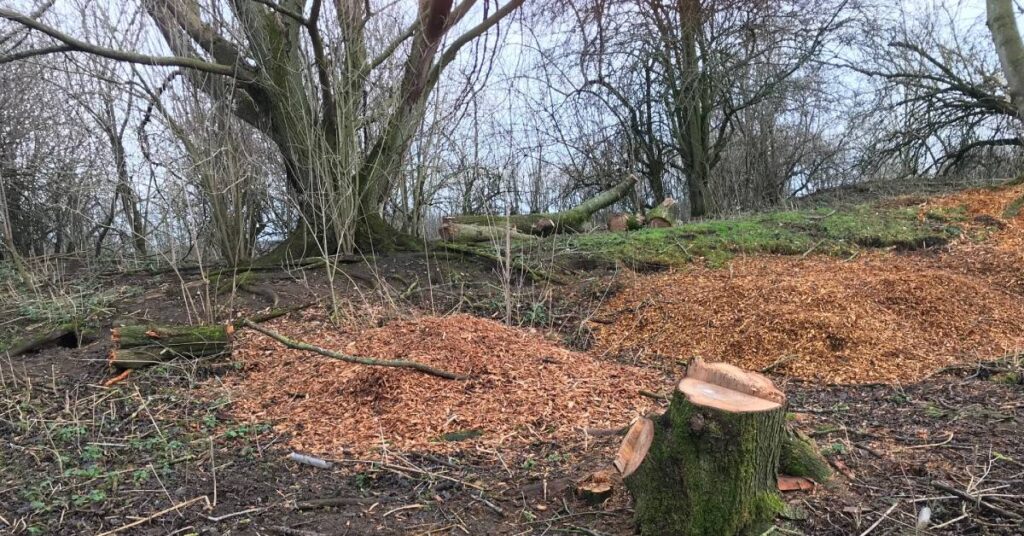
Trees have been cut down on various parts of the site
What do the objectors say?
Objectors are concerned about the extent of clearance works being carried out as part of the Skell Valley Project which they believe has progressed without detailed consultation or proper engagement with local residents, who have been visiting Hell Wath for up to 50 years.
Brian Don of Keep Hell Wath Natural, told the Stray Ferret:
“I’ve been going there for 35 years with my children and grandchildren and we have enjoyed the natural beauty of the place.
“We can understand a degree of cutting back of trees and shrubs, but what we have witnessed is devastation, with trees taken out and wide-scale clearance of hawthorn and blackthorn, followed by work on the pond, which has left an absolute mess.”
Janet Anderson, who has been visiting Hell Wath for most of her life, added:
“The removal of trees and bushes has taken away the habitat of birds and small animals, such as hedgehogs. The bullfinches you used to be able to hear singing here have gone.”
Another local resident, Sandra Miles, who has been visiting Hell Wath for 50 years, said:
“I feel that this is being imposed on us and they don’t want to know what we have to say. It has been causing me sleepless nights.”
What does the Skell Valley Project say?
Nabil Abbas, manager of the Skell Valley Project, said:
“When the nature reserve at Hell Wath was designated almost 30 years ago the grassland areas were very open, but since that time the amount of scrub on the site has increased hugely. These changes are very clear looking at historic aerial photographs of the area.
“The increasing dominance of scrub has already resulted in the loss of areas rich in wild flowers which are an important feature in the designation of the nature reserve, and left unchecked the scrub threatens to overpower those open grassland areas, which provide habitat for many plants, insects and birds.
“The three days of scrub removal which took place in December had a really minimal impact on the overall cover of scrub on the site, so there is still abundant habitat around the nature reserve for bird species which use scrub.
“The scrub removal is being undertaken in line with the nature reserve management plan to conserve the balance of different habitats on the site, maintaining open areas for wild flowers, which are crucial for butterflies, bees and other pollinators, which in turn provide feeding opportunities for birds.
“The silted up wildlife pond, which was first installed in the mid 1990s but now regularly dries out, has been brought back into good condition so that it can provide habitat for amphibians, dragonflies and other insects.
“The habitat restoration has been undertaken in mid-winter when aquatic wildlife is inactive, and outside of the bird breeding season, to minimise any impact on wildlife.
Read more:
What consultation has taken place?
With regard to the consultation process, Mr Abbas said:
“In 2018, in preparation for the successful first stage application to National Lottery Heritage Fund for the Skell Valley Project a range of engagement, consultation and audience development tasks were undertaken by the National Trust and Nidderdale Area of Outstanding Natural Beauty (NAONB) project team.
“This included engagement with individuals from the community as well as local parish councils, Ripon City Council, local landowners, local schools and colleges and the Ripon City plan committee.
“Throughout 2019 and 2020, ahead of the second stage bid, the Skell Valley Project team hosted a number of ‘Community Conversations’ workshops at Ripon Community House and Ripon Library.
“These sessions were designed to invite the local community to agree on a vision for the Skell Valley, discuss ideas for actions or initiatives which will help bring about the shared vision and to work together to develop those ideas and talk through how they compare with the current plan.
“These were widely advertised at key areas around Ripon, on social media and through the local press. including the Stray Ferret, Ripon Gazette, Harrogate Informer and BBC Radio York.
“More specifically at Hell Wath, the team hosted a free activity day to better engage with families as well as a public bioblitz event to record wildlife at the nature reserve.
“Both of these events were well attended. Following the successful stage 2 bid to the NLHF, the Skell Valley Project hosted the official launch celebration at Hell Wath in September 2021 which was open to the local community to come and enjoy the space and find out more about the project.
“Prior to any work taking place a Hell Wath the Skell Valley Project team posts public notices on site, on social media, and our website as well as engaging with the press for the more impactful work to keep the local community informed.
“Given that some people do not have access to social media, the project has also funded a new noticeboard which will be erected at the main site entrance to enable better communication.”
Mr Abbas confirmed that the Skell Valley Project would be happy to attend a public meeting. He said:
No 10: How fake grass and rewilding unleashed Harrogate passions“Should a public meeting be held about the future of Hell Wath we would be happy to attend. The team are always willing to answer any questions or concerns about work carried out as part of the Skell Valley Project.”
In this article, which is part of a series on the 15 stories in the Harrogate district that shaped 2021, we look at how fake grass and rewilding resulted in a major backlash for Harrogate Borough Council (HBC).
It seemed like a simple solution for the council. The trees meant the plants in the beds struggled for light. So why not brighten the town centre up with some of that popular artifical grass?
So on a cloudy morning in early May, residents started to notice a new and very green look for Cambridge Street and Oxford Street. Soon thereafter came a wave of condemnation on social media.
The Stray Ferret broke the news and asked the council’s press office for a reply. Despite hundreds of negative comments online, a council spokesperson insisted the move had received “lots of positive feedback”.
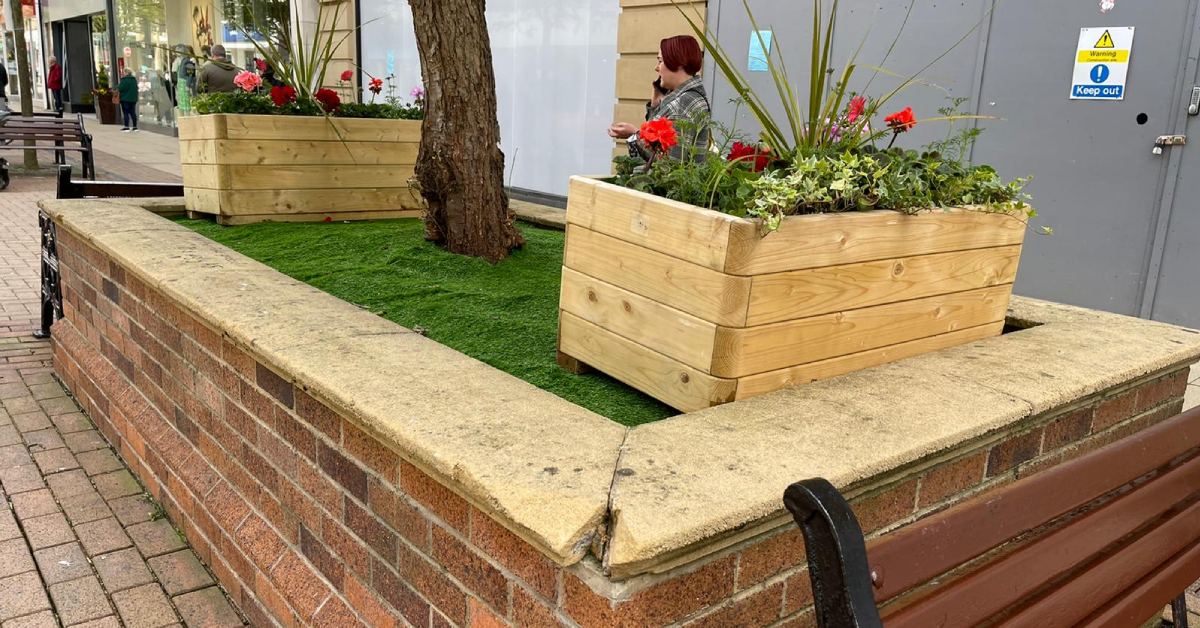
Fake grass and planters.
Pressure continued to mount on the council in the following days. Hundreds called for the removal of the fake grass but one group took matters in their own hands.
The fake grass may have looked green but Extinction Rebellion Harrogate was less than impressed with its environmental credentials so a small team of activists replaced it in one of the beds with shade-loving plants.
Extinction Rebellion later handed the plastic grass back in to the council offices on King’s Road along with annotated extracts from the council’s environmental policies.
The council finally relented, apologised and sent workers to remove the fake grass.

Extinction Rebellion hands the fake grass back.
It may have all been over in little more than two weeks but the fake grass saga saw residents engage with local politics like never before. It was, as Extinction Rebellion put it, a “victory for the people”.
Meanwhile a new debate was growing under our feet. Harrogate Borough Council’s environmental credentials may have come under fire in May but in June the town had a new, new green look.
Swathes of green spaces, including on the Stray, had been left alone by mowers and strimmers so nature can grow free as part of rewilding efforts.

The grass verges are growing in Harrogate.
Rewilding was welcomed by many who saw it as a sign that the council, which manages parks and green spaces in the district, is serious about improving biodiversity.
But others who cherish Harrogate’s long reputation for organised and elegant planting thought it made the town look untidy.
This new move sparked just as much interest as the fake grass saga with each story sparking hundreds of comment and fierce debate on social media.
Both stories revealed that, more than ever, Harrogate’s residents care about the look of our floral spa town.
Ashville College pupils plant hundreds of trees to improve campus biodiversityPupils at Harrogate’s Ashville College have planted hundreds of trees in an effort to boost biodiversity on campus.
In partnership with the Woodlands Trust, pupils under the supervision of the independent school’s grounds team added 420 native British trees to the site.
The trees included a mixture of hazel, blackthorn, crab apple, dog rose and rowan and created a hedge running adjacent to one of its sports pitches and a public footpath.
Annual tree-plantings are among many initiatives led by the College’s dedicated Green Committee, which works hard to encourage pupils to think about how their actions can either harm or benefit the environment.
In the last two weeks of term, the Green Committee also ran a Fairtrade stall in the College’s Pre-Prep, Prep, and Senior Schools, where pupils were the vendors.
Cathy Price, Ashville College Green Committee lead, said:
“The latest round of tree planting and the Fairtrade stall have come at the end of an extremely busy term for Green Committee members.
“Climate change and the environment have been on everyone’s radar, and this is going to continue. By making even small changes to our daily routines, collectively we make a big difference to the environment in which we live, work and go to school.”
Read more:
- Birstwith school appoints new headmaster
- Academy status could lead to investment in Harrogate school, says head
The trees planted are in addition to 500 native trees that were planted last November to enhance existing hedges or establish new ones to the southwest edge of the 64-acre campus.
The Woodland Trust has provided all the trees as part of its Big Climate Fightback campaign, which has so far seen more than 1.8 million trees planted by schools, community groups and businesses around the UK.
As the saplings grow, they will provide a habitat and movement corridors for wildlife and produce pollen, nectar, nuts, fruit and berries for insects, birds and small mammals.