Thank you for your interest in this story
To continue reading this article, sign up today to unlock exclusive content and be part of our community discussions
- Exclusive discounts
- Enjoy commenting on local issues
Already a subscriber? Log in here.
10
Feb 2024
Should we wind the clock back and return the Stray to nature?

Arriving in Harrogate by road for the first time, the Stray makes for a pleasant surprise: a vast expanse of green land cradling the town centre, fringed around the edges by mature trees and, in spring, swathes of crocuses and daffodils.
But it wasn’t always like this, and some believe it shouldn’t be any more – that we should turn the clock back to a time when the Stray was a bit more... wild.
The author of Robinson Crusoe, the 18th-century writer Daniel Defoe, wrote that what is now the Stray was a "most desolate out-of-the-world place", and a century before, a Dr Stanhope – who discovered the chalybeate spring at St John’s Well in 1631 – described it as a “rude barren moor”.
It was a place of “grassland, gorse, marsh, heather and peat”. There might have been the odd boulder and a sparse scattering of trees – birch, hawthorn and rowan, perhaps, with a few bilberry bushes too.
It had areas of standing water, as exist to this day after heavy rain, and was boggy in parts, where springs came to the surface. Large flocks of lapwings — tewits, in Yorkshire dialect — would congregate, and even gave their name to one of the area’s most famous wells.

Lapwings, or tewits, used to flock in great numbers on the Stray, giving one of its most famous wells its name. Photo: Steve Garvie/<a href="https://creativecommons.org/licenses/by-sa/2.0/deed.en">Creative Commons</a>.
If you think all that sounds messy and impractical, you’ll probably want to stick to the lawn-and-crocus look. But if you think it sounds beautifully natural – a healthy hotbed of biodiversity – you might want to take steps to get it back, at least in part.
So should we return our 200 acres – or some of them – to something approximating their original state? Should we rewild the Stray?
Support for rewilding
Shan Oakes is a fan of the idea. She’s a long-standing member of Harrogate and District Green Party, which successfully campaigned for wildflowers to be planted around the edges of the Stray in 2020. It’s something the council has repeated in subsequent years – and intends to continue this year – and has met with a largely positive reaction from the public. She says:
She has an ally in Dr Steve Carver. He is a senior lecturer in geography at the University of Leeds and an expert in the field, co-chairing the rewilding group for the International Union for the Conservation of Nature. He told the Stray Ferret:
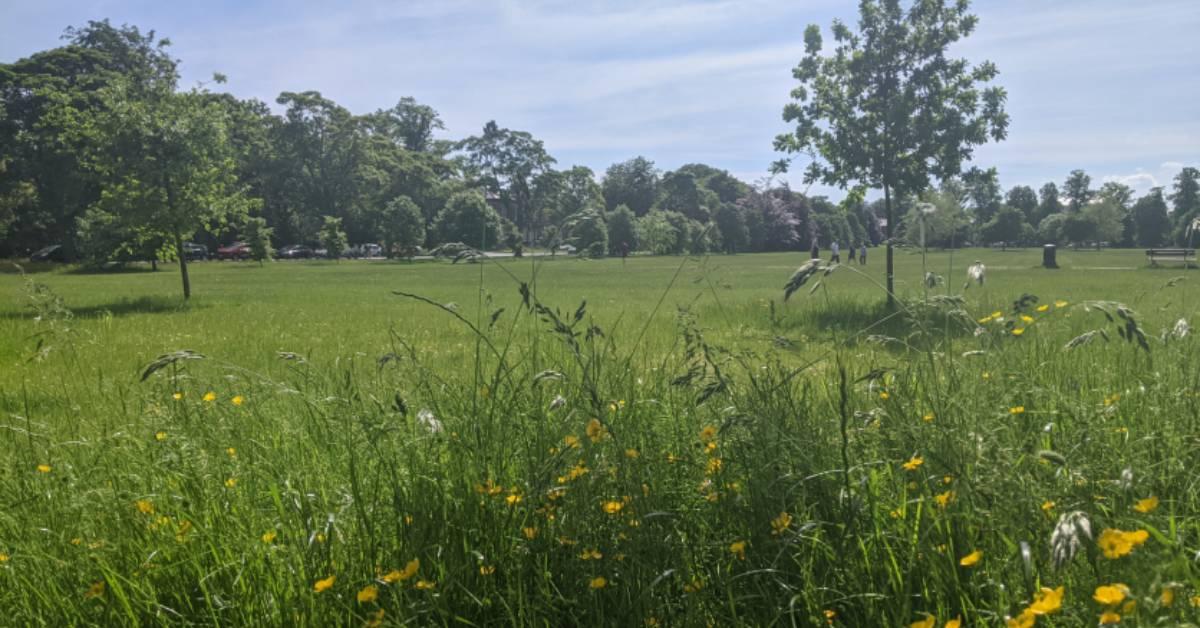
Buttercups in one of the wilded areas around the edge of the Stray.
'The uniqueness of the Stray is worth protecting'
Judy d’Arcy Thompson chairs the Stray Defence Association. Its website refers to the “neat, tidy and immaculate acres” of the Stray, and that’s exactly how she wants it to stay. She is not a fan of the wildflower cultivation, calling its late-summer phase a “bloody mess”.
She has for many years been at the forefront of efforts to preserve the integrity and look of Harrogate’s “green lung”, opposing any novel uses or applications for the land – and she is distinctly sceptical of the suggestion that the Stray could benefit from a more natural approach to land management for the sake of biodiversity.
She says:
She adds:
Dr Carver readily acknowledges that renaturalising all 200 acres of the Stray would not necessarily be desirable, but thinks a more nuanced strategy could work. He says:
He cautions that the results wouldn’t be instant, and the process would need to be helped along through “assisted regeneration”, where seedlings of appropriate species are planted in likely spots. He says:

A track bends through the rewilded landscape of Grote Netewoud in Belgium (also shown in main image) – could parts of the Stray look like this? Photo: Wim Dirckx/Natuurpunt.
Wildlife might like it, but Harrogate in Bloom’s Pam Grant wouldn’t. As far as she’s concerned, there’s nothing wrong with the Stray as it is. She says:
Neat v messy
And therein lies the yawning gulf between the two sides: a difference both in aesthetic values – one side likes neatness and the other prefers nature’s messiness – and also in the two sides’ approaches to change: one side wants to preserve the status quo, while the other prefers a more progressive approach.
But at the heart of the matter is the two sides’ respective attitudes to the environment, which for Dr Carver and Ms Oakes is of paramount importance. A glance at the data shows why.
In its State of Nature 2023 report, the World Land Trust called the UK “one of the most nature-depleted countries on Earth”. Among G7 countries, it’s the worst by a huge margin.
Since 1970, the distribution in England of pollinators has declined by 22%. Among species found on land and in freshwater, there has been an average 32% decline, and the distribution of flowering plants has dropped by a staggering 64%.
More than one in eight (13%) species in England is threatened with extinction. Numbers of lapwings – that formerly iconic Stray bird – have plummeted by 50% over the last 40 years.
Dr Carver says a more naturalised Stray could help the situation is a modest way, by providing more habitat for a variety of species currently absent, and by putting in place a wildlife corridor stretching almost unbroken from Beaver Dyke, west of Harrogate, right through to Knaresborough.
But Ms d’Arcy Thompson says the Stray already does that job:
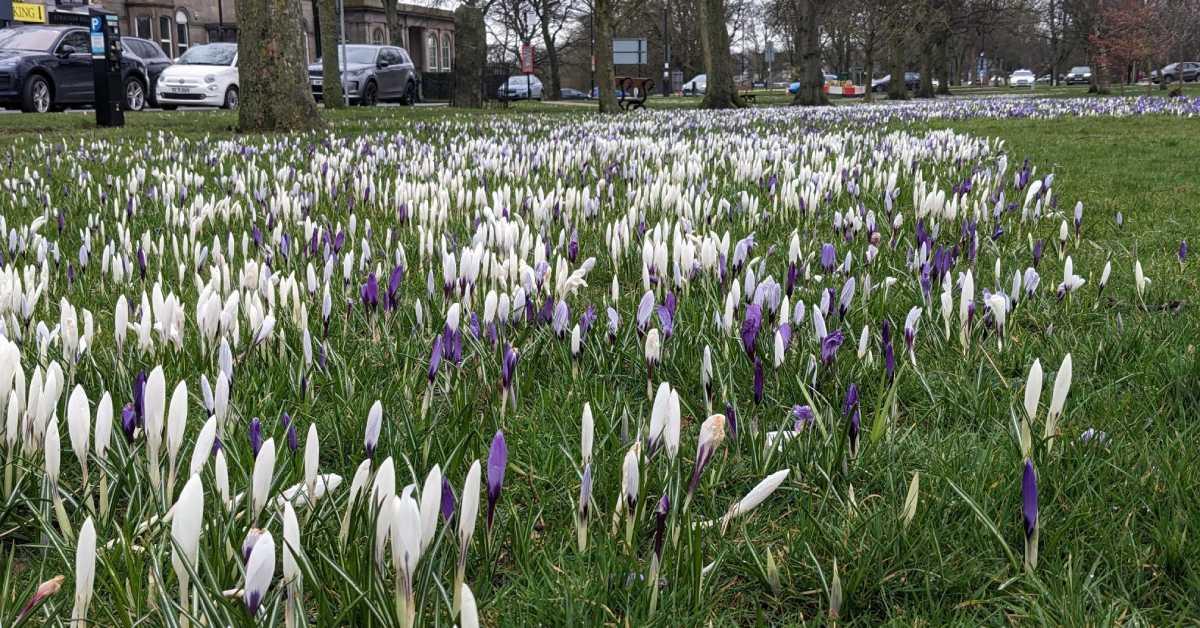
The traditionalists' preference: crocuses on West Park Stray.
Another of her objections concerns public safety. She said:
So ponds are out of the question, then?
'We always keep this under review'
In the middle of the discussion – between the 'blue' corner and 'green' corner – stands North Yorkshire Council as arbiter, deciding how the Stray is managed, from what trees are planted to when the grass is mown.
It has planted two "pocket woods" of native species in recent years, the most recent just this winter, and has said it will continue to keep the wildflowers strips, but otherwise it appears the status quo is winning. The Stray Ferret asked the council if it intended to introduce any more changes to the upkeep of the Stray, especially any that might affect biodiversity.
Jonathan Clubb, the council's head of parks and grounds, told us:
What “good practice” looks like is clearly debatable, but in the meantime, Shan Oakes just hopes people will keep an open mind and think about the possibilities. She says:
0