Thank you for your interest in this story
To continue reading this article, sign up today to unlock exclusive content and be part of our community discussions
- Exclusive discounts
- Enjoy commenting on local issues
Already a subscriber? Log in here.
08
Mar 2024
Review: Macbeth reimagined at Leeds Playhouse
 Lauren Crisp is a book editor, writer and keen follower of arts and culture. Born and raised in Harrogate, Lauren recently moved back to North Yorkshire after a stint in London, where she regularly reviewed theatre – everything from big West End shows to small fringe productions. She is now eager to explore the culture on offer in and around her home town. You can contact Lauren on laurencrispwriter@gmail.com.
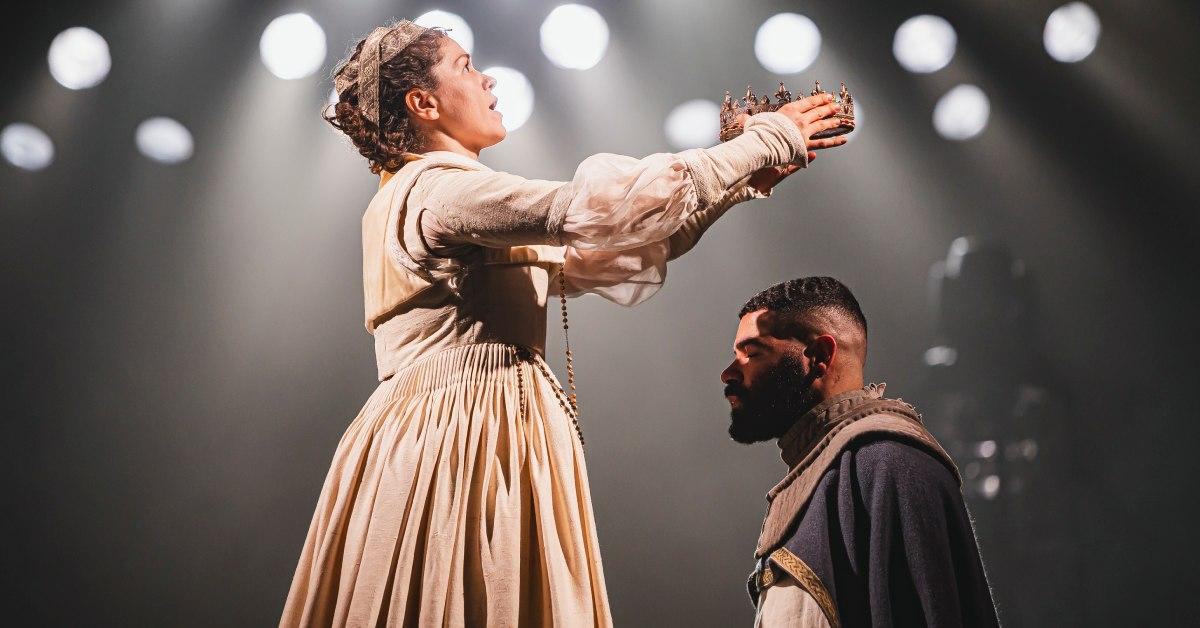
Following a previous run in 2022, Leeds Playhouse’s deputy artistic director Amy Leach returns with her dark and edgy directorial vision of the Bard’s Scottish play.
As the performance opens, the stage is stark; an enormous wooden drawbridge stands in the centre, surrounded by a forest of scaffolding towers, each one throwing a searchlight into the air. Hard-edged, cold and inhospitable, the scene is set for the treachery to come.
This central drawbridge rises and descends as the action unfolds, revealing a myriad of imaginary settings, from foggy, desolate moorland, to the interior, intimate spaces of the story, charged with secrecy, whispers and lies. The set, designed by Hayley Grindle, is distinctive and, for me, the play’s crux. Intense, dramatic sound and lighting heighten the atmosphere.
Striking, too, is the cast and creative team’s accessible vision. With its diverse company, the production is created to be accessible to all, with a dedication to audio, amplification and the integration of sign language.
Deaf actor Adam Bassett’s Macduff’s words are relayed out loud by other characters; at times, the transition between language styles is a little tricky to follow, yet more often the approach makes the dialogue even more impactful.
The cast, with their familiar regional accents and their own twists on the delivery of the Bard’s words, make this relatively straightforward to grasp (good news for the Shakespeare-shy among us). Macbeth, played by Ash Hunter of West End Hamilton fame, delivers a convincing portrayal of the eponymous lead.
Yet, the interpretation and addition of certain scenes featuring the male characters are overplayed. I found the joviality and machismo a little wearing, with an excess of fist-pumping and some exaggerated drunken behaviour. An early fight scene is less rousing than it is jarring, oddly choreographed into something that came across as a Game-of-Thrones-style dance battle, setting a strange tone.
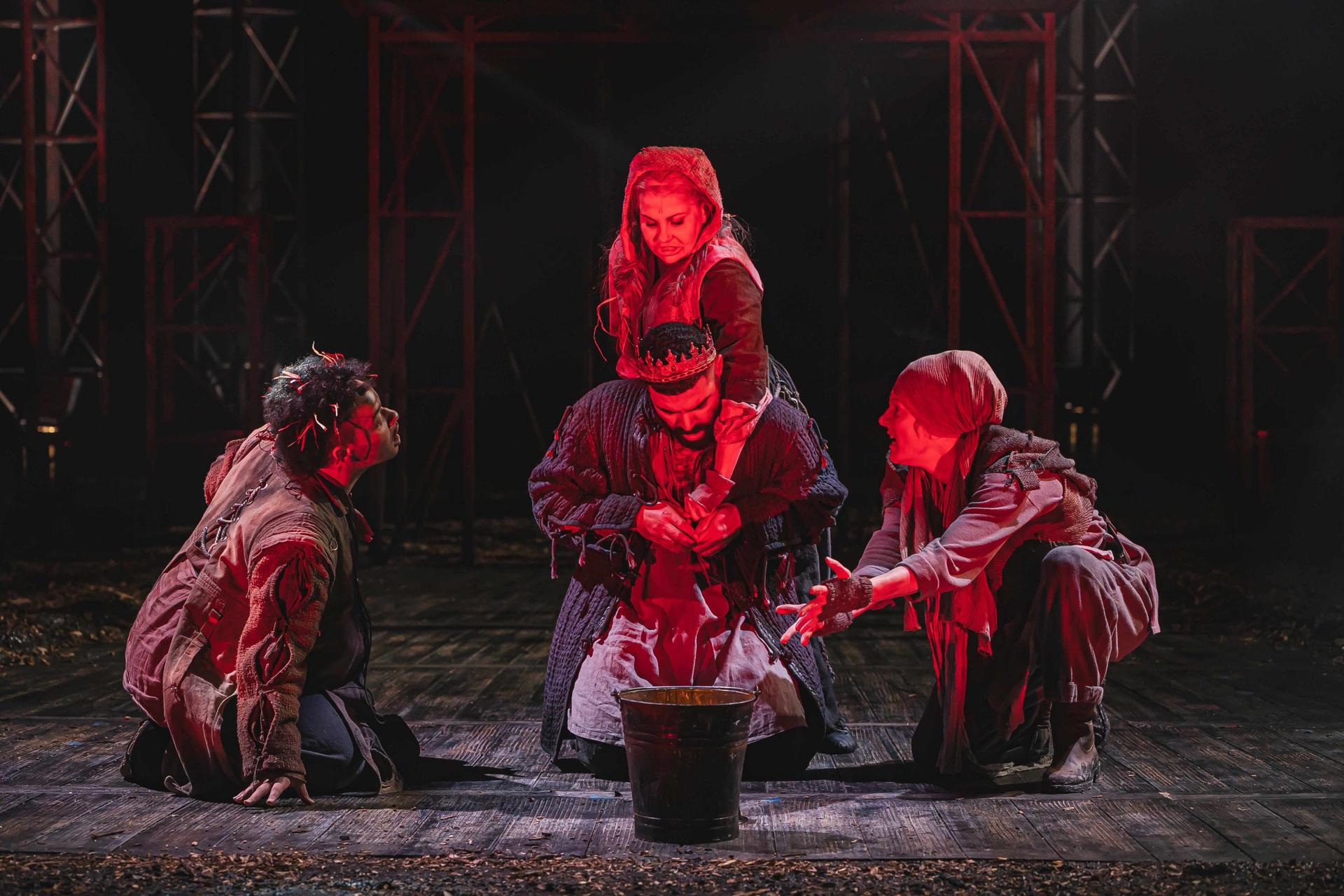
Elkanah Wilder, Karina Jones and Charlotte Arrowsmith (witches) with Ash Hunter (Macbeth). Pic Kirsten McTernan
Another effect of this over-egged manhood is to detract some attention from the fundamental female element of this play. Here, Lady Macbeth comes second to her husband, and the witches, so often the most enthralling, outlandish characters, do not garner the attention they deserve.
Characterisation, as a whole, is not mined as deeply as I would like or expect. For a play that, once stripped back, is so very human at its core, we lose a sense of humanity amid all the action. This production takes a great deal on, but it might be a case of ‘less is more’.
There is, though, much to be valued in the addition of a new, accessible edition of a play seen by centuries’-worth of theatregoers, but never seen like this; one that seeks to appeal to audiences in novel ways, and to draw new crowds.
Macbeth is at Leeds Playhouse until Saturday 23 March.
Read more:
- Review: Emma Rice’s Blue Beard at York Theatre Royal is must-see
- Review: Oh What a Lovely War brings songs and satire to Harrogate Theatre
- What does council’s culture review mean for Harrogate Theatre?
0