 The Stray Gardener is written by Rudding Park’s Kitchen Gardener, Fiona Slight. Fiona has worked in horticulture for more than 30 years in the UK and abroad, and specialises in growing fruit and vegetables for fine dining. This month, Fiona’s been dead-heading her plants; she also shares her top tips for what we should be doing in our gardens this July.
I love the therapeutic effect of dead-heading and would happily spend hours doing it if I could. I especially love dead-heading sweet peas (Lathyrus odoratus), which were one of the first flowers I dead-headed as a child with my great aunt hovering over me, concerned that I wouldn’t do it correctly. Those plants were her pride and joy!
But, is it really worth while spending all that time dead-heading the plants in your garden, and does it need to be done for every plant?
In a nutshell, dead-heading is removing flowers from plants when they are fading or dead. There are a few reasons why this is worthwhile:
- It keeps plants looking good and can encourage more flowers. Sweet peas are a great example of this as they soon set seed and die if you don’t take the old flowers off.
- Dead-heading regularly helps to encourage stronger growth. Once flowers are pollinated, seeds start to form, taking the energy away from more flowers being produced.
- It also helps to avoid petals flying all over the place, making it easier to keep things tidy.
- Dead-heading can also avoid excessive seeding with plants such as lady’s mantle (Alchemilla mollis), sweet cicely (Myrrhis odorata) and angelica, which are all likely candidates for having their flowers removed before seed is set. Unless, of course, you want the extra plants!
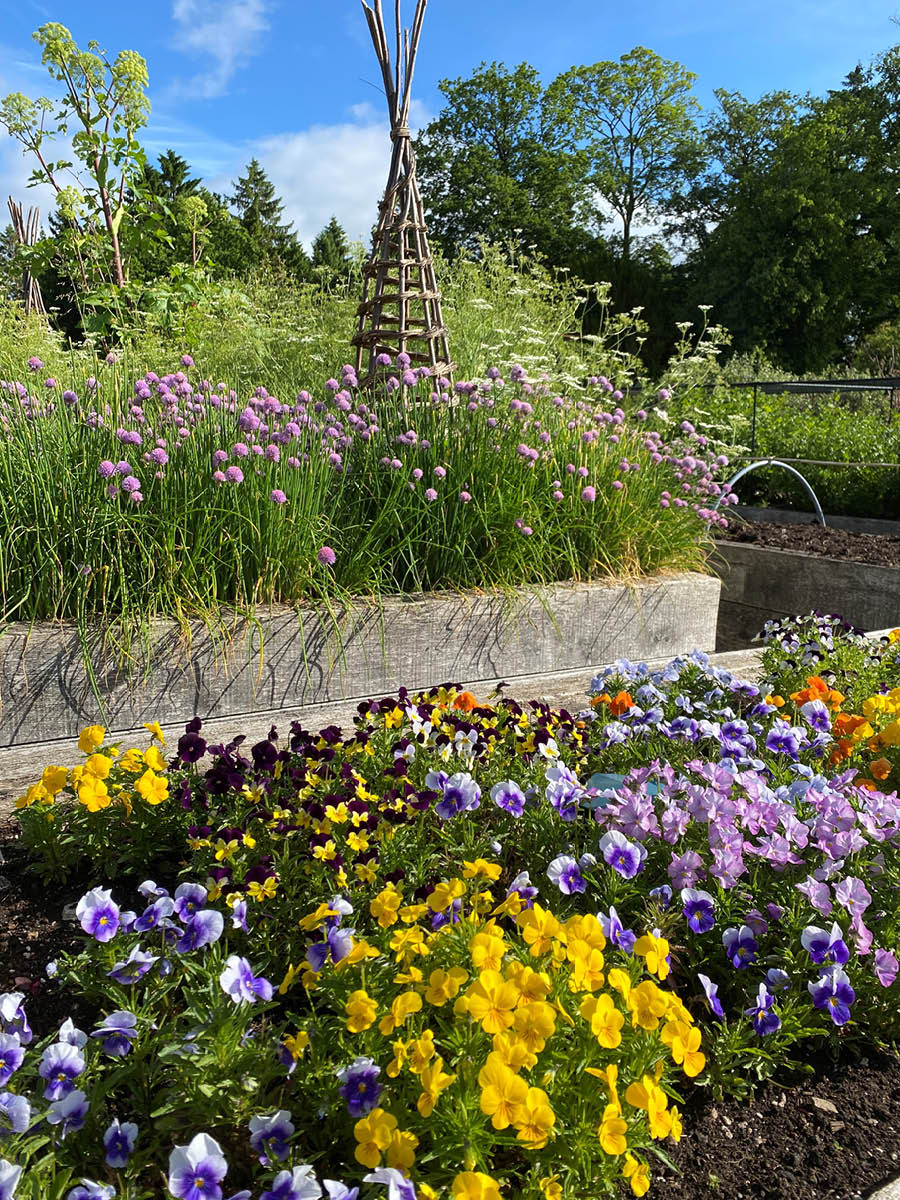
Violas and chives
There are many plants that are worth dead-heading, with bedding plants in containers and hanging baskets being the first contenders. Pelargoniums, petunias, pansies, polyanthus, violas and cosmos all benefit from dead-heading. Shrub wise, if you have time, it is well worth dead-heading rhododendrons, azaleas and camellias. Bulbs such as narcissus (daffodils) and tulips also benefit from dead-heading as the plant then directs any energy made back into the main bulb for flowering next year.
Fading or dead flowers can be removed quickly by hand and most will snap off cleanly when gently bent back. But if the flower stalks are tough or stringy, use scissors or secateurs to ensure a clean cut and to avoid damaging any developing buds underneath.
Plants such as dahlias, calendulas, marigolds and sweet peas are generally better cut with secateurs. Fading rose flowers can be snapped off just below the head rather down to the first set of leaves; this can actually help produce more flower buds more quickly on repeat flowering cultivars.
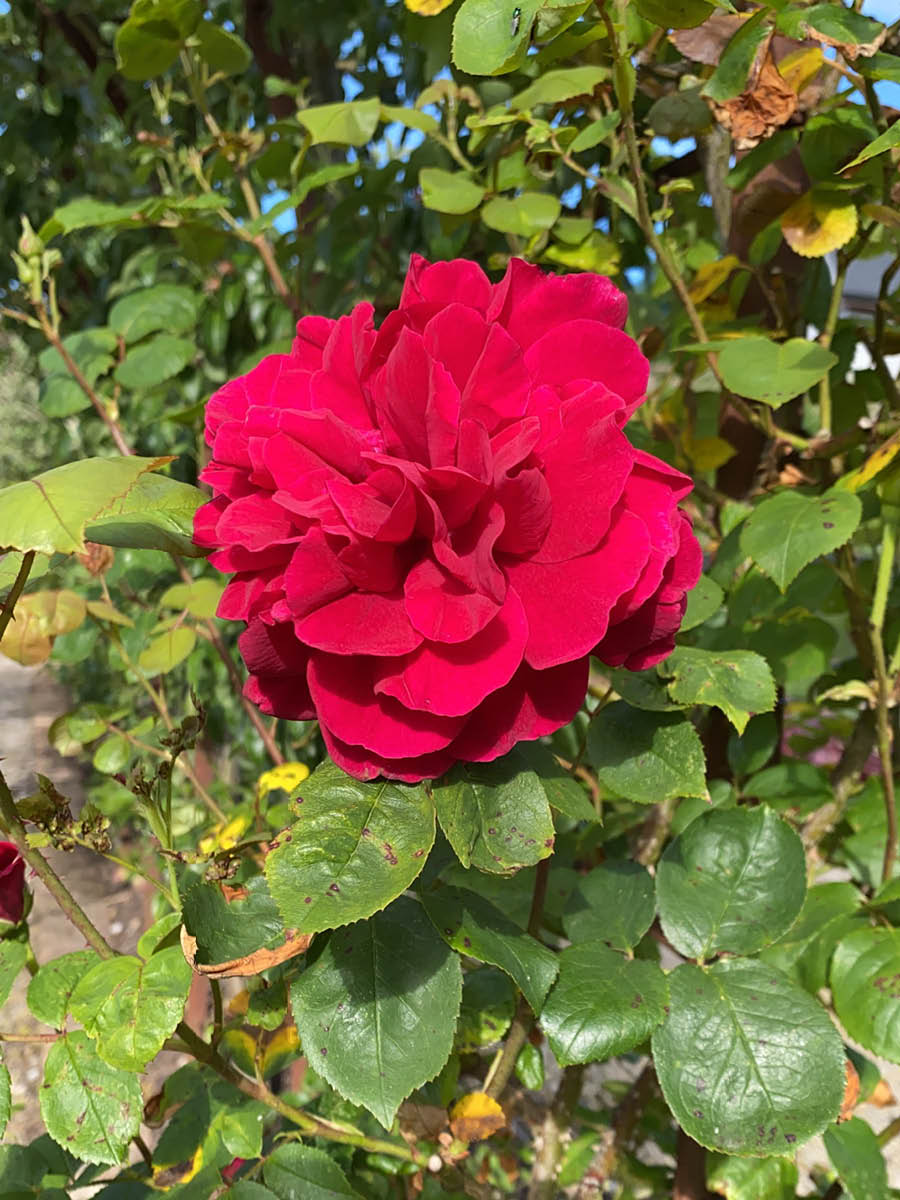
‘Tess of the D’urbervilles’ rose
But before you march out into the garden brandishing your secateurs, you don’t have to dead-head everything. Plants such as fuchsia, bedding lobelia and salvias will either dead-head themselves or don’t tend to produce a lot of seed so will keep repeat flowering. It’s also worthwhile finding out which flowers are good for wildlife. If you leave sunflower heads, the seeds will encourage birds into your garden. There are some cultivars of roses that produce beautiful hips and so are worth keeping for interest through the winter. Lastly, hydrangea flowers are actually best left until spring to protect the developing bud underneath.
If you have never dead-headed before, give it a go and hopefully you’ll find it as therapeutic as I do. Happy snipping!
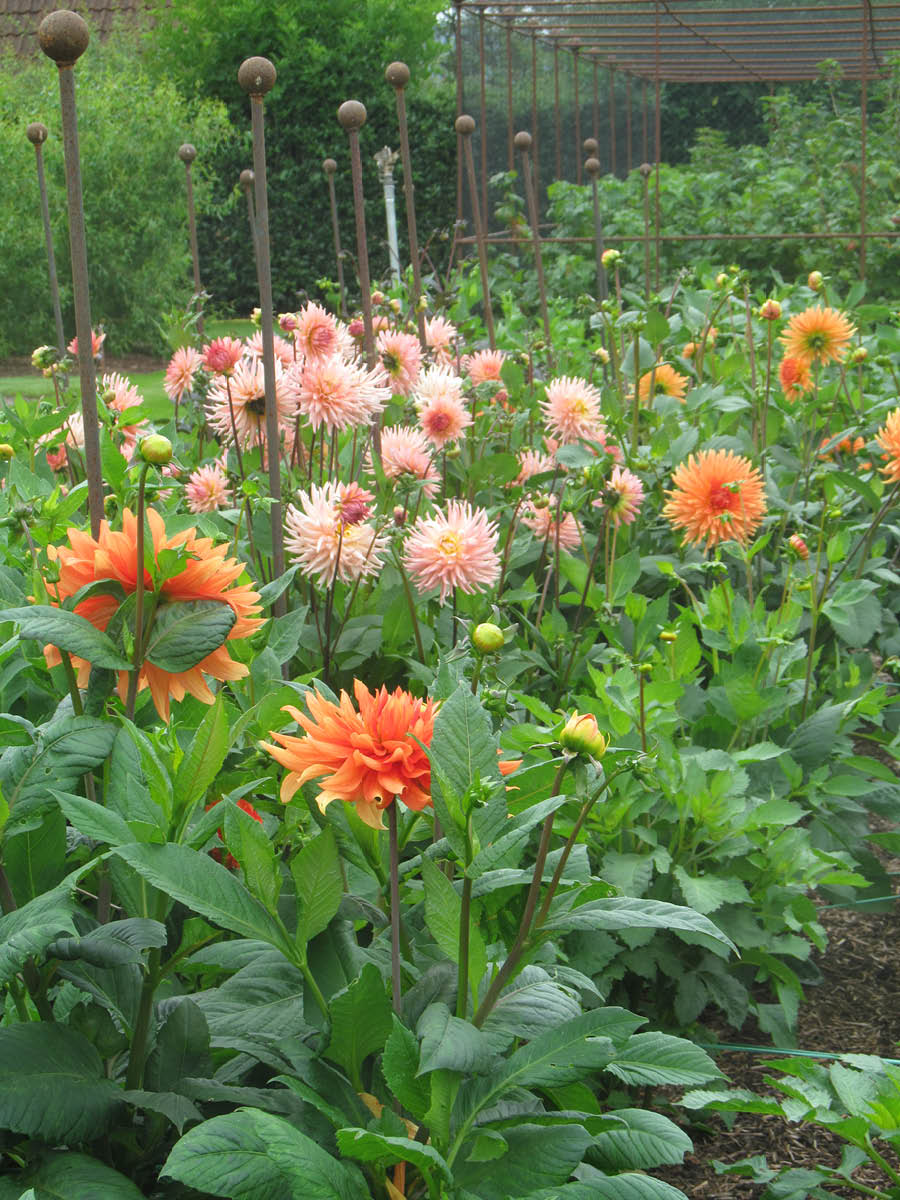
Dahlias
Five Top Tips for July
- Dead-head fading and dead flowers to keep your containers and hanging baskets looking good.
- Take the side shoots off and tie in your cordon tomatoes to keep them tidy and to ensure the energy goes into flower and fruit formation.
- Liquid feed container plants at least once a week to keep them growing and flowering well.
- Sow biennial plants such as sweet william, foxgloves, honesty and forget-me-nots now for flowering next year.
- Summer prune wisteria at the end of the month and into August. Prune back the young whippy growths to five or six buds to help allow better flower bud formation for next year.
If you want to hear more about the Rudding Park Kitchen Garden, I recommend subscribing to the Rudding Park Podcast. It provides a fascinating and entertaining insight into stories from Rudding Park and I recently joined host Peter Banks for whether the chat focuses on gardens, golf and gin – a great combination!
Enjoy!
Read More:
The Stray Gardener: Spring Stirrings
The Stray Gardener is written by Rudding Park’s Kitchen Gardener, Fiona Slight.
Fiona has worked in horticulture for over 30 years in the UK and abroad, and specialises in growing fruit and vegetables for fine dining.
We’ve made it! March is when things really start to spring in to action in the garden. The bleak winter is over and with lighter days plants start to come to life.
Spring flowering plants are especially important as a little more warmth in the air means honey bees, bumble bees and other pollinating insects start to get going and they need the early flowers to start their amazing lifecycles. Not only that, they lift our spirits and send a message letting us know that good weather is on the way and things can only get better. I have included a few of the plants that really lift my spirits and make me feel good as I work in the garden at this time.
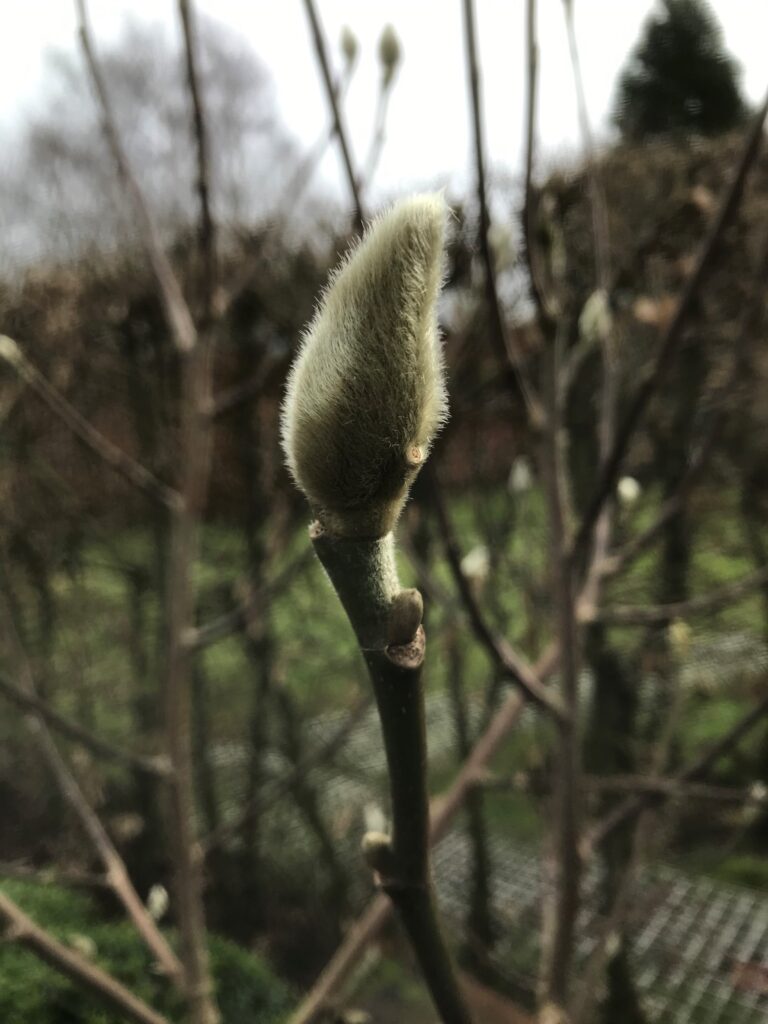
A magnolia bud
Flowering shrub wise, my absolute favourite are Magnolias. They start tempting you with the wonderful show that is going to come at the end of March and in to April with their beautiful velvety furry buds that gradually get larger and swell before the white, pink, cream or purple petals finally burst forth. My favourites are good, old fashioned M. stellata and M. loebneri ‘Leonard Messel’ which are perfect for a small garden, and M. soulangeana ‘Black Tulip’ which has wonderfully dark purple flowers and could still be grown in a smaller sized garden, eventually growing to around eight metres in time.
Looking closer to the ground, you can’t avoid the wonderful creamy/white flowers of the Primrose (Primula vulgaris), my favourite flower of all time and a real magnet for pollinating insects. You need to get down on your knees and up close with this beauty as it has the most beautiful scent and should not be missed when in full flower. Plus, even better, the flowers are edible and can be used for decoration on cakes and even as a botanical in gin. What’s not to love about that!
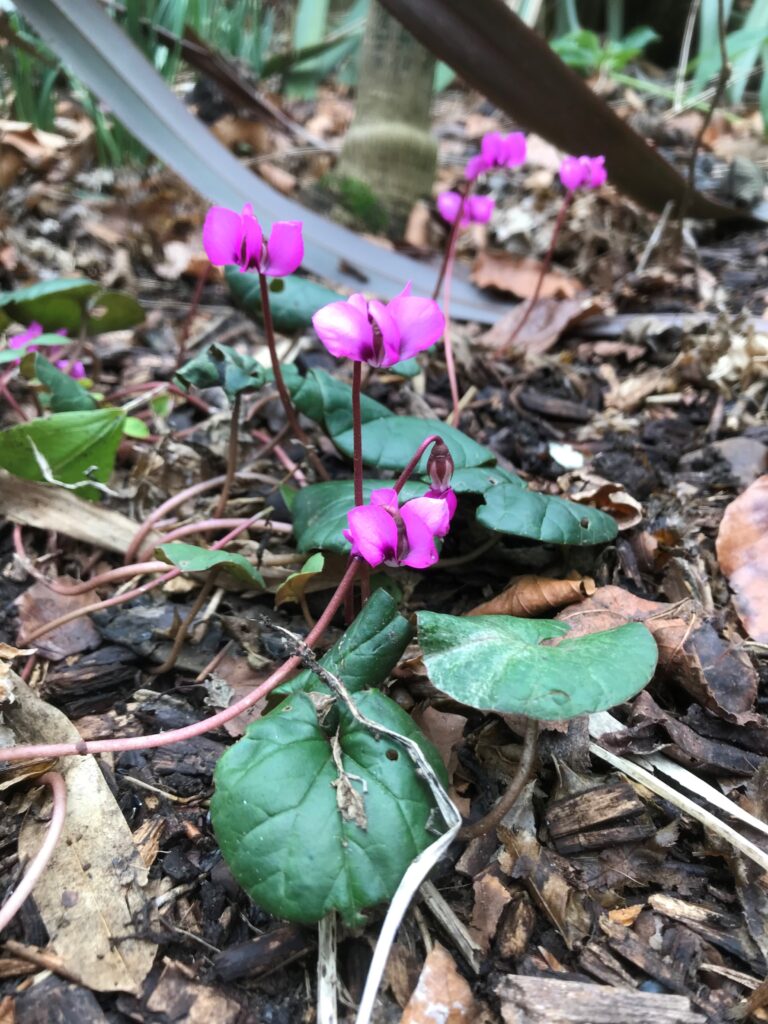
Cyclamen hederifolium
However, even before the Primulas gets going, Winter Aconites (Eranthis hyemallis) hold up their wonderful yellow heads, and not long after come the Cyclamen with their fantastic white, pink or purple flowers, followed by the many wonderful different types and colours of Helleborus. H. argutifolius is a particularly hardy and lovely choice with pale green/cream flowers, with the many different types of orientalis also making an impact when not much else is around.
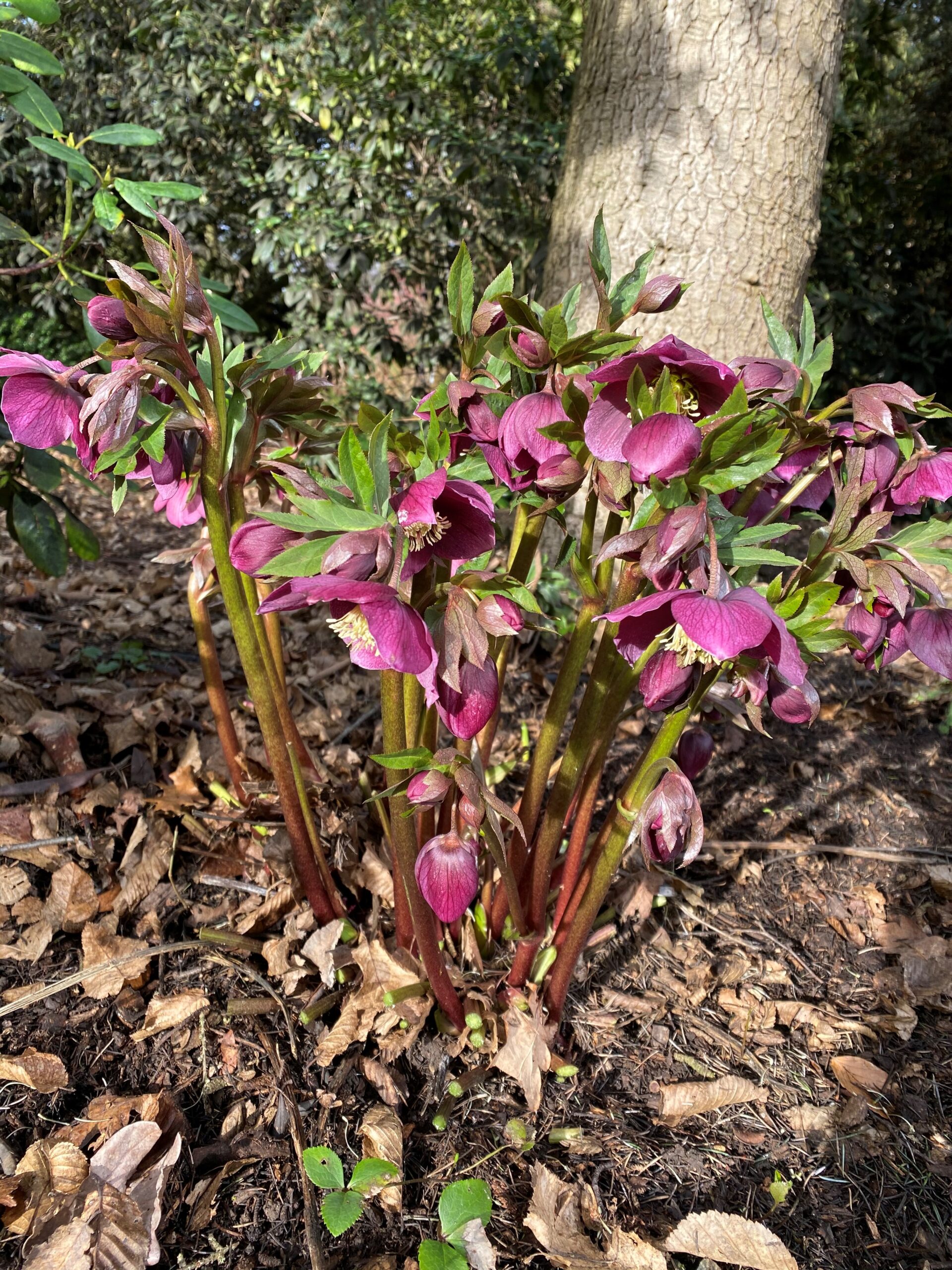
Helleborus orientalis
It doesn’t always have to be flowers that lift our spirits. In the vegetable garden, garlic plants are starting to produce the first of their leaves in preparation for their tasty cloves to develop later in the year. Purple sprouting broccoli start to produce the first of their wonderfully tender and sweet florets, and they don’t just produce one crop, oh no – they are cut and come again and will produce many florets over a few weeks in the spring.
March is a perfect time to get planting, so what’s stopping you? It’s a great way to see the flowers, ensuring you know you have chosen the colour and the type of plant you will really appreciate and love for years to come. I know I do!
Happy planting!
Read More:
The Stray Gardener: mulch, mulch, mulch
The Stray Gardener is written by Rudding Park’s Kitchen Gardener, Fiona Slight.
Fiona has worked in horticulture for over 30 years in the UK and abroad, and specialises in growing fruit and vegetables for fine dining.
Mulches are a loose covering of organic matter over the surface of the soil that can be used on garden borders, vegetable beds, underneath trees and shrubs and on containers. If there is one thing you do this spring, get mulching!
February and March are the perfect months for mulching your garden, “but why mulch?” I hear you say. Well, for lots of reasons, including; reducing water loss in hot weather, suppressing weeds, making your beds, borders and pots look neat and tidy, reduce time spent weeding, allow rain to penetrate the soil more easily, avoiding run off and puddling. Mulches break down gradually into the soil and help improve its structure and fertility.
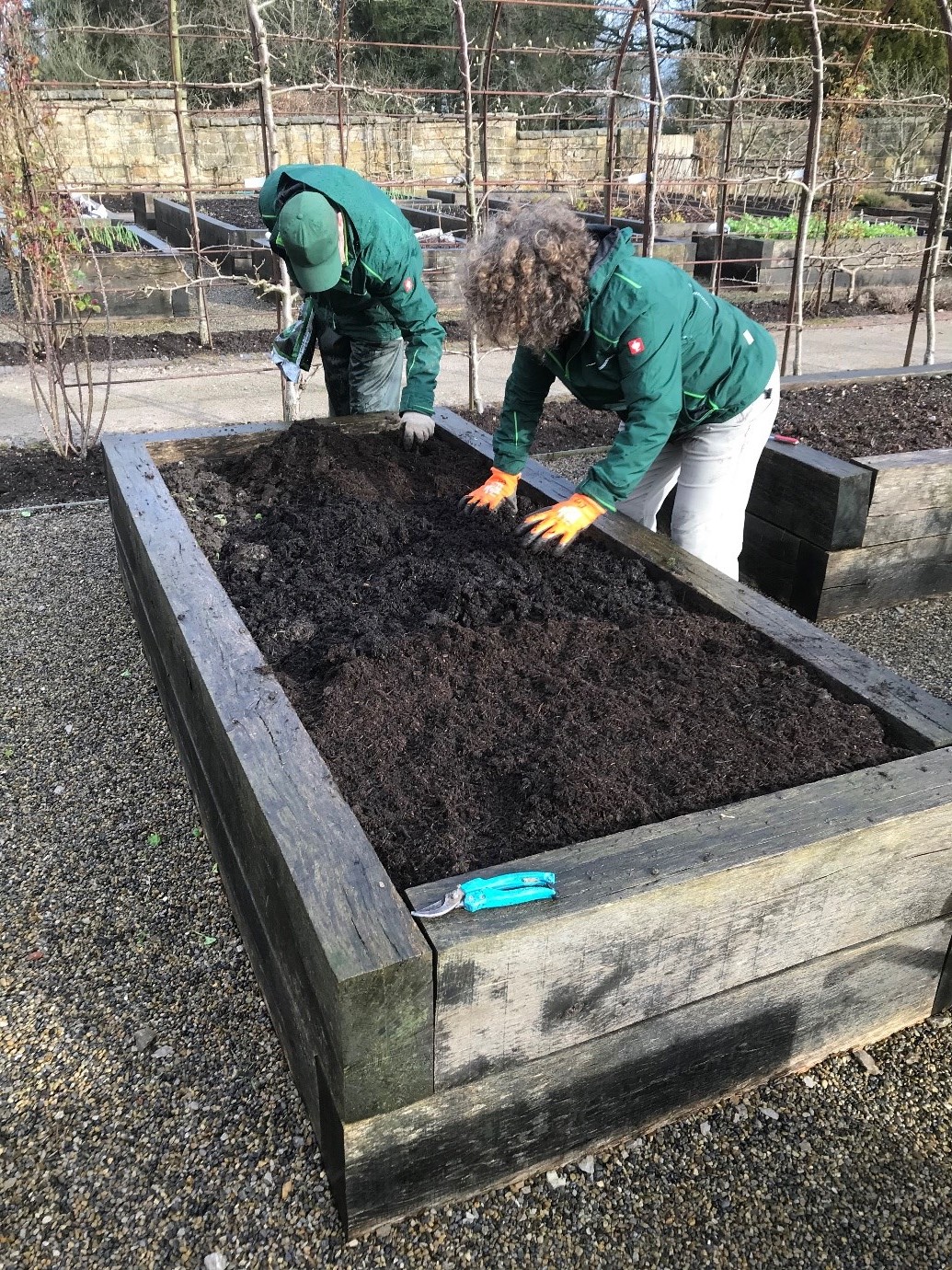
Mulching Veg Beds
The mulches I prefer to use are:
Garden compost, everyone should have a compost bin or three! Made well, this is the nectar of the gods for plants and is well worth making and is not difficult.
Wood chippings, these are much better used once rotted down, especially useful under trees and on shrub borders, it is also useful for paths in a woodland setting. I even use them on the paths around my vegetable beds at home to suppress weeds and to encourage more beneficial insects and wildlife into the garden. Most local tree surgeons are happy to supply wood chip.
Bark chippings, are a good option and can be sourced at your local garden centre or online, works very similarly to wood chippings but does tend to have a much nicer finish and aroma, well worth using on the tops of pots to give a more natural finish.
Leaf mould, another wonderful home-made product, and even with an estate covered in trees here at Rudding Park, and a massive team effort in autumn to collect them, there is never enough! Teeming with microorganisms, it is hugely beneficial to the soil. Plus, if you make your own, there are no air miles and no carbon footprint!
Well-rotted manures as long as they have been allowed to rot down properly most animal manures will work really well, but my personal favourite is horse manure.
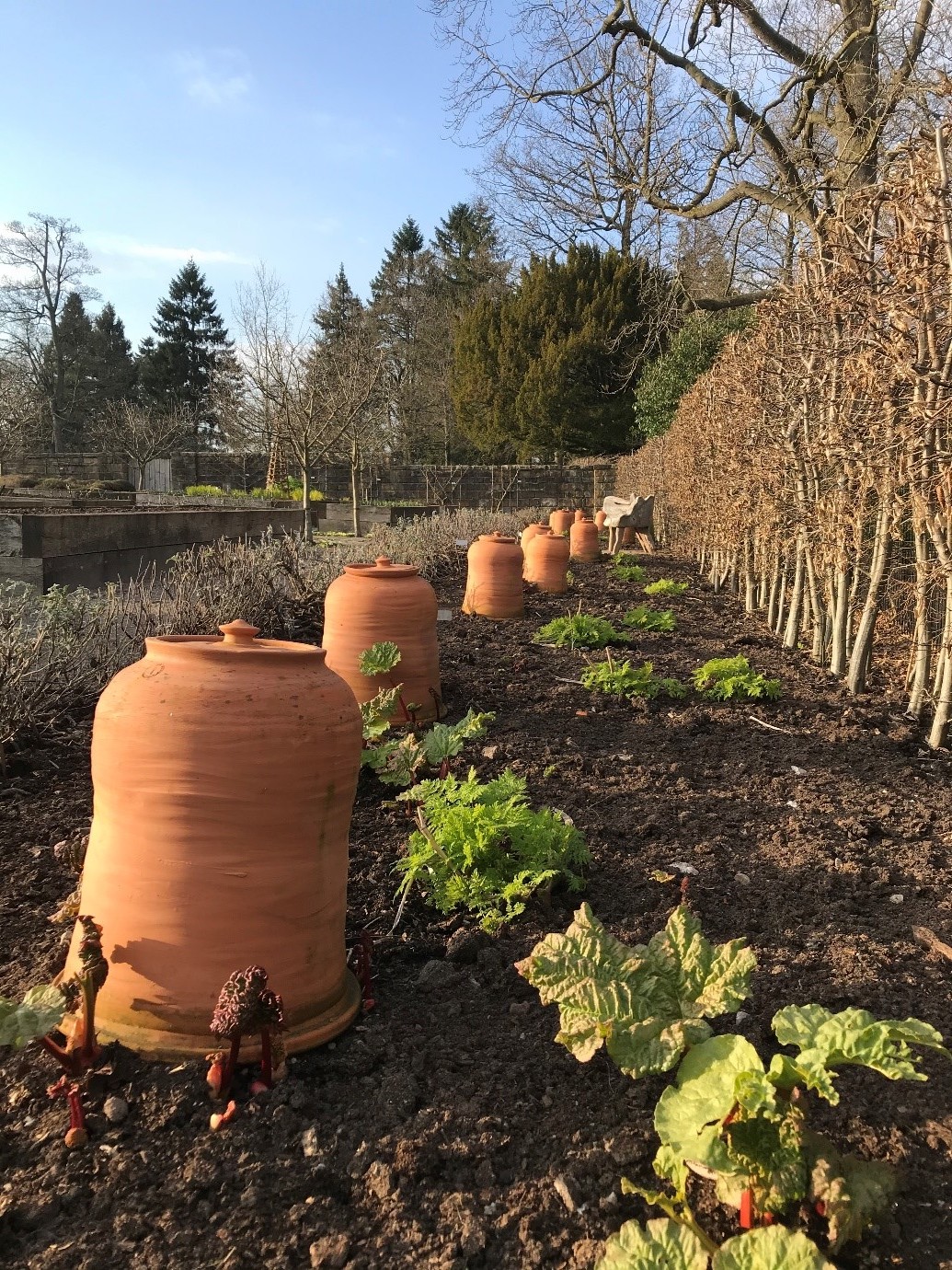
Rhubarb bed mulched with well-rotted horse manure
Mulch is best applied to at least 7.5cm or 3inches thick in spring from February onwards before weeds start to grow and herbaceous plants are still dormant. It’s a good idea to get it on before your spring flowering bulbs get too big and could be damaged whilst putting the mulch on. Be careful around low growing herbaceous plants, try not to smother them. Don’t spread it right up to the stems of trees and shrubs, leave a little space around the stem to allow air in and to avoid the chances of rotting off.
Don’t be stingy, it’s really important to get a good, thick layer down, this will help suppress annual weeds and insulate the soil better reducing the amount of water evaporating, and the amount of time you may have to water in the summer.
Try and avoid fresh material, to be at its most useful it needs time to rot down. Microorganisms in the soil can be encouraged to grow and use up reserves of Nitrogen, leaving less available for plant growth. If you are fortunate enough to have fresh material, store it somewhere for a few weeks to break down before adding.
Happy Mulching!
Read More:
- The Stray Gardener: On your marks, get set, grow!
- The Stray Gardener: Time for evergreens to shine
The Stray Garden: Planting tulips for spring colour pops
The Stray Garden is written by Rudding Park‘s Kitchen Gardener, Fiona Slight.
Fiona has worked in horticulture for over 30 years in the UK and abroad, and specialises in growing fruit and vegetables for fine dining.
If the winter days and this current strange situation is starting to get you down, it’s the perfect time of year to plant some bulbs. Tulips, in particular are perfect to plant now, and will fill you with the anticipation of the wonderful colour to come in the spring to help cheer you up.
There are hundreds of cultivars to choose from, and these are divided up into 15 different groups which include Lily flowered group, Triumph group, Fringed group, Parrot group and Darwin hybrid group. At Rudding Park, we tend to use a mixture of these in containers to produce a wonderful mixture of colours and textures.
Tulips are perfect for containers and indeed most bedding types flower at their best the first year they are planted. The varieties we are using this year are: ‘Paul Scherer’, ‘Slawa’, ‘Queen of the Night’, ‘Recreado’, ‘Princess Irene’ and ‘Purple Prince’. A mixture of orange and purple shades that really pull a punch when they are in full flower.
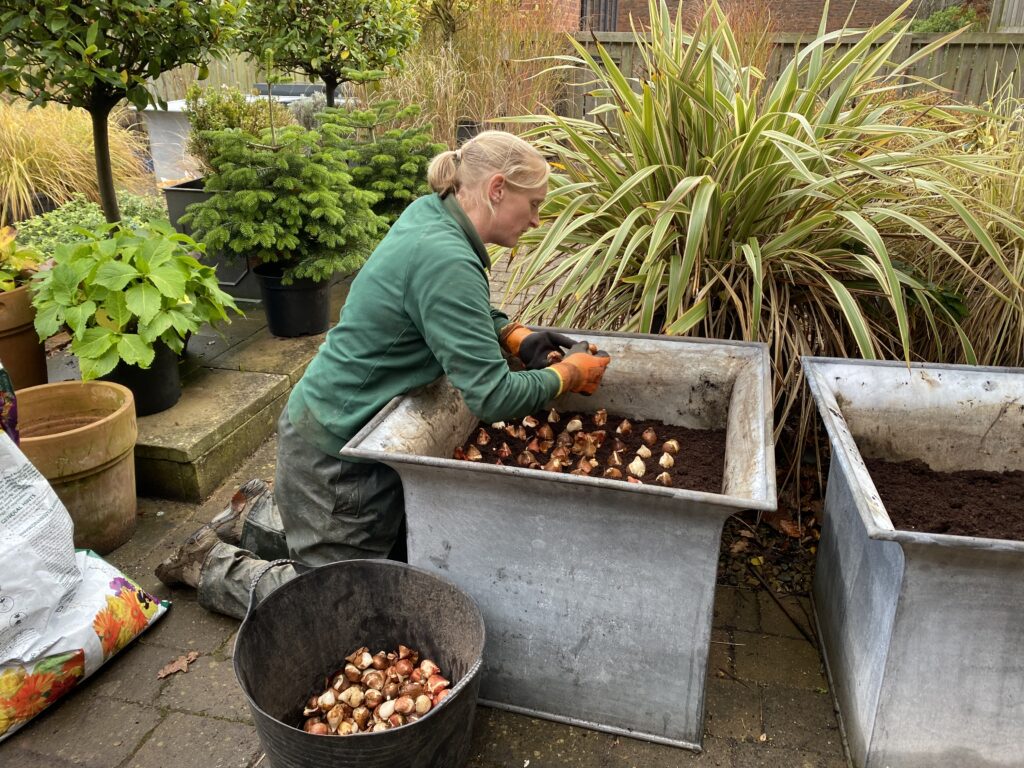
Fiona plants the tulip bulbs
We use large, deep pots for our displays, planting the bulbs in layers between 20cm and 8 cm deep. The deeper you plant the better the flower, this is especially important when you plant in the ground. You can plant the bulbs closer together in containers as the bulbs will not be staying there permanently and it does add to the overall impact. Just make sure they are at least a ‘fingers width’ apart to avoid them touching and the possibility of passing on a fungal disease.
Any well-drained multipurpose compost will work well, but make sure you add drainage to the base such as crocks or gravel. This will ensure the bulbs don’t sit in water and potentially rot off.
After that, it’s simply a case of finding a sheltered, sunny position to locate your pot. Of course, you could store the pot until you are ready to place it into its final position or you could just place it where you want it to flower and enjoy watching them develop over the winter and early spring. Don’t forget to check the pots for water as they can dry out very easily, especially if we get a dry spring.
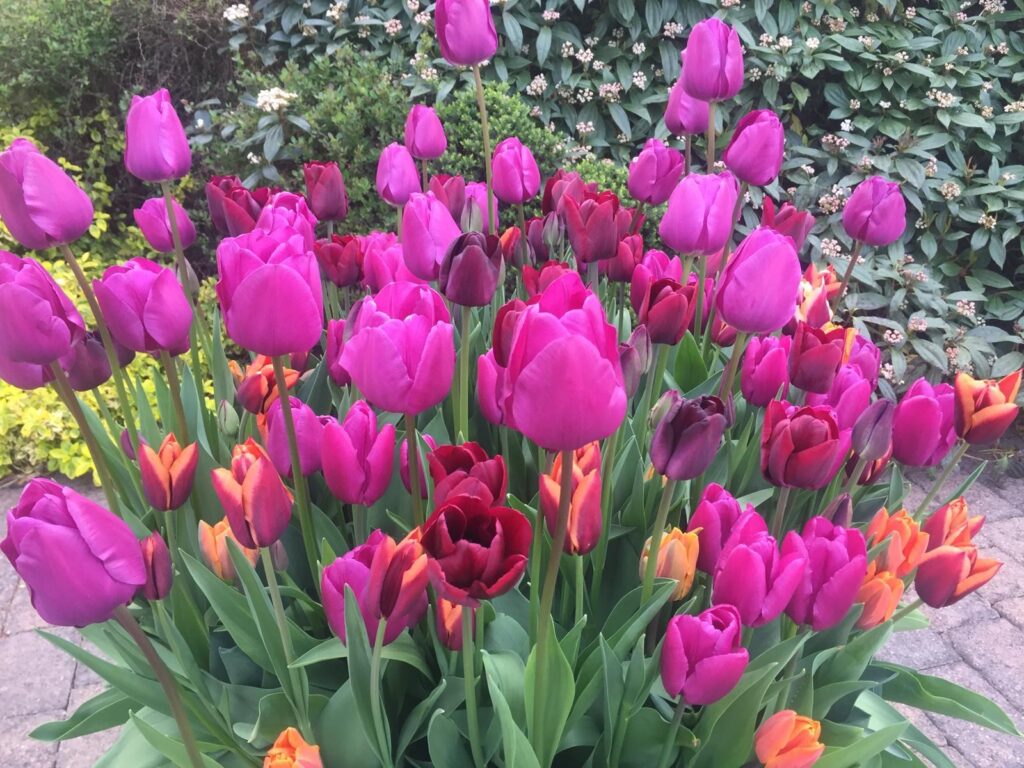
The tulips at Rudding Park
Top tip: it is possible to re-plant the bulbs once they have finished flowering, but make sure you dead head the flower as soon as it has finished flowering and re-plant it in its new position straight away. Don’t forget grit for drainage if needed and a little general fertiliser in the planting hole just to get them going. Word of warning, some cultivars will re-flower better than others!
So, to tempt you to get out there and plant those bulbs, I thought I would finish with a few ‘throwback’ images to April this year. The Rudding Park tulips came into full flower just as lockdown began, so whilst it was a shame our guests didn’t get to see the array of colour bursts, it was reassuring and joyful to see there was no stopping Mother Nature. Roll on spring 2021!
Happy planting!
Guests are welcome to explore Rudding Park Kitchen Garden, which has an array of herbs, salads, edible flowers and fruits, with a large number of quality heritage varieties that are usually hard to find.
Read More:
- Dreams become reality as district’s first community woodland is secured
- Stray Foodie: an autumn surprise for the taste buds