The Harrogate district is to take part in Yorkshire’s first Rewilding Festival to encourage debate about the value of allowing green spaces to grow naturally.
The festival has been organised by the Yorkshire Rewilding Network, a charity that aims to ‘connect, inspire and enable rewilding across Yorkshire’.
Beginning on June 13 there will be a variety of events across the summer which include a day of learning and connection for rewilders, well-being walks and workshops in some of Yorkshire’s most inspiring rewilding sites.
In the Harrogate district there are activities in High Birstwith, Kirk Hammerton and Summerbridge.
The charity said the idea of a festival was born out of a belief that more is achieved with a message of hope and that bringing people together creates a ‘buzz’ that builds positive momentum.
Samantha Mennell, Yorkshire Rewilding Festival director, said:
“We’re so excited to be launching our first festival, and for us, it’s all about connection.
“Rewilding is always at it strongest when links are being made, whether that’s within landscapes or between people.
“This festival is only possible because of the new partnerships we’ve made around the region and we’re excited about the amazing chance it gives us to reach out to more diverse audiences and get more people rewilding.”
Read More:
- Harrogate council to repeat Stray rewilding experiment
- Stray Views: is this rewilding eyesore acceptable for Harrogate?
- Wildflowers to be planted on Stray
‘Rewilding’ The Stray
In 2021, Harrogate Borough Council sparked a local debate about rewilding when it allowed parts of the Stray to grow naturally.
The council’s parks team left grass verges close to the roadside uncut until late autumn. Some residents welcomed the move, others thought it made the Stray look untidy.
The council then worked with local conservation groups to plant thousands of wildflower plugs between the Empress Roundabout and the Prince of Wales roundabout and down by the railway line.
We are currently in #NoMowMay – a movement started by the charity Plantlife which calls on all garden owners and green space managers not to mow during May – ‘liberating your lawns and providing a space for nature’.
North Yorkshire Council, which now has responsibility for the Stray’s maintenance, has not gone as far as to stop mowing all public green spaces for a month.
Samatha Mennell said NYC could do more:
“We whole-heartedly agree that the North Yorkshire council should allow public areas to grow wilder as it has a myriad of benefits for biodiversity, carbon draw down and creates cleaner air and watersystems.“In a setting like Harrogate it can be done in a way that is sensitive to the formal nature of the city centre by mowing borders and paths that complement the aesthetic of the town whilst still increasing the flowers, pollinators and birds that bring so much pleasure to its residents.”
Have you tried to rewild your garden? Or taken part in #NoMowMay? Send us your images and tell us how you’ve found the experience. contact@thestrayferret.co.uk
Council criticised for leaving ‘scorched earth’ rings around Stray treesHarrogate Borough Council has been criticised for spraying weed-killing chemicals around trees on the Stray leaving ‘scorched earth’ rings around them.
From UCI cycling to litter and rewilding, no topic exercises Harrogatonians quite like the Stray.
The latest debate involves the council’s approach to managing weeds on the 200-acre parkland which has troubled environmentalists and led to criticism on social media.
The council recently sprayed glyphosate around the base of almost every tree, bin and bench. It’s the most widely used pesticide in history but its use is controversial.
Exposure to glyphosate has been linked to poor health and several UK councils have pledged to stop or limit its use due to its negative impact on the environment.
Shan Oakes, Harrogate & District Green Party co-ordinator, criticised HBC for using the pesticide and said “we have to stop poisoning the planet”.
“It looks horrible. It doesn’t look good, so why do you need to tidy up vegetation around trees? Greenery looks better than scorched earth.
“We need plants wherever we can put them, nature doesn’t know about so-called weeds.
“We need to stop removing every little weed and so on, we have to think about bees and all the rest of the wildlife. We depend on nature.”
Rewilding row
This year, the council’s parks team has again left grass verges close to the roadside on West Park Stray uncut until late autumn to improve biodiversity.
But at least one tree has been sprayed with glyphosate in the middle of a grass verge that has been left to ‘rewild’.

Ms Oakes said the example was “an absolute contradiction”. She added:
“It’s like the plastic grass fiasco, they have not got their head around a different approach to gardening. Rewilding means a different kind of management.”
Judy d’Arcy Thompson, chair of the Stray Defence Association, took a more pragmatic approach to weed-killing on the Stray.
She said the council “presumably have their reasons” for spraying the chemicals but added weeds can give the Stray an unsightly appearance.
On rewilding, she said the verges have been used as a dumping ground for litter and dog waste.
“All those that love the wilding, there are those that hate it.
“Its a very difficult situation. It can look good and we must help the bee population. I’m down the middle on it. It’s an emotive subject, people get wound up about it.”
Read more:
- Fire Brigades Union ‘seriously concerned’ over cuts to Harrogate service
- Harrogate restaurant to do takeaways only due to staffing issues
Council’s response
A Harrogate Borough Council spokesperson explained why it has been using the weed-killer on the Stray.
Stray Views: is this rewilding eyesore acceptable for Harrogate?“Twice a year, weeds around path edges and the bases of trees, bins and other street furniture are sprayed with glyphosate.
“When applied – through a lance which produces droplets directly onto the weeds – it is instantly absorbed and kills the weed quickly. Any brown grass should grow back in the following months.
“This is kept to a minimum and only used because our lawnmowers are unable to cut close enough. It also means we’re not constantly strimming, using hoes or pulling out weeds by hand, allowing us to spend more time maintaining our parks and opens spaces across the Harrogate district.
“Understandably, weeds are favoured by some and are an eyesore to others. So we have to strike a balance to ensure all residents can enjoy the district.
“And we are constantly reviewing, trialling and amending our work practices to ensure we are working towards a sustainable environment.
“We actively encourage many areas to grow naturally and leave several areas from being cut as regularly; the Stray in Harrogate, Jacob Smith Park in Knaresborough and Quarry Moor Nature Reserve in Ripon, to name but a few. Again, some residents favour this approach and some don’t.
“We have also planted thousands of wildflowers, with the help of volunteers. As well as leaving log piles as habitats and vegetation, and adapting our formal bedding areas across the district to include more single, open flowers that are great for pollinators.
“This is a key objective for us and we have a number of schemes to enable the flora and fauna to thrive. We also continue to work in partnership with local community groups to collectively enhance the district’s wildlife and biodiversity.”
Stray Views is a weekly column giving you the chance to have your say on issues affecting the Harrogate district. It is an opinion column and does not reflect the views of the Stray Ferret. Send your views to letters@thestrayferret.co.uk.
Is this rewilding eyesore acceptable for our town?
I was interested to read in the Stray Ferret that Harrogate Borough Council has decided to repeat last years exercise of ‘wilding’ the Stray.
The article was accompanied by an attractive picture of wild flowers and grass gently bending in the breeze. It looks idyllic, and just the image that we want to project to encourage people to visit our town.
The grass verge directly in front of 8 West Park (Specialized & OKA) was ‘wilded’ last year and for weeks we had a miserable view of two-metre high weeds, and the odd dandelion amongst the sparse grass.


This year, as my images illustrate, it’s going to be another eyesore. The kind of abandoned verge you wouldn’t be surprised to see on a motorway central reservation but not Harrogate, home of the RHS Harlow Carr and Valley Gardens.
This is on the main walking route into our town, passed by thousands of visitors each year and yet the council seem oblivious to this embarrassment of a ‘maintained’ verge. There were no spring crocuses bursting through. It’s pointless the council cutting the grass because there is as much bare earth as grass. Why has it been forgotten?
I broadly support the concept of ‘wilding’. if the preparation has been done it can look really attractive as it does in neighbouring towns.
I anticipate the council’s response i.e. ‘lack of resources due to covid’ and’ budget restraints’ etc but would it cost so much for a rotavator, some weed killer and grass seed? I would gladly pay for the wild flowers seeds!
Please take a stroll past this verge and ask yourself is this acceptable for our town.
Ian Latham, Harrogate
Sort out this traffic light mess!
I agree with Liz Carnell and the appalling situation with traffic congestion on Skipton Road.
The phasing on all the traffic lights from Bilton Lane right through to Claro Road is completely rubbish.
They all need to be adjusted to time and flow with emphasis on ensuring traffic turning into Skipton Road is not then impeded by red lights, which in turn cause log jams such as King’s Road and Woodfield Road into Skipton Road, both of which allow three cars to turn and immediately into red lights.
As always, local authority make changes at will without understanding the situation in the first place and almost always make the problems worse.
Tony Petrie, Woodfield Road, Harrogate
Do you have an opinion on the Harrogate district? Email us at letters@thestrayferret.co.uk. Please include your name and approximate location details. Limit your letters to 350 words. We reserve the right to edit letters.
Council could sell Harrogate district grass verge cuttingsNorth Yorkshire County Council will trial collecting the grass it cuts from verges, saying cuttings that have for years been left to rot away are “a potential revenue-earner”.
The council will examine the commercial demand for harnessing energy from the cuttings to boost the country’s electricity supply while also improving the biodiversity and appearance of its road network.
The authority has approved investigating the benefits of taking grass cuttings to one or more anaerobic digesters as it continues trials of alternate rural grass cutting regimes to identify ways it can help to enhance flora, while ensuring changes grass cutting regimes do not impact on highway safety.
It comes days after Harrogate Borough Council said it intended to repeat last year’s experiment of leaving parts of the Stray to grow wild to encourage biodiversity.
Three-year trial
The trials at about 20 locations across the county are set to last three years.
Following the authority significantly reducing the amount of verge mowing in 2015 to save an annual £500,000 as part of austerity cutbacks, grass cutting and verge management has continued to be one of the leading issues raised by residents.
With county council-funded cuts in urban and rural areas reduced to five and two per season respectively, the authority has been approached by several town councils seeking to enhance biodiversity in their communities.
Read more:
- Harrogate council to repeat Stray rewilding experiment
- Harrogate district residents’ chance to learn about new North Yorkshire Council
An officer’s report states while cut grass is currently left on the verges to decompose, the authority is preparing a proposal for funding from its Beyond Carbon programme to allow for a commercial cut and collect operation to be assessed, alongside identifying the “wider appetite for verge cutting material” from anaerobic digestion firms.
Cllr Don Mackenzie, the authority’s executive member for access, said although collecting the cuttings would cost more, the grass could be used at the Allerton Waste Recovery Plant near Knaresborough to generate electricity and make money for the authority.
He said:
“If you remove the grass cuttings, the advantage to the environment is it makes the soil much less fertile which would encourage the growth of the sorts of wildflowers, such as buttercups, poppies and cornflowers that people would like to see on their verges.
“Leaving the grass cuttings on the verges tends to encourage only the growth of nettles and course grass.”
The authority’s leadership believes that with the relatively simple change of collecting the cuttings they could see what was a lose-lose situation transform into a win-win one.
Cllr Mackenzie said:
Harrogate council to repeat Stray rewilding experiment“You get criticism from both sides of the spectrum. Certain people say because some verges have been left uncut they look untidy while others question why the verges are being cut as it doesn’t encourage biodiversity. While we get criticism from both sides, if we are in the middle we are just about getting it right.”
Harrogate Borough Council will again leave sections of the Stray uncut this year to improve biodiversity.
In 2021, the council’s parks team left grass verges close to the roadside on West Park Stray uncut until late autumn.
The new look was welcomed by many who saw it as a sign that the council, which manages parks and green spaces, is serious about improving biodiversity and attracting bees, birds and insects.
But those who cherish Harrogate’s long reputation for organised and elegant planting said it made the town look untidy.
Others suggested the move was down to cost-saving reasons, which the council denied.
A council spokeswoman said this morning:
“We will be repeating what we did last year and will leave the bulb areas on the Stray uncut until September/October time.”
Read more:
- Your guide to Valley Gardens’ Fire and Light Experience, which starts tonight
- Conversion of former Harrogate Arms moves step closer
Long Lands Common ponds ready for habitation
Three ponds have been built and filled at Long Lands Common with the hopes of encouraging newt habitation.
The ponds began construction in late January after planning permission was granted for the project.
It is unclear how long it will take before the ponds become inhabited by Great Crested Newts as migration will occur naturally over time.
The project was completed in collaboration with the Wildlife Trust and Natural England which helped to fund it.
It is part of a larger scheme which began in 2020 when a group of stakeholders bought the land to create Harrogate’s first common wildlife area between Bogs Lane and Bilton Lane and prevent development.
Read more
The common was opened to the public in summer 2021.
Long Lands Common secretary Chris Kitson said:
“The pond building was the first step to transform the area from a farm to a nature reserve, we’ve got a lot lined up to make the area more biodiverse.”
The group has also just finalised their woodland creation plan which involves the planting of trees and a variety of plants. They hope to begin a large scale scheme of planting in Autumn of this year.
In 2020, around 3,000 people bought shares in the land. The appeal raised £375,000 to purchase 30 acres of land near the Nidderdale Greenway and protect it from development.
An official open day was held on the land for people who pledged money in July.
No 10: How fake grass and rewilding unleashed Harrogate passionsIn this article, which is part of a series on the 15 stories in the Harrogate district that shaped 2021, we look at how fake grass and rewilding resulted in a major backlash for Harrogate Borough Council (HBC).
It seemed like a simple solution for the council. The trees meant the plants in the beds struggled for light. So why not brighten the town centre up with some of that popular artifical grass?
So on a cloudy morning in early May, residents started to notice a new and very green look for Cambridge Street and Oxford Street. Soon thereafter came a wave of condemnation on social media.
The Stray Ferret broke the news and asked the council’s press office for a reply. Despite hundreds of negative comments online, a council spokesperson insisted the move had received “lots of positive feedback”.
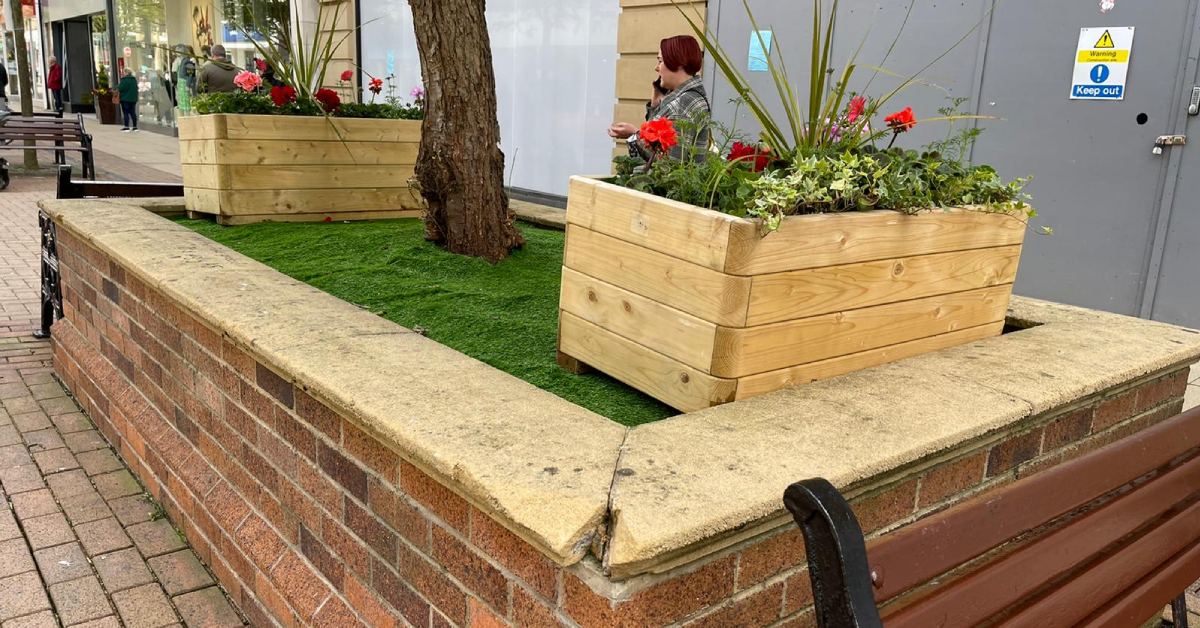
Fake grass and planters.
Pressure continued to mount on the council in the following days. Hundreds called for the removal of the fake grass but one group took matters in their own hands.
The fake grass may have looked green but Extinction Rebellion Harrogate was less than impressed with its environmental credentials so a small team of activists replaced it in one of the beds with shade-loving plants.
Extinction Rebellion later handed the plastic grass back in to the council offices on King’s Road along with annotated extracts from the council’s environmental policies.
The council finally relented, apologised and sent workers to remove the fake grass.

Extinction Rebellion hands the fake grass back.
It may have all been over in little more than two weeks but the fake grass saga saw residents engage with local politics like never before. It was, as Extinction Rebellion put it, a “victory for the people”.
Meanwhile a new debate was growing under our feet. Harrogate Borough Council’s environmental credentials may have come under fire in May but in June the town had a new, new green look.
Swathes of green spaces, including on the Stray, had been left alone by mowers and strimmers so nature can grow free as part of rewilding efforts.

The grass verges are growing in Harrogate.
Rewilding was welcomed by many who saw it as a sign that the council, which manages parks and green spaces in the district, is serious about improving biodiversity.
But others who cherish Harrogate’s long reputation for organised and elegant planting thought it made the town look untidy.
This new move sparked just as much interest as the fake grass saga with each story sparking hundreds of comment and fierce debate on social media.
Both stories revealed that, more than ever, Harrogate’s residents care about the look of our floral spa town.