On Wednesday, Roger Hewitt will don his town crier regalia and read one of his hand-written short scripts opening Knaresborough market.
It’s something Roger has done every Wednesday for more than eight years, making him one of the most familiar faces — and voices — in Knaresborough.
But this will be the last time he performs the civic duty, which stretches back to the 1600s, before retiring.
He remains an incredibly popular figure, so why is he stepping down?
“I’m not getting any younger. I think things are going quite well at the moment but I don’t want to carry on until people say ‘it’s time form the poor bugger to go’.”
Roger has a fine line in self-deprecation. He describes himself as a Knaresborough incomer, having only lived in the town for 44 years. He taught chemistry at Harrogate Grammar School for 23 years before becoming town crier. He says:
“I’ve bumped into many people I used to know from my teaching days and from what I can see, I don’t think I have done any serious psychological harm to any of them.”

The pirate of the Nidd. Picture by Charlotte Gale
The town crier role, which is managed by Knaresborough & District Chamber, appealed because he was “coming up to retirement age and the wife was keen for me to have something to do”.
Roger’s background in amateur dramatics, alongside his humour, people skills and commitment to the role — he often agrees to appear at coffee mornings and charity events above and beyond the call of duty — have made him the perfect town crier. It’s worked for him, too.
“I’ve loved it. It’s been absolutely brilliant. The best part is meeting kids. They all think I’m a pirate. All I need to do is let them ring the bell and it’s like someone has given them the best Christmas present ever.”
Although Roger is leaving the role, he’s most certainly not leaving Knaresborough. He says he and his wife would like to do something together now. What makes the town so special?
“I think it’s the combination of history and scenery. People walk around for the most part with a smile, partly because there are so many pubs but also because it’s such a nice place.”
Tradition dictates he opens the Wednesday market at 11am even though, as he puts it, “the fish man is nearly sold out by then”.
He writes 150 to 200 words for each cry, which lasts about 90 seconds and always includes three ‘Oyez’ and ‘God save the King’. He admits to one time mistakenly shouting ‘God save the Queen’ after she had died.

Roger helped to select his successor Mark Hunter (third from left).
Does he have any advice for his successor, Mark Hunter, who in a break from tradition will also have two deputies?
“The only advice I would give is to do your own thing and enjoy it. I’ve said I’ll give him two things — my best wishes and my phone number. I won’t be there telling him what to do but if he has any questions I will happily answer them.”
How will he feel after making his final cry?
“I know how I will feel an hour afterwards because one of the pubs has invited me round!
“I shall be nostalgic for what has been a very, very happy eight years but also happy to hand over to someone else.”
Read more:
- Knaresborough town crier Roger Hewitt to retire
- Mark Hunter wins contest to be Knaresborough’s next town crier
Mary, 87, retires after 47 years and 18,000 shifts as a lollipop woman in Summerbridge
A Nidderdale lollipop woman is set to retire after 47 years of helping children cross the road.
Mary Fisher, 87, is North Yorkshire’s longest-serving lollipop woman.
She has supervised generations of children crossing the busy Pateley Bridge to Harrogate road outside Summerbridge Community Primary School since 1975 — the year the Vietnam war ended, Margaret Thatcher became leader of the Conservative Party and Leeds United were beaten in the final of the European Cup.
Now, after 18,000 morning and afternoon patrols involving thousands of children, she has decided to retire. Her last day is due to be December 16.
Nick Coates, executive headteacher of Darley and Summerbridge Community Primary School Federation, said:
“Mary will still be a regular visitor to school but in a guest capacity rather than a working role and is going spend her retirement taking it easy, gardening, baking with the odd bit of knitting thrown in.
“We wish her all the best and of course, it goes without saying, all our love.”
Read more:
- Is Mary the Harrogate district’s longest-serving lollipop woman?
- Plan submitted for 20mph zones around five schools in Harrogate
Mary came to North Yorkshire in 1954 with her husband Jim, and soon became firmly embedded within the local community.
In 1956 the couple moved to Summerbridge, where Mary worked at New York Mill and Jim worked in the building trade.
Over the next decade or so Mary and Jim raised their four children, all of whom attended the school. It was at this point that Mary’s relationship with the school really began.
Bringing the children to school everyday, it was soon noticed by the local ‘bobby’ that Mary would make a great lollipop lady and despite initial reluctance, she eventually agreed.
Two years ago, when she celebrated her milestone of 45 years, she said:
“One of the best parts of the job is that everyone recognises you – everyone always waves at me.
“I love being outside and active as well. I have to be out and about rather than sat inside. Not a day goes by where I think I don’t want to get up today and do it.”
Now, after 47 years and five headteachers, she has finally decided to call it a day.
‘Inspired every day’: Studley Royal gardener retires after 45 years
The head of landscape at Studley Royal Water Garden in Ripon has retired after 45 years, working on the garden he calls “the most beautiful in the world”.
Michael Ridsdale has worked for the National Trust for 45 years, with 37 of those at Fountains Abbey and Studley Royal.
He is the trust’s longest serving gardener.
Over the years Mr Ridsdale has worked to restore the garden and its buildings to how they would have been in their heyday of 1871.
His 37 years at the helm of the gardening team haven’t all been plain sailing: he’s had to deal with severe flooding and foot-and-mouth disease, which threatened the garden’s large deer herd in 2001.
Key projects for Mr Ridsdale have included the conservation of follies, bridges and paths throughout the site, silt removal from the Skell river and Studley lake, restoration of the monastic precinct wall and the ongoing conservation of Fountains Hall and the Elizabethan garden.
He also spent four years restoring the Moon Ponds after their formal shapes were almost completely lost.
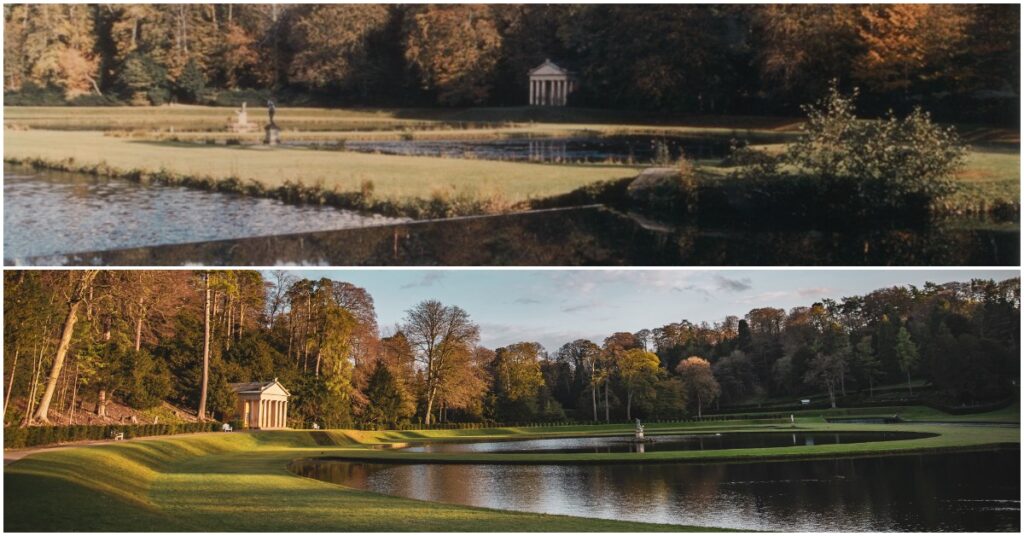
Moon Ponds: from this (above) in 1983 to this (below) today
Mr Ridsdale said:
“That early project set the tone for how we would look after and care for the site.
“The confidence in our restoration began to build and we created something magical, recreating what visitors would have seen in 1781. It’s one of my proudest achievements.”
Three years after Mr Ridsdale’s arrival, Studley Royal and the ruins of Fountains Abbey became a World Heritage Site in 1986.
Mr Ridsdale added:
“It was the most wonderful recognition for all the hard work we’d done, and recognition from the international community that this place was on par with other cultural sites around the world.”
Read more:
- Bilton artist sells paintings from his garage to millionaires abroad
- Harrogate’s Horticap opens revamped free nature trail
He said the “forever changing” gardens kept him inspired all these years and he wishes he had another 50 years to complete all the ongoing restoration.
But Mr Ridsdale won’t be too far away: he has taken on a new role as a volunteer at Fountains Abbey and Studley Royal.