North Yorkshire Council is considering whether to ban people depositing commercial waste at all of its household waste recycling centres.
It is one of a range of options being considered as part of cost-saving measures.
Other ideas include restricting the number of trips vans can make to the centres and banning people who don’t live in North Yorkshire from using them.
The options, which would affect sites at Penny Pot Lane and Wetherby Road in Harrogate, Dallamires Crescent in Ripon and mobile sites in Pateley Bridge and Boroughbridge, are due to go out to consultation.
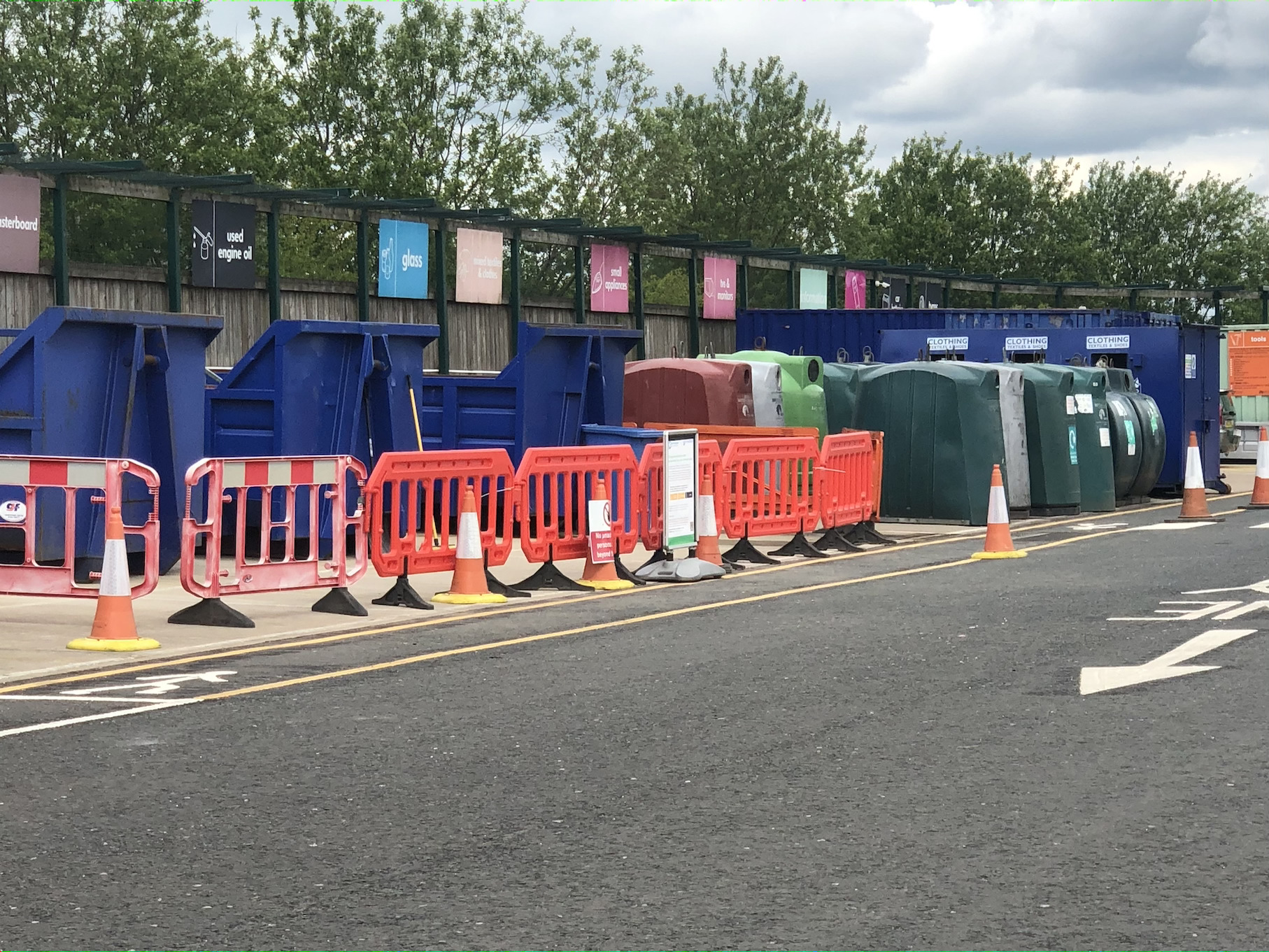
The Penny Pot Lane tip.
A council decision notice last week announced plans to consult on changes, which it said would “avoid the need to reduce the service but do impact certain site users”.
The Stray Ferret asked the council why it was proposing changes, what the options were and the likely cost associated with them.
In a statement, it replied:
“To help make savings and improve the service they provide, North Yorkshire Council is looking at various changes at household waste recycling centres.
“This includes limiting the use of HWRCs to North Yorkshire residents only, limiting the access for commercial-like vehicles as well as changes to commercial waste.
“Around 15 per cent of visits are not made by North Yorkshire residents. Limiting the use to the county’s residents could generate savings of about £140,000 every year and would align with neighbouring authorities.
“The council is also proposing to limit access for commercial-like vehicles (including those in a van or pick-up). Figures show 93 per cent of visitors in a commercial-like vehicle make less than 12 visits per year. Limiting these vehicles to 12 visits could bring savings of about £370,000 and could reduce congestion at the sites.
“Before implementing these changes, people will be asked to share their views on the proposals, as well as whether they support commercial waste continuing to be accepted at HWRCs.”
Read more:
- Scrapping household waste charges will cost taxpayers £889,000, says council
- Harrogate hospital £20m RAAC repairs a ‘critical building safety issue’, says MP
According to the council’s website, commercial waste is currently accepted at all of its centres except Wetherby Road in Harrogate.
Environment minister Rebecca Pow announced in June that households would no longer have to pay to get rid of DIY waste at household waste recycling centres.
DIY waste is now treated the same as household waste, saving tip visitors up to £10 per sack of rubble or sheet of plasterboard.
North Yorkshire Council said this would cost £889,000 and force it to look for new ways of saving money.
Last month, the Local Government Association, which is a membership body for councils, warned the change could mean tip closures and reduced hours in some council areas.
Harrogate district motorists could face new fines
Motorists who drive in cycle lanes, fail to obey no entry signs and misuse box junctions in North Yorkshire could face tougher action.
Currently, moving traffic offences in the county are only enforceable by police.
But North Yorkshire Council is considering securing new powers available to local authorities to enforce moving traffic offences on the county’s roads.
It follows a 2019 survey by the Local Government Association, which revealed 67% of local authorities said the police did not actively enforce any moving traffic offences in their area.
A total of 90% said that they would use civil enforcement powers if they were available, primarily to ease congestion and improve road safety.
The Conservative council has now asked people to share their views on a proposal to introduce traffic enforcement at a yellow box junction on the A19 in Selby.
This would be the first location in North Yorkshire where the council would use new powers to crackdown on driving offences — but others could follow.
Cllr Keane Duncan, the council’s executive member for highways and transport and the Conservative candidate to be mayor of York and North Yorkshire, said:
“We are seeking to take tougher action to tackle dangerous driving on North Yorkshire’s roads.
“Using new powers, we have the chance to enforce offences such as driving in cycle lanes, failing to adhere to one-way systems and no entry signs, entering yellow box junctions and failing to give priority to ongoing traffic.
“By adopting these enforcement powers proportionately in problem areas, we hope to improve road safety for all road users, reduce congestion, emissions and journey times, and allow North Yorkshire Police to focus resources elsewhere.”
Read more:
- Council prepares alternative options to save £11.2m Harrogate Station Gateway
- 10 schemes proposed to reduce congestion in Harrogate
Cllr Duncan said the Selby consultation would help it decide whether to apply to the Department for Transport for new powers.
The Traffic Management Act in 2004 introduced civil enforcement of traffic offences in England and Wales.
The act was laid before Parliament in 2022, granting local authorities’ powers to enforce minor traffic offences.
For local authorities to be granted these powers, they must apply to the DfT by October 25, highlighting at least one area that needs to be consulted on and submitted as a pilot scheme.

The Gowthorpe junction in Selby.
The Gowthorpe / Scott Road junction in Selby has been identified following concerns about vehicles entering the box junction on the A19.
If the application for the pilot is approved, traffic enforcement on the junction would be enforced from early next year. Similar enforcement action could then be introduced in other North Yorkshire locations.
The council said in a statement any income generated through traffic offences would be ring-fenced to pay for road improvement projects, public transport schemes or environmental campaigns.
You can take part in the consultation, which closes on October 23, here.
Unions call for Harrogate council staff to get £2,000 pay rise
Harrogate Borough Council staff should receive a minimum £2,000 salary increase, according to trade unions.
Unison, GMB and Unite today formally lodged the 2022/23 pay claim for local government workers.
The claim also called for a covid recognition payment, a national minimum agreement on homeworking policies for all councils, the introduction of a home working allowance and a reduction in the working week to 35 hours.
It is the start of a negotiation process with the Local Government Association, the national membership body for local authorities. The claim is for all council workers in England and Wales.
David Houlgate, secretary of the Harrogate local government branch of Unison, said council employees had seen their pay reduced by 27% in real terms over the last decade.
He added:
“Councils can’t get staff and they can’t keep staff because of pay. They need to wake up and smell the coffee.
“It is impacting services, such as swimming pools being open for reduced hours, bins not being collected as often, streets not being cleaned and streetlights not being fixed.
“I’ve worked for the local council for 25 years and I’ve never known it to be as bad as this.”
Read more:
- Woodfield school closure ‘an absolute disgrace’, says union
- North Yorkshire fire service ‘struggling to buy the basics’, says union
Mr Houlgate said staff morale was poor and the looming abolition of Harrogate Borough Council had created extra uncertainty but the key issue was pay and recruitment. He added:
“If local councils can’t be competitive with other employers we are not going to overcome the recruitment problem.”
Responding to the unions’ claims, Cllr Sian Timoney, chair of the National Employers at the Local Government Association, said:
Unison Harrogate canvasses election candidates over ‘shameful’ council pay“We will be consulting with councils during June to seek their views which will inform the National Employers’ response to the unions.
“Local government continues to face significant financial challenges, which became more acute during the pandemic, having lost more than £15 billion in government funding since 2010.
“As well as rising inflation, cost of living, energy and fuel prices, the forecast increases to the National Living Wage also presents a significant cost to local government that will put further pressure on council budgets.”
Unison in Harrogate is to write to next month’s local election candidates to find out their stance on local government pay.
Davie Houlgate, secretary of the Harrogate local government branch, said the union was looking to lodge a pay claim for the 2022/23 financial year.
The move comes after Unison’s attempt to call a strike in January over a 1.75% pay offer in the previous year failed because not enough members turned out to vote.
The trade union had branded the pay offer ‘derisory’.
The offer followed a national consultation by the Local Government Association, which is the national membership body for local authorities, over a pay increase.
Read more:
- Unison Harrogate rejects ‘derisory’ council staff pay offer
- Harrogate council strike action averted after national ballot
Mr Houlgate said the union was now considering another pay claim because the cost of living crisis is “squeezing” workers’ pay packets.
He added that officials will be writing to candidates ahead of the election in North Yorkshire on May 5 to find out their stance on the issue.
Mr Houlgate said:
“Local government pay must be increased to match the cost of living squeeze our members are now experiencing on the back of year-on-year below inflation pay increases.
“Without a decent above-inflation pay rise to help workers meet soaring costs, vital council services will struggle to hang on to skilled staff which could put some services at risk. Indeed this is already happening.
“Council workers need an above inflation pay rise, simply to try to catch-up with what they have lost in real terms over the past decade – a 25% pay cut. But it is more imperative than ever as a result of the cost-of living crisis we are now in.
“The situation is unsustainable and cannot go on.”
He added:
Harrogate council staff could strike over ‘derisory’ pay offer in New Year“We need to know if candidates have any idea of the enormity of the problems faced by council staff.
“It’s shameful that people that make our towns and villages so attractive or do high skilled, essential and much-valued jobs on which everyone depends, don’t get paid enough to meet their basic costs.”
Strike action over a “derisory” pay offer for council staff could take place in Harrogate in the New Year.
Unison at Harrogate Borough Council is set to ballot members over whether or not to take industrial action after its members rejected a 1.75% pay increase last month.
Of a turnout of 62% of its members, 74% voted to refuse the pay offer.
The offer followed a national consultation from the Local Government Association over a pay increase.
A draft timetable will see members receive ballot papers from December 1 and close on January 14.
Read more:
- Unison Harrogate rejects ‘derisory’ council staff pay offer
- Union concerns over staffing shortages at Harrogate district leisure centres
- Government rejects £6m levelling up bid for Ripon and Masham
It means strike action could take place as early as February, if members vote for this option.
David Houlgate, secretary of the Harrogate branch of Unison, has described the pay offer as “inadequate” and “derisory”.
He said:
Senior staff could get pay rises totalling around £133,000“This overwhelming majority makes clear the strength of feeling among local government workers about their pay, here in Harrogate but nationwide too.
“Council and school workers have been the unsung heroes of the covid pandemic, working tirelessly and often at risk to their own safety to serve their communities.
“Meanwhile, since 2010 the value of their pay has fallen by 25%. The 1.75% pay offer is completely inadequate and Unison members have made their feelings about it clear.”
Some of the most senior staff at Harrogate Borough Council could be in line for pay rises totalling around £133,000 between them.
The authority has proposed a new senior management pay structure with increases to the upper salary limits for 17 top earners including the chief executive Wallace Sampson, two directors and several heads of service and managers.
Mr Sampson is the highest paid member of staff and could see his upper limit increased to £130,000 under the proposals, which were supported by the council’s human resources committee on Wednesday and will require a final approval from full council next month.
It follows a review by the Local Government Association (LGA) and Yorkshire and Humber Employers Association, which concluded the recruitment and retention of senior staff was challenging and that pay was a factor.
The review looked at council salary levels elsewhere in the region, as well as Harrogate’s cost of living, and proposed several pay rises to be introduced from 1 July.
These will not apply to mainstream staff who had their pay structure reviewed two years ago and are currently in negotiations for a further rise.
Speaking at a meeting on Wednesday, Kay Atherton, head of organisational development and improvement at the council, explained:
“In 2019, as part of the National Joint Council pay agreement, a new pay structure was agreed for mainstream staff where some staff did see an uplift in pay.
“That pay structure was to address the issues of low pay – which it did.
“At this point in time, because we have only reviewed the pay structure for mainstream staff recently, we don’t feel we need to do that again.”
Read more:
- Self-isolation payments widened for Harrogate district low-income earners
- Harrogate council leader: Sustainable transport ‘will always cause controversy’
Under the proposals for senior staff, the vacant position of director of community would be scrapped after Paul Campbell suddenly stepped down last spring and was paid £55,065 in compensation for loss of office after three and half years in the role
His responsibilities – which included emergency planning, housing, parks, and health and safety – have since been shared between the other two directors and this arrangement is likely to continue.
Rachel Bowles is director of corporate affairs, while Trevor Watson is director of economy and culture, and he could see his title renamed as director of economy, environment and housing under the proposed changes.
The pair would also see their upper salary limits increased from £92,194 to £100,000, although this is only an upper limit and how much they and all other senior staff actually earn is based on a grading system.
Meanwhile, Paula Lorimer, director of Harrogate Convention Centre, would remain on the same £104,502 salary, while the managing director of the council’s new leisure company Brimhams Active, Mark Tweedie, could earn up to £76,350.
For the 12 heads of service, the upper limit would be boosted from £63,584 to £75,000.
Meanwhile, some managers, including those in charge of communications and engagement, elections, and democratic services will see no increase in their upper pay limit.
All council workers last received an across-the-board 2.75% pay rise in August, but union officials have issued a warning over the “perception” by lower-paid workers and the public of reviewing senior staff pay now.
In response to the LGA review, Unison Harrogate said in a statement:
“Whilst we do not dispute the legitimacy of the senior management proposal, perception is something that does need to be factored in.
“Staff, who have recently been offered a derisory 1.5% pay rise, will understandably question why a senior management review is happening much quicker than one for the majority of staff, which seems way off in the future.
“It is our expectation that the council gets on with the pay and grading review for mainstream staff now, prioritises it and delivers on it in a much quicker time frame than is being proposed.”