Rivers minister Robbie Moore was in Knaresborough this morning to confirm the River Nidd had achieved bathing water status.
All 27 sites that applied for bathing water status were granted it today. The Stray Ferret reported earlier today that Knaresborough’s bid had been granted.
It means the Environment Agency will be obliged to act if tests find the river does not pass water quality checks.
Mr Moore joined Harrogate and Knaresborough Conservative MP Andrew Jones. who has led the Nidd campaign, at Knaresborough Lido to announce the news today.
Mr Moore said:
“The value our bathing waters bring to local communities is incredible – providing social, physical and positive health and wellbeing benefits.
“These popular swimming spots will now undergo regular monitoring to ensure bathers have up-to-date information on the quality of the water and enable action to be taken if minimum standards aren’t being met.
“I am fully committed to seeing the quality of our coastal waters, rivers and lakes rise further for the benefit of the environment and everyone who uses them.”
Mr Jones said it had been “a big community effort” and thanked those involved in what he described as “a constructive, positive approach to making our waterways healthier”.
He added:
“The Nidd is used by hundreds of people for recreation and the bid is all about helping them to do that in a consistently cleaner environment with water quality that shows sustained improvement.
“Whilst I was quietly confident we would be successful I am delighted that we did it!”
Designated bathing water status is an official way of recognising that a waterway such as a river, beach or lake is a popular site for water-based activities.
Achieving it means that during each bathing season from May to September, the Environment Agency will test the Lido for pollutants.
If any sites do not meet regulatory standards the Environment Agency will investigate and create a plan to tackle the sources of pollution.
While Mr Jones’ office monitored the number of bathers at the Nidd last summer, Nidd Action Group carried out water quality sampling.
David Clayden, chair of the Nidd Action Group, said:
“The Nidd Action Group welcome the news of the bid’s success and will support and scrutinise the actions of the Environment Agency and Yorkshire Water to improve our river’s health in the long term.
“We wish to keep the river as clean as practicable – not just for ourselves, but for all the communities that value the river and the wildlife which lives there. Thanks to the success of the bid we can look forward to a cleaner Nidd, fit for the future.”
“We are grateful to our local MP Andrew Jones and his team who volunteered to drive the bathing water bid forward so effectively.”
However, the clean water campaigner Feargal Sharkey said achieving the status was no guarantee of clean water. He posted on social media that sites currently with the status had not seen improvements.
Every single stretch of river currently designated as a bathing area has a 'Do not swim' advisory posted.
You have been warned. https://t.co/W0g1ptBNG1
— Feargal Sharkey (@Feargal_Sharkey) May 13, 2024
Read more:
- River Nidd at Knaresborough granted bathing water status
- Could Labour target Harrogate and Knaresborough at the next election?
- Stunning Northern Lights display lights up Harrogate skies
River Nidd at Knaresborough granted bathing water status
The River Nidd has been granted bathing water status at Knaresborough Lido.
Environment minister Robbie Moore is expected to announce the news this morning.
The Department for Environment, Food and Rural Affairs received 27 applications for bathing water status this year.
Decisions were expected in spring and well placed sources have told us that the application for the Nidd, which was submitted by Andrew Jones, the Conservative MP for Harrogate and Knaresborough, is among those approved.
It means the Environment Agency will be obliged to undertake measures to improve water quality at the Lido, which will impact the rest of the river.

Andrew Jones (right) and Environment Secretary Steve Barclay discussing the bid.
As part of the Defra submission, Mr Jones’ office ran surveys last summer on the number of bathers using the Lido, which revealed the venue attracted 276 bathers a day on average during summer.
Water sampling work was carried out along the river by Nidd Action Group, which was formed by fly-fishermen concerned about water quality and now also includes academics, charities and volunteers.

Volunteers involved in water sampling.
Achieving bathing water status will mean that during the bathing water season from May to September, the Environment Agency will test the Lido for pollutants and designate it either ‘excellent’, ‘good’, ‘sufficient’ or ‘poor’.
If it is not rated highly, the government agency will create a plan to tackle the sources of pollution.
Only two rivers, including the Wharfe at Ilkley, currently have bathing water status and the water quality of both is currently rated ‘poor’ so there are concerns about how effective designation is.
The state of the Nidd came under sharp focus last year.
Nidd Action Group sampling revealed high levels of the faecal bacteria E.coli.
Last year Knaresborough Bed Race competitors were advised to keep their heads above water to avoid the risk of swallowing water containing sewage.
Read more:
- Government opens two-week consultation on Nidd bathing water status
- Pierce Brosnan ‘borrows screwdriver’ from Knaresborough optician
- Knaresborough pulls together to help flood victims
Local river bathers to get live data on sewage
Outdoor bathers at places such as Knaresborough Lido will be able to get almost real time data this summer on sewage being pumped into rivers.
There has been widespread concern about the state of local rivers, especially the Nidd and Ure.
Yorkshire Water announced yesterday it had launched an interactive map that will provide current information on the operation of storm overflows.
Water companies use storm overflows to release extra rainwater and wastewater into rivers when the sewerage system is at risk of being overwhelmed.
This usually happens during heavy rainfall but there has been concern about the overflows operating at other times and pumping more sewage into waterways.
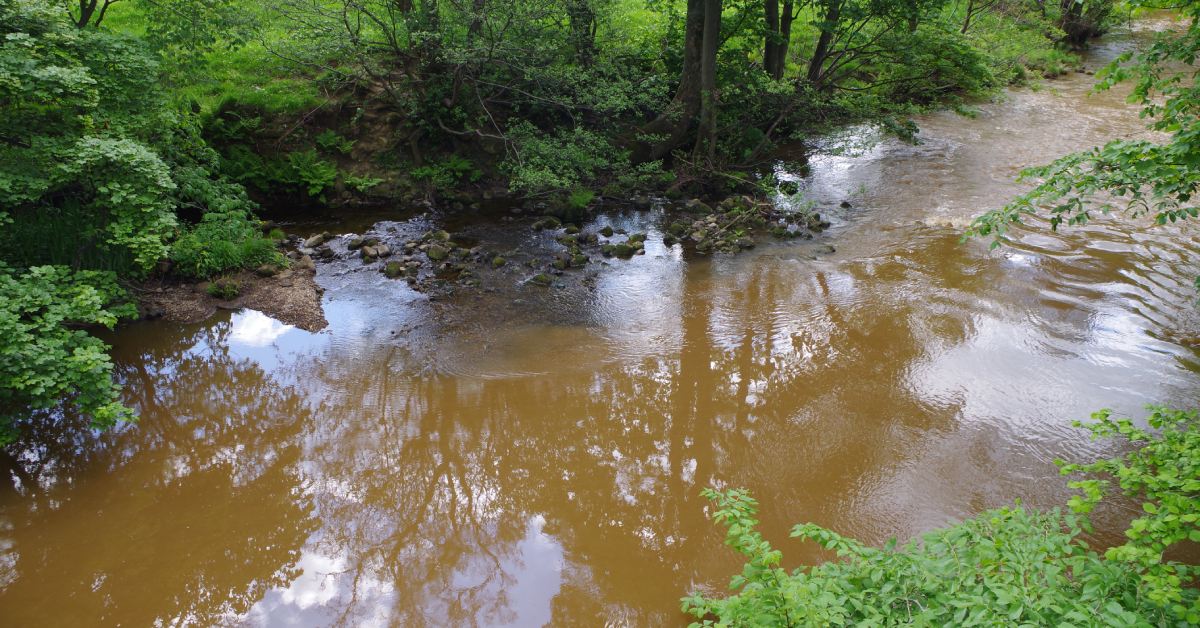
River Nidd
The interactive map has been launched ahead of the 2024 bathing water season, which runs from May 14 to September 30.
It shows the live status of each of Yorkshire Water’s storm overflows, when they last discharged into a watercourse and for how long. The information refreshes at 15-minute intervals,
Yorkshire has 2,180 storm overflows and Ben Roche, director of wastewater at Yorkshire Water, said the map would increase transparency for customers:
Mr Roche said:
“All the data will be available to anyone accessing the map. We have decided to launch now, ahead of the bathing water season to ensure customers are better informed about our operations in their area.
“We know replumbing the whole of Yorkshire is not a quick fix as it would be both significantly disruptive and costly to customers. The map shows just how big an engineering challenge this is from the vast numbers of overflows we have.”
He added Yorkshire Water was “investing £180m by the end of April 2025 to tackle 134 of the more frequently discharging overflows”.
The £180m investment is split into four areas, he added. They are: increasing storage at Yorkshire Water’s wastewater treatment works and within the sewage network; separating surface water from the combined sewer system; reducing groundwater infiltration into sewers; and changes to the operation of treatment works.
You can view the storm overflow map here.
Read more:
- Sewage in Nidd and Ure: local politicians react to increase
- Rivers Nidd and Ure named among UK’s most polluted rivers
- Environment secretary ‘impressed’ by River Nidd bathing water bid
No 9: River Nidd pollution and politics take centre stage
In this article, which is part of a series on the 12 stories in the Harrogate district that shaped 2023, we look at how the River Nidd rose up the political agenda this year.
National concerns about rivers were magnified locally in a year of intense focus on the River Nidd.
The state of the Nidd has become a major issue in recent years amid reports of bathers falling ill with sickness and diarrhoea and wider pollution concerns.
It led anglers, academics, conservationists and members of the public to set up Nidd Action Group to campaign for long-term improvements on the river, which is a tributary of the River Ouse that flows through Pateley Bridge, Birstwith and Knaresborough before meeting the Ouse at Nun Monkton..
The group bookended 2023 with two public meetings in Knaresborough. In between there was unprecedented activity that included water sampling and a campaign to achieve bathing water status.
The need to act was starkly highlighted in May when Professor Peter Hammond, a mathematician who analyses data on sewage discharges, published research showing the equivalent of 317 Olympic pools of raw sewage was discharged into the River Nidd at four sewage treatment works at Pateley Bridge, Harrogate, Darley and Kirk Hammerton in 2020.
The following month Knaresborough Lions, which organises the town’s joyfully insane annual bed race, issued a warning urging participants to “keep your head above water”.

Bed race competitors were told to keep their heads above water.
During summer, scores of volunteers monitored usage of the Nidd at Knaresborough Lido as part of the bathing water campaign led by Andrew Jones, the Conservative MP for Harrogate and Knaresborough.
Water quality has become a highly charged and politicised issue and not everyone welcomed Mr Jones’ campaign.
Tom Gordon, the Liberal Democrat parliamentary candidate for Harrogate and Knaresborough, made rivers one of his main campaigning issues in 2023. He said local waterways were “being pumped full of raw disgusting sewage” under the Tories’ watch and accused water firms of awarding bosses “insulting pay-outs” after it was revealed Yorkshire Water paid £2.09 million to four executives in the year ending March 2023.
Mr Jones said he was taking a pragmatic approach to tackling an important local issue that is as much about farming and ancient sewers as government policies.
He even called for a parliamentary debate on the subject in January, when he told MPs:
“Rainwater run-off from farmland, which can include animal waste and pesticides, is a big factor affecting the quality of our waterways. It is a complex issue, and local farmers produce some of the highest quality food in our country, so can we have a debate to explore how the government can support farmers in mitigating this issue?”
Mr Jones’ bathing water campaign focused on Knaresborough, where leisure use of the Nidd is at its highest. There is an large wild swimming group, Lido bathers and boating on Waterside, as well as angling and riverside holiday homes.
If the bid, which the government is expected to adjudicate on in spring, is approved then agencies will be required to take measures to clean the Lido that should impact a much wider stretch of the river.
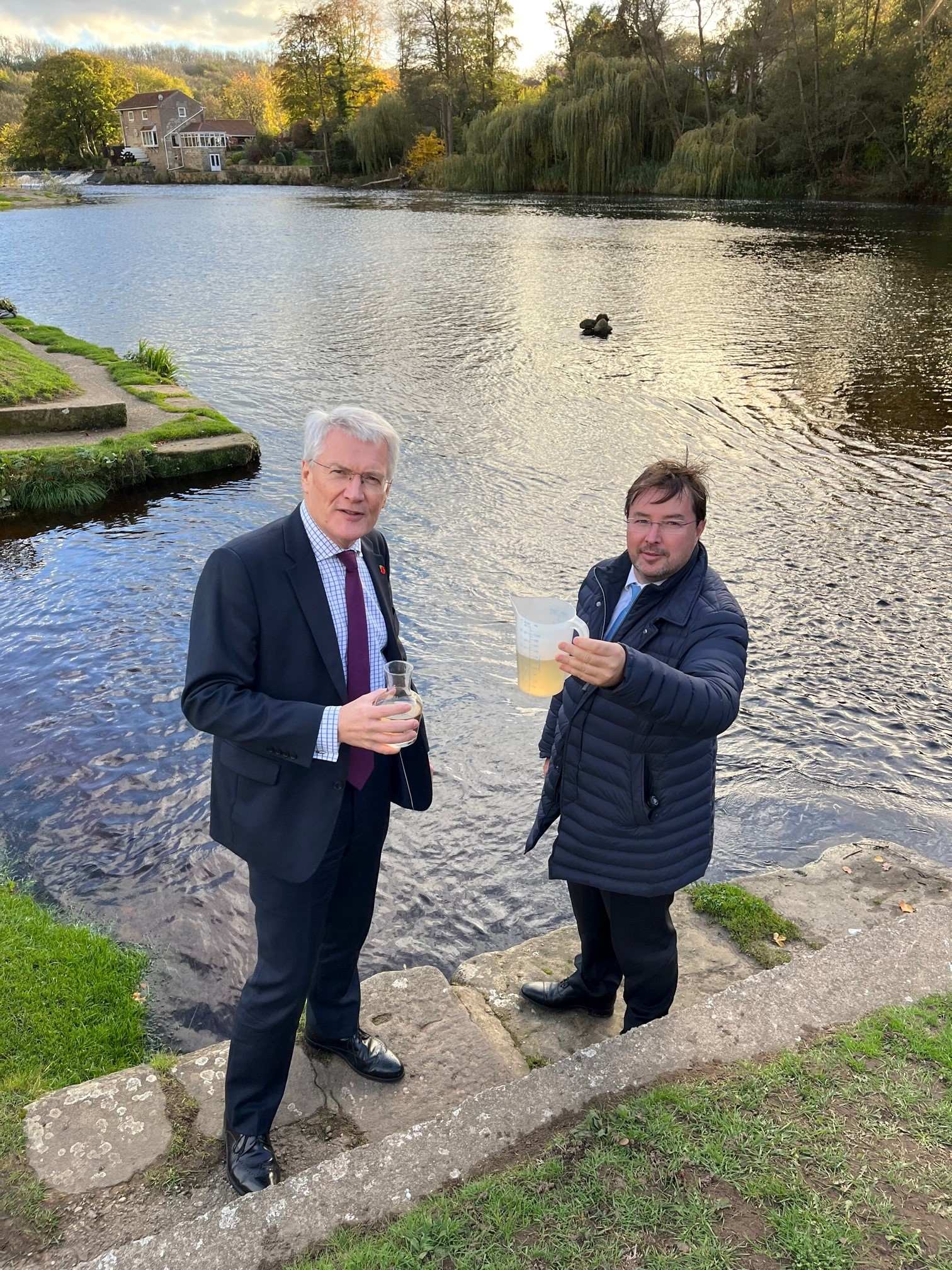
Andrew Jones (left) with the owner of Knaresborough Lido.
Besides the bathing water bid, action group volunteers organised two rounds of water sampling along the entire length of the Nidd in August and October to establish scientific data on water quality.
The results confirmed high levels of the faecal bacteria E.coli. in much of the river. Tributaries in the middle and lower Nidd catchment, including Ripley Beck, Oak Beck and Crimple Beck, had the highest concentrations of E.coli, with Bilton Beck the worst.

Nidd Action Group volunteers learning to take water samples.
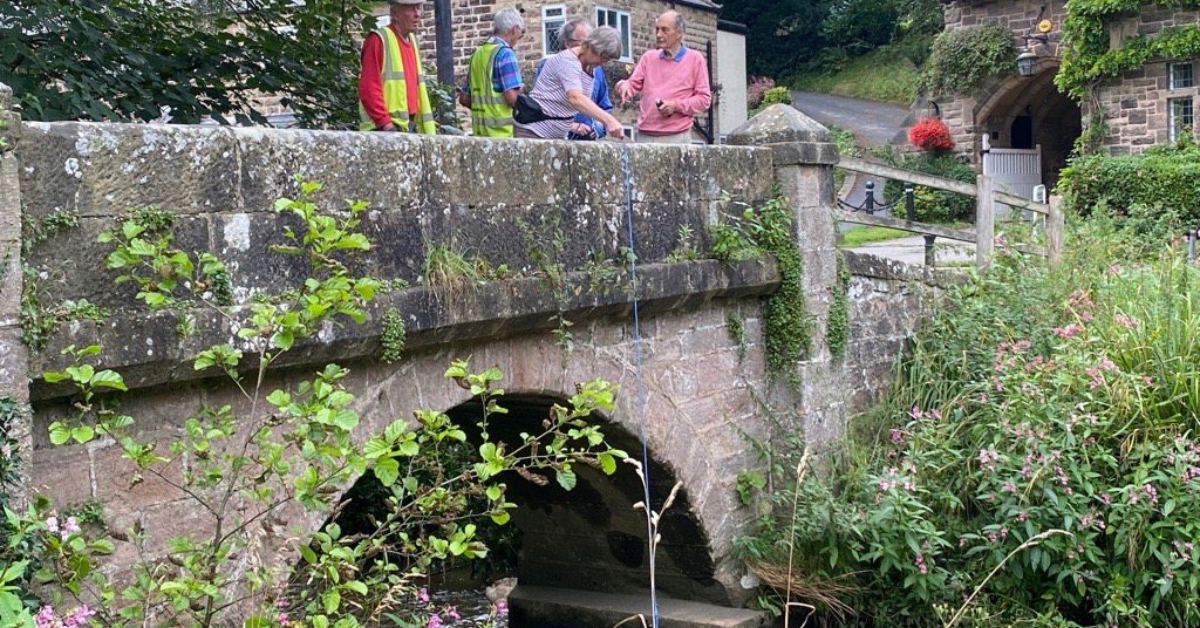
Sampling at Bilton
The results were discussed at the action group’s December meeting, at which some of the early fervour to tackle pollution had given way to a more hard-headed and strategic long-term approach.
The presence of Yorkshire Water at the meeting may have surprised some, but many felt the company was an integral part of whatever plans are drawn up.
Professor Jonathan Gray of the Wild Trout Trust told the meeting the creation of channels that took the river off its natural flood plain “with hindsight was not a good idea” and spoke about the need to reverse this.

Nidd Action Group’s meeting in March.
David Clayden said there had been some initial “naivety” about what could be achieved and both he and James McKay, a Knaresborough resident and academic who has been at the forefront of analysing the water samples, agreed a lot has been achieved in 2023 — but it will take time for this to filter down to actual measures that improve water quality.
Megan Godden, the wild swimming representative on the action group, said people entering the Nidd should avoid swallowing water at all costs and consider avoiding it for a couple of days after heavy rainfall when e.coli levels are at their highest. But she was optimistic action could eventually make a difference.
Maddy Wright, a PHD student at Leeds University, said
“E.coli is the most problematic factor and exists in levels that could pose significant risks”, adding she hoped bathing water status would lead to data about the state of the river being published so “people can see and they will know the risks before they go bathing”.

The clean-up campaign was boosted in November when Yorkshire Water agreed to pay £1 million for polluting Hookstone Beck in Harrogate in 2016.
Half of the sum was awarded to the Yorkshire Dales Rivers Trust, which will use what is now known as the iNidd project to clean-up the River Nidd. The name is similar to the iWharfe campaign on the River Wharfe.
Charlotte Simons, a senior project manager at the trust, said:
“The sad thing is we have the money because something went wrong. But we have been given a lump sum that can lead to long-term improvements on the River Nidd.”
River quality is a murky business.
Read more:
- Harrogate and Knaresborough MP submits River Nidd bathing water status bid
- River Nidd clean-up campaign boosted by £500,000 from Yorkshire Water
- Harrogate Lib Dems criticise Yorkshire Water £2m executive payments
- River Nidd sampling reveals high levels of faecal bacteria
Public meeting to be held about state of River Nidd
A public meeting is to be held in Knaresborough next month to discuss the campaign to improve water quality in the River Nidd.
The drop-in meeting will follow a similar format to the one held in March, which marked the start of the campaign.
Groups involved will give short presentations and talk to people on a one-to-one basis.
Topics will include the results of recent water sampling on the Nidd, which revealed high levels of faecal bacteria, the bid for bathing water status and Yorkshire Water’s business plan for 2025 to 2030.
Nidd Action Group, which includes Knaresborough town councillors, environmental campaigners, anglers, councillors and community groups, will again stage the event at the Centre-on-Gracious Street.
The meeting, titled ‘What do we know about the River Nidd and its tributaries – and what do we need to do?’ will take place on December 5 from 3pm to 6.30pm.
Stands and displays will enable visitors to familiarise themselves with the campaign, which was prompted by concerns about water quality and bathers at Knaresborough Lido suffering sickness and diarrhoea,
Andrew Jones, the Conservative MP for Harrogate and Knaresborough, submitted the bid for bathing water status to rivers minister Rebecca Pow last week.
If successful, government agencies would be obliged to take action to improve water quality at the lido. This would also improve water quality on a much longer stretch of the river.
The bid has been backed by 33 organisations and businesses, including Knaresborough Town Council, North Yorkshire Council, Yorkshire Agricultural Society and Bilton Conservation Group.
A decision is expected by the end of April next year.
Read more:
- High levels of faecal bacteria in River Nidd confirmed
- Knaresborough bridge to close tonight for nighttime resurfacing
High levels of faecal bacteria in River Nidd confirmed
A second round of water sampling on the River Nidd has confirmed high levels of the faecal bacteria E.coli.
Volunteers tested for E.coli levels along the length of the Nidd as part of a clean-up campaign amid concerns about the state of the river and reports of bathers at Knaresborough Lido suffering sickness and diarrhoea.
The first round of sampling took place in August and the laboratory results of the second round, which took place a fortnight ago, were released last week.
David Clayden, chairman of Nidd Action Group, which coordinated the sampling, said the latest results confirmed the previous findings, which showed concentrations of E. coli bacteria were above acceptable limits.
He added the locations identified as E.coli hotspots in August once again produced the most concerning results.
Tributaries in the middle and lower Nidd catchment, including Ripley Beck, Oak Beck and Crimple Beck, had the highest concentrations of E.coli, with Bilton Beck the worst.

Sampling at Oak Beck in August.
In general, concentrations of E. coli were much lower in the upper catchment of the river from Pateley Bridge to Birstwith, than in the middle and lower catchments.
Knaresborough sampling locations revealed concentrations above the levels deemed sufficient for inland bathing water.
The Nidd Action Group committee met on Friday to talk about next steps, which will include organising a second public meeting to discuss progress and plans for 2024.
Mr Clayden said the meeting will be held in Knaresborough in early December and would follow a similar format to the one staged in March this year.
Meanwhile, Andrew Jones, the Conservative MP for Harrogate and Knaresborough, is expected to submit a bid to the government in the next few days to designate bathing water status on the Nidd.
If accepted, agencies will be obliged to undertake measures to clean the Nidd, as has happened on the River Wharfe in Ilkley.
Read more:
- River Nidd bathing water bid to be sent next month
- Knaresborough reptile centre issues urgent plea for help
A scheme to build a water-powered turbine on the banks of the River Nidd in Knaresborough has received a £10,000 boost.
Knaresborough Community Energy, a not-for-profit community benefit society founded in February this year, wants to build the turbine at the town’s Lido to produce low carbon electricity.
A £10,000 grant from electricity distributor Northern Powergrid will enable the society to conduct structural surveys of the Lido weir to ascertain its condition.
If the weir is found to be in good condition the scheme will proceed to the next stage, which would involve civil engineering design, environmental permits and a planning application.
Building a water turbine is estimated to cost a minimum of £300,000, which would be raised via a community share offer.
Investors would be paid back from revenue generated from the electricity sold. Any surplus would be reinvested in more renewable energy projects.
Gilly Lacey, director and secretary of KCE said:
”Our purpose is to generate low carbon electricity for the community as a means to tackle climate change in a positive way.
“Our current project is a proposed hydroelectric turbine on the River Nidd at the Lido. It will be similar in design to the one on the Nidd at Goldsborough”.
Fellow director Adam Harper said it hoped to know by next summer whether the Lido project is feasible.
He added the group also had plans to help install rooftop solar panels on local buildings.
Read more:
- Any vehicle can park in Knaresborough electric vehicle bays, says council
- Knaresborough’s first pop-up shop to open tomorrow
Volunteers begin testing River Nidd water quality
Volunteers lined the banks of the River Nidd and its tributaries this week to test water quality as part of a major clean-up campaign.
Nidd Action Group coordinated the activity as part of a bid to achieve bathing water status, which would require organisations to take measures to improve water quality.
It follows concerns about the state of the river and reports of bathers falling ill at Knaresborough Lido.
Nidd Action Group includes conservationists, anglers, academics and residents. Harrogate and Knaresborough MP Andrew Jones is also supporting the initiative by gathering data on the number of people using the river at the Lido.
On Thursday afternoon, 40 volunteers dipped test kits into the Nidd at various points from the upper reaches at Scar House, north of Pateley Bridge, right down to Moor Monkton, close to where the Nidd joins the River Ouse.
Volunteers learning to take samples last month.
A second round of sampling will take place late next month before a bid for bathing water status is submitted to the government.
David Clayden, chairman of Nidd Action Group, said this week’s sampling appeared to go well.
He added:
“The weather was kind to us, unlike the previous very wet day. The river was running quite high, but I’ve had no reports of any incidents.
“All the samples in their sterilised bottles have been assembled, along with the documentation and the data collected at the river.
“Samples are being analysed in the accredited laboratory in Lichfield, and further samples will be sent to another laboratory on Monday for less urgent analysis.
A second round of sampling will take place late next month in the same locations but in different weather and river conditions.

Bilton Conservation Group volunteers sampling at Oak Beck on Thursday.

Shirley Hare and Warren Considine with a sample from Oak Beck.
Mr Clayden said the results would then be shared and “we will identify any inferences that can be drawn, and discuss any actions, beneficial to the river, that might be taken”.
Sampling took place ar Scar House Reservoir, Lofthouse, How Stean Gorge, Low Sikes, Ramsgill, Wath, Pateley Bridge, Glasshouses, Summerbridge, Birstwith, Crag Hill Farm, Ripley Beck, Killinghall, along Oak beck in Bilton, Nidd Viaduct, Knaresborough, Crimple Beck, Little Ribston, Hunsingore and Moor Monkton
Mr Clayden commended the volunteers for their commitment and thanked Yorkshire Dales River Trust, a charity based in Pateley Bridge. for assembling the sampling kits and the Environment Agency staff who also undertook sampling.
Read more:
- Volunteers turn out in force to support campaign for cleaner River Nidd
- Council backs bid for River Nidd bathing water status
Volunteers turn out in force to support campaign for cleaner River Nidd
Conservationists, anglers, academics and residents turned out in force at Knaresborough yesterday to prepare to begin water sampling on the River Nidd.
Samples will be taken along the length of the river on August 3 and then again the following month.
The results will form part of a bid to achieve bathing water status on the Nidd, which would require agencies to take measures to improve water quality.
Yesterday’s gathering near Conyngham Hall enabled volunteers to learn how to conduct accurate sampling.
It follows concerns about the state of the river, amid reports of bathers at Knaresborough Lido falling ill after entering the water.
Test kits were supplied by Yorkshire Dales River Trust, a charity based in Pateley Bridge that helped gather data for the River Wharfe’s successful bid for bathing water status.
Charlotte Simons, a senior project manager at the trust, said the volunteers would test for nutrients, such as nitrates and phosphates, as well as bacteria, such as E coli. She added:
“By testing along the whole river we can get a snapshot of what’s happening.”

Charlotte Simons and David Clayden hold a test kit above the River Nidd.
David Clayden, chairman of Nidd Action Group, which was set up to co-ordinate the clean-up campaign, said:
“We’ve had a really good response from volunteers. The real thing starts on August 3, when everyone involved will be apportioned a place on the river to carry out sampling.”
Andrew Jones, the Conservative MP for Harrogate and Knaresborough, is also supporting the campaign.
He is co-ordinating efforts to monitor how much the river is used at the Lido.
A bid for bathing water status is expected to be submitted to the government in autumn.
Read more:
- Outrage over water firm’s response to concerns over quality of River Nidd
- More than 150 Nidderdale children take part in moorland education event
Yorkshire Water discharged sewage into the River Nidd 870 times last year, according to Environment Agency monitoring data.
The discharges lasted for a total of 6,177 hours. Dacre sewage pumping station alone saw 87 spills and 1,014 hours of sewage discharged.
By comparison, there were 318 spills into Oak Beck and Coppice Beck, which lasted for 438 hours.
Water companies are legally allowed to release sewage through overflow pipes when the sewage system becomes too full, which can happen during increased rainfall.
317 Olympic pools of raw sewage pumped into River Nidd, study claims
The equivalent of 317 Olympic pools of raw sewage were discharged into the River Nidd at four sewage treatment works in 2020, according to a study.
The sewage was released into the river at Pateley Bridge, Harrogate, Darley and Kirk Hammerton.
Professor Peter Hammond, a mathematician who analyses data on sewage discharges, conducted the research, according to an article in the Guardian.
It says Prof Hammond studied four of seven sewage treatment works on the Nidd so the amount of raw sewage pumped into the river could be significantly higher.
The study aimed to reveal the volume of discharged effluent released from storm overflows by water firms.
Water companies are currently required to reveal the number of discharges and how long they lasted — not the actual volume of raw sewage discharged.
Prof Hammond studied 30 treatment works in 2020 run by nine of England and Wales’ 10 water companies in England and Wales to calculate the volume of raw sewage discharged.
Four of those were on the Nidd, which is currently the subject of a clean-up campaign following reports of bathers falling ill last summer.
Harrogate and Knaresborough MP Andrew Jones and the Nidd Action Group are leading the campaign to achieve designated bathing water status at Knaresborough Lido, which would oblige agencies to take action.
David Clayden, secretary of Harrogate Flyfishers’ Club and a member of the Nidd Action Group, told the Guardian he saw no reason water companies could not reveal the volume of raw sewage being discharged into rivers.
He said.
“It is extraordinary to see estimates of the volume being discharged. I am very disappointed that the government did not follow the recommendations of the environmental audit committee and make water companies fit volume monitors.”
Read more:
- Andrew Jones MP appeals for help at ‘critical time’ for River Nidd bathing water bid
- Yorkshire Water chief executive apologises for sewage failures