Liberal Democrats have come out in favour of the creation of a Harrogate town council.
A second consultation on whether to set-up a town council runs until May 5.
North Yorkshire County Council said in March the move would require 35,000 households to pay an additional council tax charge of between £40 and £60.
But local Liberal Democrats said today a town council would enable locally-elected councillors to take control of assets such as off-street car parks, the Stray, Royal Hall, Sun Pavilion and Valley Gardens.
Harrogate and Scarborough are the only parts of the county not to have a parish or town council.
Eight Liberal Democrats, including former Harrogate borough councillors and current North Yorkshire councillors, signed in support of a town council.
Cllr Pat Marsh, chair of North Yorkshire Council‘s area constituency committee for Harrogate and Knaresborough, said her party supported devolving power. She added:
“Without a new town council, Harrogate would be at a real disadvantage when bidding for services to remain local.
“Harrogate residents need to have a voice when it comes to the future of local assets, just as those in Knaresborough, Ripon, Pateley Bridge, Boroughbridge and many other villages in North Yorkshire have.”
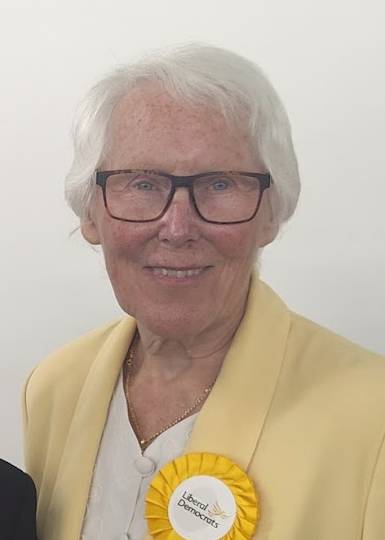
Pat Marsh
Cllr Marsh said “unique decisions relating to Harrogate should be being made in Harrogate by people who have received the endorsement of Harrogate residents” rather than councillors in places such as Catterick, Ryedale and Scarborough.
She added:
“Assets that could be considered for control by the town council include off-street car parks, the Stray, Royal Hall, Sun Pavilion, Valley Gardens and the other green and floral spaces within the town.
“Without local protection, these assets are always in danger of being cut by North Yorkshire councillors not from Harrogate.
“A Harrogate town council would also provide a formal representative voice for local residents on planning applications and other consultations.
“Harrogate is a very special place and decisions about our town need to be made by local people who know, love and understand this town.”
Read more:
- Second consultation to be held on whether to form Harrogate town council
- Just 3.5% responded to Harrogate town council consultation
A total of 75% favoured setting up a Harrogate town council in last year’s first consultation but only 1,250 homes — 3.5% of those affected — responded. The low response rate triggered concerns about the validity of the response.
The statement urges residents and businesses to respond to the second consultation before the May 5 deadline.
The Lib Dem councillors who signed today’s statement are:
Pat Marsh — Stray, Woodlands and Hookstone.
Philip Broadbank — Fairfax and Starbeck.
Chris Aldred — High Harrogate and Kingsley
Peter Lacey — Coppice Valley and Duchy
Mike Schofield — Harlow and St Georges
Monika Slater — Bilton Grange and New Park
Honorary alderman Trevor Chapman
Honorary alderman Matthew Webber
Councillor Michael Harrison appointed first charter mayor of Harrogate
Councillor Michael Harrison was appointed the first charter mayor of Harrogate at the Civic Centre this morning.
Cllr Harrison is a Conservative who represents Killinghall, Hampsthwaite and Saltergate on North Yorkshire Council.
The non-political role will involve promoting the historic and ceremonial traditions of the Harrogate area during events and occasions such as Remembrance Sunday.
It will differ from the former Harrogate Borough Council mayoral role, which covered the whole of the former borough and undertook a wider range of engagements.
Cllr Harrison described the position as “mayor-lite“. He said:
“We’re doing that deliberately but there needs to be the element of civic duty that will continue. I can assure you I will be doing that.”
The mayor was elected by the Harrogate charter trustees, which are 10 councillors who represent divisions covering the unparished parts of Harrogate town.

Harrogate’s 10 charter trustees
It was a more low-key occasion than previous Harrogate Borough Council mayor-making ceremonies, which were traditionally held each year at Harrogate’s Royal Hall.
Cllr Harrison was nominated for the role by Liberal Democrat councillor for High Harrogate and Kingsley, Chris Aldred, who was also appointed charter deputy mayor during the meeting.
Cllr Aldred said:
“Some observers may expect us to nominate one of our own but it’s also equally important to prove that charter trustees are actually non-political in order to continue the civic traditions and heritage of Harrogate. I’m sure Michael will do that and be a great ambassador for the town.”

Cllrs Michael Harrison and Chris Aldred
Cllr Harrison’s first engagement as charter mayor will be at the unveiling of new sculptures at the New Zealand garden in Valley Gardens this month.
He will also attend ANZAC memorial day at Stonefall Cemetery.
Read more:
- Councillors to elect ceremonial mayor for Harrogate this month
- Mayor of Ripon nominated to serve a third term in office
Ceremonial robes and chains most recently used by the last Harrogate borough mayor, Victoria Oldham, will be used by the charter mayor.
But he won’t be entitled to perks enjoyed by previous council mayors such as having a chauffeur-driven car to get to events.
The new council has allocated an annual budget of £12,100 for Harrogate charter trustee business.
However if a Harrogate Town Council is created, it will assume responsibility for the mayoral position from North Yorkshire Council should it want it.
The charter trustees will meet again in October. Cllr Harrison said at the next meeting the charter trustees will make a suggestion to North Yorkshire Council on what the council tax precept for the town council might be.
Consultation documents for the town council state Harrogate households would be asked to pay between £40 and £60 on top of their council tax each year if a Harrogate Town Council were created.
The budget would be spent on accommodation, employment costs, office and IT equipment, insurance, professional fees, the mayor and delivering services.
What those services might be are still to be decided but it would likely involve taking control of assets once held by the abolished Harrogate Borough Council.
Councillors to elect ceremonial mayor for Harrogate this monthCouncillors will elect a mayor for the town of Harrogate at a meeting this month.
Called a ‘charter mayor’, the non-political role will involve promoting the historic and ceremonial traditions of the Harrogate area during events and occasions such as Remembrance Sunday.
The mayor will be chosen by the Harrogate ‘charter trustees’, which are 10 councillors who represent divisions covering the unparished parts of Harrogate town.
This differs from the former Harrogate Borough Council mayor who covered the whole of the former borough and undertook a much wider range of engagements.
Like the Harrogate Borough Council mayor, the charter mayor will also serve a term of 12 months.
If a Harrogate Town Council is created, it will assume responsibility for the mayoral position from North Yorkshire Council.
The new council has allocated an annual budget of £12,100 for Harrogate charter trustee business.
The mayor and deputy mayor will be elected at a meeting of the Harrogate charter trustees on April 17 at the Civic Centre in Harrogate.
Ceremonial robes and chains most recently used by the last HBC mayor, Victoria Oldham, will be used by the new mayor.
On the final day of the council’s existence last week, Ms Oldham tweeted:
“Thank you everyone who has made my 10 months as the last mayor of the borough of Harrogate so special.
“I have enjoyed meeting so many caring, marvellous people. Also, special thanks to my deputy mayor Cllr Robert Windass for his help, and being my consort.”
Read more:
- Mayor of Ripon nominated to serve a third term in office
- Second consultation to be held on whether to form Harrogate town council
North Yorkshire Council’s assistant chief executive for legal and democratic services, Barry Khan, said:
Harrogate residents face prospect of new £60 council tax charge“The charter trustees are non-political. Nominations for mayor and deputy mayor will be made at the first annual meeting on Monday, April 17, where they will be voted on.
“The mayor will wear the chains of office when acting as mayor. The robes are usually reserved for ceremonial occasions at which the mayor feels they are appropriate.“
Creating a Harrogate town council could require 35,000 households to pay an additional council tax charge of between £40 and £60, it was revealed today.
Under proposals put forward, elections would take place on May 2 next year to elect 19 councillors in 10 wards.
People living in the wards would face an additional charge on their annual council tax bills to pay for the new local authority.
North Yorkshire County Council today opened a second round of consultation on the proposals, which discussed how much council taxpayers would pay. It said:
“It is not possible to state an exact figure at this stage, but it is anticipated the amount could be in the region of £40 to £60 per year for a Band D property. This amount could give a total precept budget in the range of £1m to £1.6m.”
Knaresborough Town Council and Ripon Town Council currently levy charges on households of £25.27 and £70.77 respectively for a Band D property.
The county council said the precept “will need to be sufficient to cover the set-up costs, administration and running costs and costs of service delivery for future years”. It adds:
“It is anticipated that there would be a surplus in year one, which would go to reserves for use in future years and enable the parish to begin on a secure financial footing.”
A total of 75% favoured setting up a Harrogate town council in last year’s first consultation but only 1,250 homes — 3.5% of those affected — responded. The low response rate triggered concerns about the validity of the response.
Harrogate and Scarborough are the only parts of the county not to have a parish or town council.
The abolition of Harrogate Borough Council at the end of the month has led to calls to set up a town council to ensure local views are heard. But others say the cost will not be worth the limited power available the town council – which would have no more authority than a parish council.
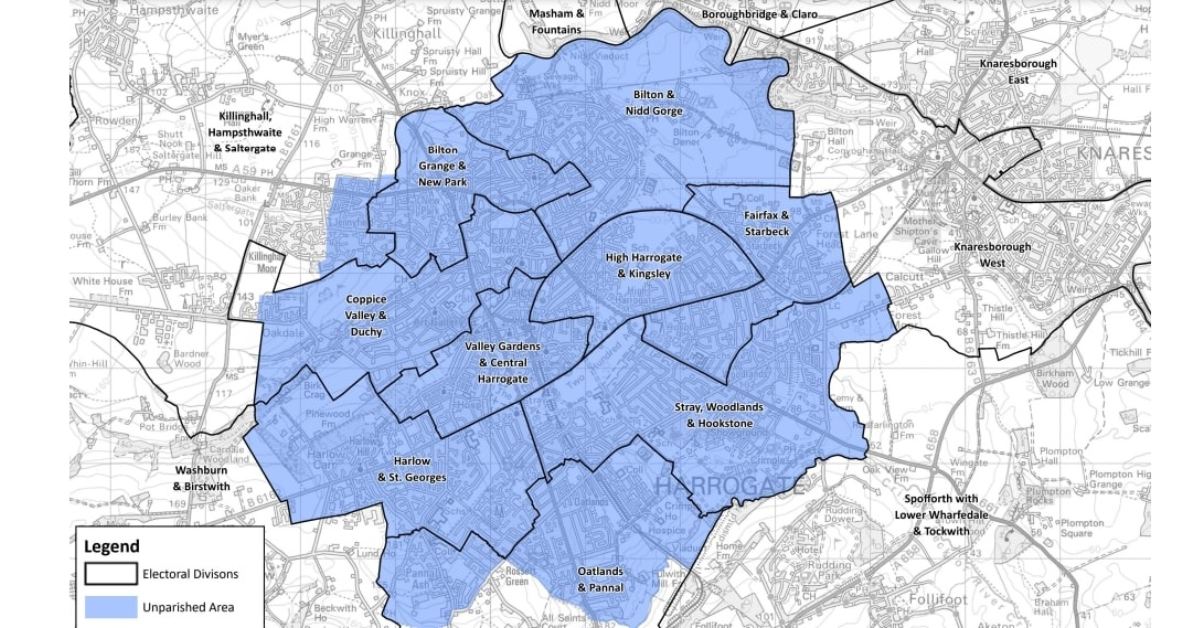
The blue areas face an additional charge.
The consultation says the names of the 10 wards of the new council be the same as the names of the existing county divisions, with the exception of the unparished part of the Oatlands and Pannal division, which will be known as Oatlands ward; and the unparished part of the Killinghall, Hampsthwaite and Saltergate division, which will be known as Saltergate ward. The ward names to be:
Bilton and Nidd Gorge
Bilton Grange and New Park
Coppice Valley and Duchy
Fairfax and Starbeck
Harlow and St Georges
High Harrogate and Kingsley
Oatlands
Saltergate
Stray, Woodlands and Hookstone
Valley Gardens and Central Harrogate
Councillor Greg White, the county council’s executive member for stronger communities, said:
“Town and parish councils give residents the ability to help to determine how the places in which they live look and feel. The benefits can be seen across our communities every day, so I urge people in Scarborough and Harrogate to seize the opportunity this consultation offers to have a say in shaping local empowerment where they live.”
Read more:
- Harrogate set to get town council after 75% back the idea
- Just 3.5% responded to Harrogate town council consultation
- Second consultation to be held on whether to form Harrogate town council
‘Strong support for proposals’
Cllr David Chance, the county council’s executive member for corporate services, said:
“Having received strong support in the initial consultation for the creation of new parishes and councils to serve them, we are keen to hear views from as many residents as possible on the detailed proposals we are now putting forward.
“If you took part in the first consultation, please share your views again on these detailed proposals. This is a separate consultation, so please make sure your views on the proposals are taken into account by completing the survey.”
You can take part in the consultation, which runs until Friday, May 5, here.
Or you can request a paper copy of the survey by calling 01609 536400 between 9.30am and 4.30pm, Monday to Friday, or emailing cgr@northyorks.gov.uk.
Second consultation to be held on whether to form Harrogate town council
A second consultation is to be launched into the creation of a Harrogate town council.
North Yorkshire County Council will write to households across Harrogate as part of an eight-week survey starting on February 20.
Harrogate and Scarborough are the only parts of North Yorkshire which do not have a parish or town council.
The second consultation is expected to be more detailed than the first one, which merely invited people to say whether they supported the idea.
Residents will be sent information including the number of councillors, assets and reasons for why it is needed.
A further survey on the matter was approved by senior county councillors today.
The areas in Harrogate which would fall under the new town council.
Cllr Michael Harrison, the Conservative executive member for health and adult services who represents Killinghall, Hampsthwaite and Saltergate, said while he supported the second consultation, he had reservations over the town council.
He said:
“Members will be aware of my concerns more generally about proceeding to the next stage of consultation. I have made my views both informally and on a one-to-one basis.
“We are removing a layer of local government by moving to a unitary authority and we are immediately going to be replacing it in the Harrogate area with another, so there is an underlying concern there.
“We are creating a likely future tax liability on a population without any real idea of what that tax would be or what the residents would get for paying that tax and I think that was one of the comments that came back in the consultation.”
Read more:
- Harrogate set to get town council after 75% back the idea
- Revealed: the Harrogate areas set for new council tax charge
- Just 3.5% responded to Harrogate town council consultation
However, Cllr Harrison added he understood it would be “an anomaly” to leave an unparished area in a county full of parish areas.
He said:
“I do acknowledge that there is an aspiration for double devolution with the new unitary council which clearly you could not achieve without a town or parish council for Harrogate.”
The consultation is set to be held instead of a local referendum, which the county council said was not “legally possible” after a request from Harrogate Borough Council.
The county council added it could not “fetter its discretion” to hold a referendum and that a further survey of residents may elicit a similar outcome.
Cllr Harrison told senior councillors that it was “vital” that every household was written to as part of the consultation in the absence of a referendum.
Referendum should not ‘slow down’ Harrogate town council creationA referendum should not slow the process of creating a Harrogate town council, local Liberal Democrats have said.
Harrogate and Scarborough are the only parts of North Yorkshire which do not have a parish or town council. However, a lower-tier authority looks set to be created after 75% backed a proposal in an initial consultation.
North Yorkshire County Council looks set to hold a second consultation on the plans instead of a local referendum.
Both Liberal Democrat and Conservative councillors in Harrogate called for a binding referendum over the matter in September last year.
However, local Lib Dems have now said that, while the party backed a referendum, they feel it should not slow down the town council process.
Cllr Chris Aldred, who represents Fairfax on Harrogate Borough Council, said:
“Harrogate and Knaresborough Lib Dems are in support of a town council and have been out talking to residents about the need to protect our local voice.
“We encouraged people to take part in a consultation last year and make their opinions known.
“Our council group voted in favour of a referendum but would not want to see a referendum process slow the establishment of a town council if the outcome of the public consultation showed strong support.”
‘Democratic legitimacy’
Cllr Richard Cooper, Conservative leader of the borough council, tabled a motion at a meeting in September last year calling for a referendum on the matter.
The resolution also said information should be made available prior to the referendum as to which services a new town council could provide, together with an indicative level of investment required to give “democratic legitimacy” to the process.
The creation of a town council will see Harrogate residents pay an additional precept on their council tax to fund its functions.
Read more:
- Harrogate set to get town council after 75% back the idea
- Revealed: the Harrogate areas set for new council tax charge
- Just 3.5% responded to Harrogate town council consultation
At the time, Cllr Cooper said a ballot had to be held before residents were asked to pay an extra tax to fund it.
He said:
“Asking the public if they want a new town council without informing them what it might do and how much extra council tax they would have to pay is not a meaningful conversation.
“And if as everyone tells me that the people of Harrogate are clamouring for a town council, then what do we have to fear?”
The Stray Ferret asked Cllr Cooper for comment on the news that a consultation couldl be held instead of a referendum, but did not receive a response.
Referendum ‘not justified’
A report due before North Yorkshire County Council’s executive on January 10 says a referendum “may not be justified” if a consultation is likely to give the same result.
Cllr Carl Les, Conservative leader of the county council, said in response to the borough council’s motion:
“It should be noted that it is not legally possible to hold a binding referendum to create a town council as the legislation does not provide for this and the council cannot fetter its discretion in this way.
“However we note the council’s request about how to carry out any future consultation.”
The report goes on to add that such a referendum may not “illicit a different response” to a consultation and that the additional cost may not be justified.
“It is not clear that a referendum would elicit a different response. There is no requirement under the law for a referendum to form part of a community governance review to provide democratic legitimacy to the outcome.
“The additional cost of a referendum may not be justified if the outcome is likely to be the same as writing to all households.”
Instead, the county council has recommended a second public consultation to be held for eight-weeks from February 20.
Just 3.5% responded to Harrogate town council consultationJust 3.5% of homes sent information packs as part of a consultation on creating a Harrogate town council bothered to respond.
Letters were posted to each of the 35,431 households on the electoral register in the unparished area of Harrogate inviting them to have their say on the subjects. Only 1,250 did so.
A total of 75% favoured setting up a town council but the low response rate triggered concerns about the validity of the response.
Establishing a town council, wit yet to be determined powers, would create an additional annual council tax charge for the 35,431 homes affected.
A report to North Yorkshire County Council‘s Conservative-controlled executive on January 11 recommends it proceeds with moves to create a 19-person town council in April 2024. But it says:
“There was some concern raised about the apparent low response rate and whether this gave a sufficient democratic mandate to create new town councils.
“It is further noted that whilst the rates are low, it is not unusual with the background of similar reviews and the Association of Electoral Administrators consultant has advised that it is sufficient to proceed with the response rate at this level based on previous reviews.
“The decision being requested is whether to proceed with a further set of consultations on a preferred proposal and the response rate and details of that consultation can be considered before a final decision is made.”
No referendum
The county council is also likely to ignore a plea by Harrogate Borough Council to hold a referendum.
On September 21, the borough council unanimously passed a resolution:
“This council calls upon North Yorkshire County Council to hold a binding referendum of Harrogate town residents who could become constituents of a new Harrogate Town Council to determine whether such a council should be formed.”
The resolution also said information should be made available prior to the referendum as to which services a new town council could provide, together with an indicative level of investment required to give “democratic legitimacy” to the process.
But the report to the county council quotes leader Carl Les saying:
“it should be noted that it is not legally possible to hold a binding referendum to create a town council as the legislation does not provide for this and the council cannot fetter its discretion in this way.”
Read more:
- Harrogate set to get town council after 75% back the idea
- Revealed: the Harrogate areas set for new council tax charge
Cllr Les adds the consultation, which will now proceed to a second stage, should merely “take into account” the views of the borough council. The report added:
Revealed: the Harrogate areas set for new council tax charge“It is not clear that a referendum would elicit a different response. There is no requirement under the law for a referendum to form part of a community governance review to provide democratic legitimacy to the outcome.
“The additional cost of a referendum may not be justified if the outcome is likely to be the same as writing to all households.”
Large parts of Harrogate, including Bilton, Starbeck and Jennyfields as well as central areas, look set to be hit by a new council tax charge.
North Yorkshire County Council said last week it would press ahead with plans to create a Harrogate town council after the results of an initial consultation revealed 75% in favour of the idea.
Areas covered by the new council, which will have 19 councillors, will face an additional charge on their council tax bills to pay for its services.
The sum is not yet known but Ripon City Council and Knaresborough Town Council currently charge £70.77 and £24.27 respectively for a band D property.
The areas facing new charges are:
- Bilton and Nidd Gorge
- Bilton Grange and New Park
- Coppice Valley and Duchy
- Fairfax and Starbeck
- Harlow and St Georges
- High Harrogate and Kingsley
- Oatlands (including the unparished parts of Pannal)
- Saltergate (including the unparished parts of Killinghall and Hampsthwaite)
- Stray, Woodlands and Hookstone
- Valley Gardens and Central Harrogate
A report on the consultation gave short shrift to calls by three respondents for Starbeck to get its own parish council. It said:
“No justification or detail was provided.
“It is considered that due to the small size of the area considered to be Starbeck, less than 6,000 electors, any parish council would not be in a position to provide services or amenities on the scale that could be provided by a much larger neighbouring Harrogate town council, potentially leading the the residents of Starbeck missing out on the opportunities to be provided by a larger town council.”
Read more:
- Harrogate set to get town council after 75% back the idea
- Harrogate district town councils to be invited to take on more powers
How is council tax calculated?
Council tax bills in the Harrogate district are calculated by adding the sums charged for services by North Yorkshire County Council, Harrogate Borough Council, North Yorkshire Police and North Yorkshire Fire and Rescue Service, plus any parish precepts.
Harrogate residents do not currently pay a parish precept because it does not have a town council.
This year’s Harrogate district Band D bill, minus any parish precept charges, rose by £72 to £2,079.59. This is how it was broken down.
- North Yorkshire County Council – £1,467
- Harrogate Borough Council – £255.92
- North Yorkshire Police – £281.06
- North Yorkshire Fire and Rescue – £75.61
The abolition of Harrogate Borough Council and North Yorkshire County Council on April 1 means the charge for their services will no longer exist.
However, the new North Yorkshire Council, which will replace them, has indicated it will charge Harrogate district households £23.47 less than the amount currently paid to the two councils.
The new Harrogate town council charge could mean devolution, hailed as a cost-saving exercise, could actually result in higher council tax bills.
However, a Harrogate town council is unlikely to be formed until May 2024 so any precept it charges will not feature in the calculations for council tax bills in 2022/23, which will be finalised in the new year.
Harrogate town residents have been spared a parish precept because they do not have their own town council, unlike other towns in the Harrogate district and the city of Ripon.
So the abolition of Harrogate Borough Council and likely creation of a Harrogate town council will affect them more than residents in places such as Ripon, Knaresborough, Boroughbridge, Pateley Bridge and Masham, which already pay a parish precept.
In a report to the Conservative-controlled North Yorkshire County Council’s executive, Barry Khan, assistant chief executive (legal and democratic services) has recommended opening a second, eight-week consultation on creating a Harrogate town council on February 20.
The executive will meet on January 10 to decide whether to accept the recommendation.
Harrogate set to get town council after 75% back the idea
A proposal to create a town council for Harrogate has received overwhelming backing from people and organisations who responded to an initial consultation.
Harrogate and Scarborough are the only parts of North Yorkshire which do not have a parish or town council.
North Yorkshire County Council said today more than two thirds of residents who responded to public consultations in the two towns were in favour to the idea of creating the new councils.
In Harrogate, 74.7 per cent were in favour of creating a parish council, with 14.5 per cent against, while in Scarborough the figures were 69.9 per cent and 18 per cent.
The recommendation for Harrogate is that a new parish be established for the currently unparished area of the town, and that the new authority be called Harrogate Town Council.
The parish would be divided into divisions, based largely on those that will apply to the new North Yorkshire Council after April 1. A total of 19 members would be elected to the town council.
The town council would be formed for administrative purposes from April 2024, and the first elections would be on May 2, 2024, when councillors would be elected for a reduced term of three years. Elections would then take place every four years from 2027.
Subject to approval by the council’s executive, there will be a further consultation on the draft recommendations between February and April to allow final recommendations to be presented to North Yorkshire Council in the summer.
Read more:
- Harrogate district town councils to be invited to take on more powers
- Harrogate district’s garden waste collection to remain county’s most expensive
On April 1 next year, North Yorkshire County Council, Scarborough Borough Council and Harrogate Borough Council, along with the county’s five other district authorities, will be replaced by a new North Yorkshire Council that will deliver all local services.
A central pledge in the case for this change was that town and parish councils would be enabled to take on greater responsibilities if they want to and can make a successful business case.
As centres of population without parish councils, residents of unparished parts of Scarborough and Harrogate were invited in summer to give their views on whether they wanted to create a council.
North Yorkshire County Council’s executive member for corporate services, Cllr David Chance, said:
“Parish and town councils have a vital role in representing their communities. That local voice is essential in understanding the issues facing a community at a local level and the needs of the people within that community.
“Although the new North Yorkshire Council will cover a large, diverse geographical area, it aims to be the most local in the country. We have made a clear commitment to work with town and parish councils, as well as other partners, to support and empower communities to drive local action and local priorities.
“Therefore, I am pleased that such a strong majority of respondents in both the Harrogate and Scarborough areas recognise the benefits of seizing this opportunity.”
Harrogate district council tax set to fall by £23 under devolution
Council tax bills for a Band D property in Harrogate are set to fall by £23.47 for the next two years as part of the transition to the new North Yorkshire Council.
Harrogate Borough Council currently charges the highest council tax of the seven district councils in North Yorkshire.
An average band D property in the district is currently £1,723.27, compared with £1,586.83 in Hambleton, which has the lowest level of council tax in the county.
The seven councils will be abolished on April 1 as part of the government’s devolution agenda and North Yorkshire County Council is to meet next week to discuss ways to harmonise the level of payment across the county.
Under plans being drawn up, Band D bills in the Harrogate district would fall by £23.47 a year for two years while Hambleton’s bills would increase by £89.49.
However, the rises and falls due to harmonisation do not take into account the annual increase in council tax bills, which is set to be approved by county councillors in February. The figures also relate to just the precept for county and district authorities, and do not include money for North Yorkshire Police, the county’s fire brigade and parish or town councils.
If a Harrogate town council is formed, the precept for people living in the town council area would increase.
Decision on Tuesday
The advent of a new council covering the whole of the county in April means there is a legal requirement to ensure all council taxpayers in North Yorkshire are charged the same amount.
The proposals to phase this in over the next two years will be considered by members of North Yorkshire County Council’s decision-making executive when they meet on Tuesday next week. They are based on recommendations by a cross-party working group of councillors.
The working group, which was established by the county council’s executive in June, considered a range of proposals, including harmonising council tax bills over a period of up to eight years.
Read more:
- Harrogate council refuses to say if chief executive will get payout package
- Councillors vote to defer decision on 53 homes in Bilton
North Yorkshire County Council’s executive member for finance, Cllr Gareth Dadd, who is also the authority’s deputy leader, said:
“The challenge to harmonise council tax bills across the county is obviously a significant one, but it is an issue we have to address before the new North Yorkshire Council is launched in April next year.
“We are acutely aware of the financial pressures which everyone is under not just in North Yorkshire, but across the whole country, as we see inflation rising and the cost of energy soar along with the price of food and drink and other essential items.
“A great deal of work has gone into the proposed scheme to harmonise council tax bills across all seven districts, and we believe that the plan that has been drawn up to introduce the changes over the two years represents the fairest way forward for everyone involved.”
There would be huge variations in the amount of funding generated if the decision was taken to opt for moving council tax levels to the lowest amount seen in Hambleton or choosing to adopt the highest level in Harrogate.
If council tax bills were brought in line with Hambleton, there would be an annual reduction of funding in the region of £21 million, falling from the current level of £401.8 million to £380.4 million.
By comparison, an extra £11.3 million would be generated by increasing council tax bills to the level currently paid in the Harrogate district, with the average across North Yorkshire for owners of a Band D property paying £1,723.27 instead of £1,676.32.
Funding from council tax is used to finance services ranging from waste collection and recycling to highways maintenance and adult social care.