An investigation by the Stray Ferret has found discrepancies in documents used by Harrogate Council to advise the planning committee between 2017 and 2019.
The council claimed that there was a shortage of land for new housing development and delayed submission of the local development plan.
During that time, councillors say they were “forced” to approve major developments to boost housing numbers.
Yet we have found evidence that could have given councillors greater powers to reject speculative planning applications earlier.
How Harrogate went from building too few new homes to approving too many
Government planning policy directs councils to ensure it has enough land on which new homes can be built –it must have a 5 Year Land Supply (5YLS).
This important statistic can decide the outcome of planning decisions.
Without one a legal situation is triggered which makes it’s easier for a developer to obtain planning permission.
Between January 2017 and September 2018, planning reports advised the planning committee that Harrogate didn’t have a 5-year land supply.
Our investigation uncovered evidence that Harrogate expected over 12 000 new homes to be delivered between 2019 and 2024. That equates to a land supply of more than 9 years.
It’s more than double the number of homes required by local housing targets approved by the Secretary of State for the same period.
We wanted to know how the district went from a housing shortage in August 2018 to a housing surplus in January 2019.
Key Documents:
The council produced a series of reports containing expected housing delivery rates throughout 2017 – 2019.
The Housing Land Supply Update is a document that publishes the rolling assessment of the district’s 5YLS – it’s revised and published every three months.
Between 2017 and 2018, these documents showed a deficit 5 YLS position.
From June 2018, these reports showed a ‘marginal’ 5YLS of 5.2 – just above the threshold required.
We have studied other documents the council produces:
The Strategic Housing and Economic Land Availability Assessment 2017 (SHELAA) gathered data about ALL land that the council considers suitable for development along with information as to when homes will be delivered on each site over 5, 10 and 15 year forecasts.
A Housing Background Paper sets out the council’s progress in achieving its policy objective of ‘accelerated’ housing growth with measured targets and delivery rates.
When we examined these documents, we found evidence of a much stronger position than the planning reports suggested.
A Timeline of Development in Harrogate:
December 2016:
Two years after it failed to adopt a Local Plan in 2014 The Planning Inspectorate rules that Harrogate still cannot evidence a 5YLS.
Harrogate was inundated with major development applications.
Even applications that had previously been refused were re-presented and approved.
For nearly two years, the planning committee made decisions based on the belief that they had to approve applications to boost housing numbers.
Yet documents reveal that in 2016 Harrogate identified new sites which the council believed would deliver over 1000 new homes within five years. Only a percentage though were included in the calculation of the 5YLS.
January 2018 Documents show that Harrogate was on track to deliver a whopping 9.7-year land supply by April 2019 – when the local development plan was due to be adopted.
But planning reports from the same month advised the councillors that the 5-year land supply had reached an all-time low of just 4.2 years.
Councillors continued to accept recommendations to approve applications to boost housing numbers.
June 2018 Housing Land Supply Update showed that that Harrogate had achieved a 5.02-year land supply.
However, the advice to councillors didn’t change.
Throughout July and August 2018, the planning reports were based on the earlier deficit position.
August 2018 The Housing Background Paper continued to state that the supply would increase to 9.7 years by April 2019.
The council submitted its local development plan for approval.
September 2018 The Planning Reports state that the council now has a ‘marginal’ 5-year land supply of 5.02 years.
Councillors are advised that approvals are still necessary to ensure that the fragile land supply is maintained.
January 2019 The Planning Inspectorate held hearings to determine if the council’s Local Development Plan was sound.
The Planning Inspectorate insisted that Harrogate cut its housing targets and drop 24 developments from the local development plan.
After the cuts, the planning inspectorate agreed that Harrogate retained a 6.87-year land supply.
The Planning Committee was now in a stronger position to take difficult decisions to refuse speculative and undesirable planning applications even against the advice of planning officers.
The Stray Ferret offered to discuss our findings with Rebecca Burnett, former Cabinet Member for planning and Richard Cooper, Leader of Harrogate Borough Council before we published. Neither agreed to be interviewed.
In a statement issued by the press office, the council said:
“Our approach to calculating housing land supply has been tested on a number of occasions at planning appeals and at the local plan examination. It was found to be in line with national policy and guidance.
“During the period where we did not have an adopted local plan, the housing supply position was kept under constant review and councillors were routinely briefed.
“It is absolutely ridiculous to suggest that councillors were misled in relation to the housing land supply. We have seen no credible evidence whatsoever to back-up this claim.”
We have been told by councillors of all parties how concerned they are at the council’s performance record on planning.
We also put a series of questions to Andrew Jones MP regarding planning within the district.
We have not yet received an acknowledgement to our email.
Read More:
- Harrogate Housing Investigation: district targeted for development during planning chaos
- Harrogate Housing Investigation: the politicians defend their records
Housing Investigation: 26,500 more cars on the district’s roads
If every home in Harrogate district’s Local Plan is built there could be an extra 26,500 cars on Harrogate’s already gridlocked roads, analysis from the Stray Ferret has found.
Many feel congestion on the district’s roads has already reached crisis point:
 Phil’s story
Phil I’Anson owns HG Heat in Harrogate and services boilers across the district. He told the Stray Ferret that in ordinary times traffic is crippling his business and could force him to relocate from Harrogate, which has been his home all his life.
Mr I’Anson said traffic has “gone crazy” in the four years since he set up his business, and it’s having a significant impact on his company’s bottom line.
“I spend approximately two to three hours a day in traffic in Harrogate. It costs me one or two jobs a day. That’s £150 a day and 20% of my earning capability.”
He said that it appears to him that neither HBC nor NYCC “has any control” over the congestion. “The builders seem to just do whatever they want,” he said.
Mr I’Anson also said that the impact of facing Harrogate’s traffic day after day is affecting his mental health.
“The most stressful thing I do isn’t running my company, it’s the traffic and driving around Harrogate. The work I can handle, but the traffic is what is stressful.”
And Mr I’Anson is not alone in his concern.
No strategic approach
Because Harrogate was unable to control where houses were built, it’s led to particular pressure points such as Skipton Road, where traffic regularly grinds to a standstill throughout the day.
At the time of writing, there are 15 new housing developments at various stages of construction in Harrogate, with trucks buzzing in and out transporting building materials from outside the district.
In October residents in the Whinney Lane area submitted their objections to a 270 house development to HBC- every resident cited traffic as a major concern:
“the road infrastructure in the area is already woefully inadequate to accommodate this and other existing new developments..”
“Whinney Lane and Lady Lane are country roads which are not capable of supporting additional traffic of at least 270 homes”
“traffic assessments cannot be viewed simply in terms of the increased traffic from a single proposal without looking at the cumulative impact of several developments in the area”
And it’s this cumulative impact that is causing serious problems for businesses like Mr I’Anson’s.
“I’ll move out of Harrogate. It’s just crazy. It’s spoiling the town for me.
“We haven’t got the infrastructure to keep building the houses they are building. At some point, it will become just gridlock but I’ll be gone by then hopefully. Where does it end?”
Harrogate’s gridlocked future?
Our figure of 26,500 extra cars comes from a North Yorkshire County Council formula.
The authority controls roads in the Harrogate district and asks each developer to include a set number of car parking spaces for every home they build.
For a one– or two-bedroom home, the minimum requirement is one space, but for three bedrooms and over it’s two spaces.
We analysed the number of bedrooms in different housing developments across the district to project a total figure of 26,500.
The real figure could be higher- according to a 2018 report by North Yorkshire County Council. 33,000 people who currently live in Harrogate and Knaresborough fall into the top 10% wealthiest people in the UK, which is almost a third of all people living in the two towns.
A government survey of household car ownership by income group found that 26% of people in this financial bracket own three or more cars, with more than 43% owning two.
As developers aim to maximise profits and build large homes to target high earners, those new owners will inevitably arrive with more cars.
Read more on our housing series:
-
Housing Investigation: New homes out of reach for too many locals
- Investigation: Harrogate targeted for development during planning chaos
- Housing case study: 75 homes forced on Killinghall after appeal
- Housing Investigation: infrastructure at breaking point?
Public transport
Public transport could hold the key to unlocking Harrogate’s congestion problems. However, according to NYCC’s congestion survey last year, just 6% of regular commuters in Harrogate will get the bus.
While some areas of the district, such as Killinghall, parts of Knaresborough and Ripon, are well served by Transdev buses, there are other pockets where housing is planned that have inadequate, or non-existent, bus services.
Kingsley Road is one of Harrogate’s main pressure points for new housing, with more than 600 homes mooted for development in the Local Plan, yet the nearest bus stop is half a mile away on Knaresborough Road. The furthest reaches of the planned development will be almost a mile away from the nearest bus stop.
Then there is the 600-home Manse Farm development on York Road, Knaresborough, which is served by the number 21 bus into the town centre, but it only stops nearby every hour and 40 minutes – and doesn’t run at all on a Sunday or after 5.15pm.
The 125-home Harlow Hill Grange development near Beckwithshaw, meanwhile, is not served by any bus routes. The number 6, into central Harrogate, has its closest stop more than half a mile away, up a steep section of Otley Road.
The half-hourly service stops running at 7pm on weeknights and Saturdays. On Sundays, an hourly service runs until just after 6pm.
For an elderly couple wanting to do a small shop in town, or a family going out for a meal, easy access to a frequent bus service at the right time could be the difference between using a car and not.
Accepted congestion problems
For Harrogate’s cycling community, the key to unlocking congestion is on two wheels.
Recently the government awarded NYCC £1million pounds to create additional cycle routes and walkways. But the construction of bespoke cycle routes (such as the one on Otley Road) has been painfully slow. Unless there is a rapid expansion of cycle routes in the next few years, many new home owners will be wedded to their cars.
According to North Yorkshire County Council’s congestion survey, the average car journey in the town is less than 1.6 miles.
But since NYCC scrapped plans for a controversial “relief road” through the Nidd Gorge, there has been little progress in tackling congestion around Harrogate. It means any roadworks such as the recent ones on Skipton road can bring the system to a standstill.
For many one of the very few joys of lockdown is how quiet the road network has been and the ease of moving around the district.
As normality returns next year Phil l’Anson and others like him will have to decide if the roads have become so congested he is forced to work elsewhere.
Tomorrow: in the final part of our housing series we’ll be looking at the environmental impact and sustainability of the new developments.
If you want to get in touch with us about any aspect of this series please email us: contact@thestrayferret.co.uk
Housing Investigation: infrastructure at breaking point?The Local Government Association says it “can’t be emphasised strongly enough” that quality infrastructure must be the starting point of any good Local Plan.
But Harrogate didn’t have a Local Plan for six years. Thousands of homes were built, yet there was no strategic plan for vital services such as schools and healthcare.
Mike Newall lives in a cottage on Whinney Lane – until recently, a quiet rural street on the west side of Harrogate.
The Pannal Ash area is now though surrounded by new development and faces the prospect of thousands of new homes over the next few years – changing the face of where he lives forever.
He is clear that both Harrogate Borough Council and North Yorkshire County Council have so far failed to ensure that residents will be able to access vital services when the housing is eventually built and asks:
“Where is the social infrastructure?
“Apart from a new primary school on Whinney Lane, where are the thousands of new residents going to get GP and dentist visits? Local surgeries and dentists are full. A normal appointment at Mowbray Square medical centre takes two to three weeks.
“It goes to show that prior to HBC having a local plan, the council were hobbled and exposed.”
Schools places
Harrogate Grammar School, St Aidan’s and St John Fisher are some of the highest-rated comprehensive secondary schools in the north of England.
The growing number of homes in the area has made the scramble for school places even more competitive, with high value placed on homes within the catchment area.
A freedom of information request submitted by the Stray Ferret to North Yorkshire County Council reveals that every secondary school in the district is heavily oversubscribed, and the situation deteriorated from 2018-2020.
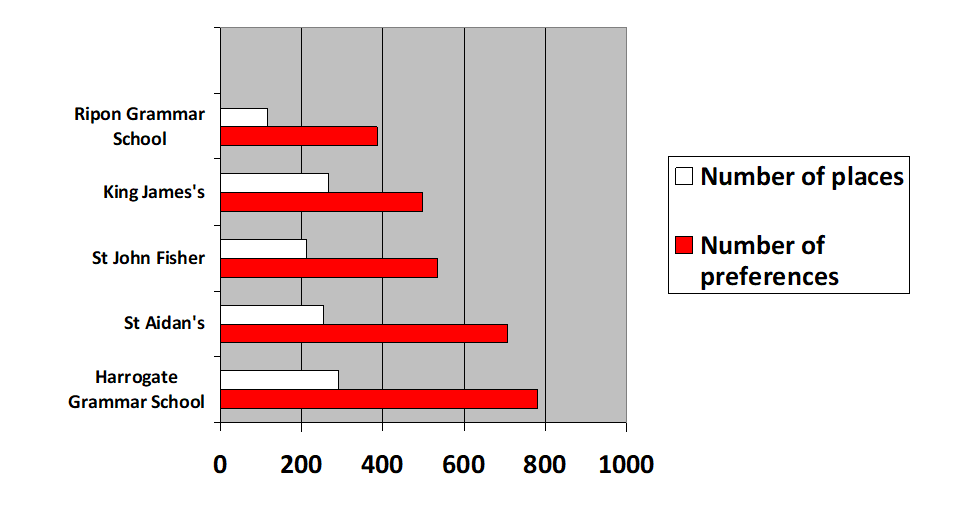
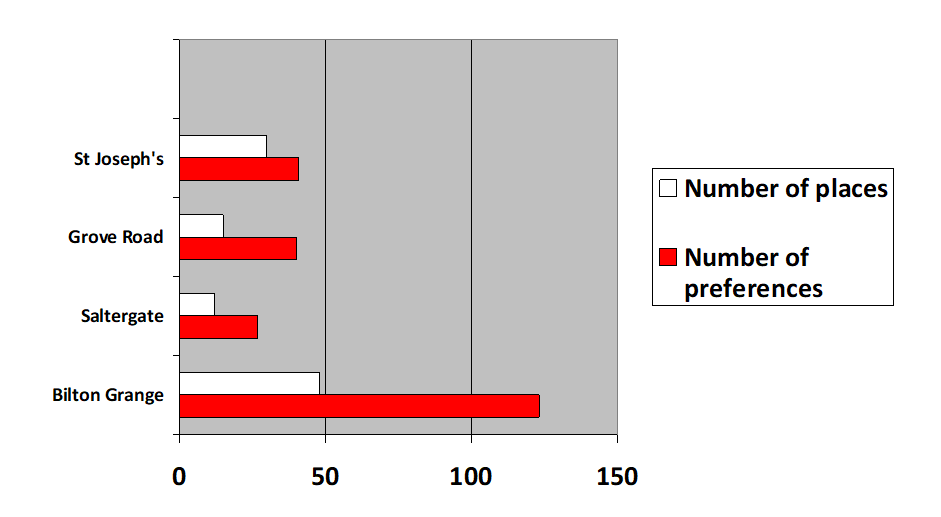
Similarly, primary school places are at a premium. The data reveals 55 of the district’s 71 primary schools were oversubscribed for 2020.
New primary schools have been included in plans at Whinney Lane in Pannal Ash and Manse Farm in Knaresborough, but in many cases where there are large housing developments planned, no new schools are proposed and the local primary schools are oversubscribed.
There are developments underway in the Kingsley Road and Granby triangle, as well as the Bellway and Persona developments on Skipton Road, with hundreds of homes between them.
There are several primary schools in the area that could educate children from the new developments- all are oversubscribed, including:
Doctors’ surgeries
While a scramble for school places could affect Harrogate’s youngest residents’ start in life, a rapidly ageing population means there will also be a greater demand on the district’s health services.
From the beginning of the Local Plan period in 2014, HBC forecasts a 54% increase in the local population of people aged over 65 by 2035 –that’s 18,720 more people– which will put GP practices in the district under increased pressure.
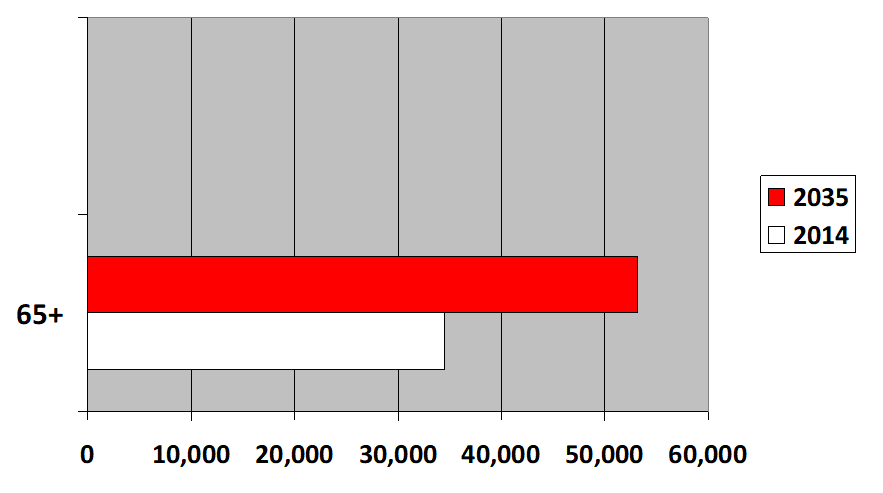
But other than Homes England’s 1,300-home development at Ripon Barracks, none of the major developments with planning permission in the district proposes to build new healthcare facilities to accommodate them.
There are currently 17 GP surgeries in Harrogate, Ripon, Knaresborough and the district’s villages.
But a 2020 NHS survey of GP practices found that the district’s practices did not score well for patients wanting to get a prompt appointment with their GP.
Read more of our housing investigation:
-
Housing Investigation: New homes out of reach for too many locals
- Investigation: Harrogate targeted for development during planning chaos
- Housing case study: 75 homes forced on Killinghall after appeal
Just 44% of patients at Beech House surgery in Harrogate said they were able to speak to their GP when they wanted to. At Leeds Road surgery, that number fell to 39%.
A spokesperson for NHS North Yorkshire Clinical Commissioning Group (CCG), in charge of healthcare provision for the district, said:
“North Yorkshire CCG is actively involved in discussions with the planning department at Harrogate [Borough] Council on all the large scale housing developments in the district so that the impact on local health services is taken into account and any appropriate funding is secured that can be used to provide additional clinical capacity within primary care.”
Following a recommendation from the government’s planning inspector, Harrogate Borough Council is currently developing a “Parameters Plan” for the Western side of Harrogate, where 4,000 more homes are mooted.
The intention is to consider sites as a whole in terms of infrastructure, public transport and sustainability, rather than a piece meal approach. But it’s been delayed which has left local residents group HAPARA very concerned.
Developers avoided paying for infrastructure
One reason why so little appears to be done to improve infrastructure is developers have been able to get away without making enough financial contributions – thanks, in part to a lack of a Local Plan, which has weakened the council’s hand with developers.
With no Local Plan, it meant HBC had no roadmap for how the new housing would impact on infrastructure in the district. It meant developers were able to fall back on national planning policy which says a development “should not be subject to such a scale of obligations and policy burdens that their ability to be developed viably is threatened”.
As a normal condition of planning permission, the council asks developers to sign what is called a section 106 agreement to help pay for infrastructure that residents will use.
For schools, the money could pay for bigger classrooms or more equipment.
But the Stray Ferret has learned through a freedom of information request that since 2014, Harrogate Borough Council has collected just £2.6m in payments from developers to help pay for schools, roads, health or public transport to cover the whole district.
Dr Quinton Bradley, senior lecturer in planning and housing at Leeds Beckett University, said developers in Harrogate have been able to use these viability assessments to argue their way out of paying.
Whereas if HBC had a Local Plan with a clear focus on infrastructure, it would have been more difficult for developers to do this.
He said:
“It’s money that should have come from developers and landowners, but the public taxpayer has to compensate because the developers didn’t pay it.”
The situation is so serious that the council has requested government introduces a Community Infrastructure Levy (CIL) to supplement Section 106 agreements. This is because the council has identified a £98m shortfall until 2035 to pay for infrastructure, including £42m for schools.
The cumulative effect of having no Local Plan has been significant, and it’s meant schools and healthcare facilities in the district have lost out on additional funds to service a rapidly growing population.
- Tomorrow : More than 26,500 extra cars on the road: one local man says congestion is putting him out of business
- Friday: Climate change: why the district’s new homes are already out of date when it comes to the environment
If you have any comments on our housing series or are personally affected in any way get in touch on contact@thestrayferret.co.uk