A landmark building on Harrogate’s prestigious James Street has been put on the market for offers over £3.85m.
The freehold of the property — home to the Harrogate branch of department store Hoopers — is being marketed by Green & Partners.
The particulars say the retail business has a remaining lease of two years and eight months, due to expire or be renewed in March 2025.
The description says:
“The property comprises a retail store arranged on ground, basement and three upper floors. Sales accommodation is offered over ground, basement and two upper floors with ancillary accommodation at third floor level.
“There is a main staircase and customer lift to the rear of the property which connects all five levels. The property is serviced to the rear with deliveries taken into the basement level via Market Place. The property lies within a conservation area and is not listed.”
Read more:
- Hoopers store warns: ‘Harrogate is not bulletproof anymore’
- Harrogate’s James Street to get 17-bedroom aparthotel
- Revival for James Street as major brands set to open doors
The building, at 28-32 James Street, extends to 1,904m sq and currently generates an annual rental income of £350,000 on a full repairing and insuring lease.
It was previously sold in 2010 for £5.95m, according to the Land Registry. If the guide price is achieved, it would represent a drop in value of more than 35% in the last 12 years.
The sales particulars state that James Street is viewed as “the prime retailing thoroughfare” and cite brands including Oliver Bonas, Joules, Hotel Chocolat and Whistles as examples of its “higher end boutique” shops.
The information also advises that options for the building include negotiating a new lease to Hoopers, or securing vacant possession in order to redevelop the site. The description says:
“Neighbouring properties have achieved planning permission to convert and extend upper parts into residential flats and we believe the subject property lends itself to a full redevelopment (STPP [subject to planning permission]). The property benefits from large and regular floor plates with good natural light.
“The property is also well situated in the town centre for residential occupiers as in close proximity to the train station, which would suit commuters to Leeds and York extremely well. Harrogate house prices are some of the most expensive in Yorkshire highlighting the popularity to live in the area.”
The Stray Ferret has approached Hoopers for a comment but has not yet received a response.
The building was previously home to Marshall & Snelgrove. The late historian Malcolm Neesam wrote about its history for the Stray Ferret’s history walks, available by clicking here.
Devolution prompts Ripon to take charge of city assetsHarrogate Borough Council’s impending demise following last week’s devolution decision has prompted Ripon councillors to secure the future of two city assets.
A ‘for sale’ sign remains in place outside Spa Baths, but city councillors at their July full meeting agreed to progress an application to nominate the Edwardian building for listing as an Asset of Community Value.
At the same time, they agreed to renew calls for Harrogate Borough Council to transfer the freehold of Hugh Ripley Hall — a building named in honour of Ripon’s last wakeman and first mayor.
Council leader Andrew Williams said:
“We have been told by Harrogate Borough Council that the freehold on the hall is not available and they have no plans to sell the building.
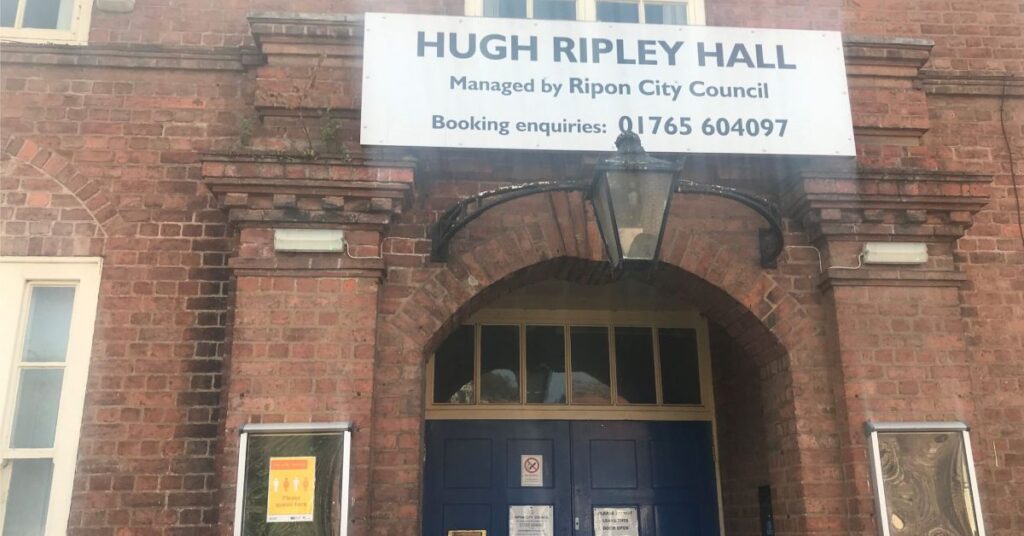
Ripon City Council wants to have full control of Hugh Ripley Hall.
“With our lease still having 30 years to run and changes coming about through devolution on the horizon, it would seem sensible for the city council to take over the freehold.
“Under the terms of the lease, we have responsibility for maintaining the building, but have to apply for permission from the landlord (Harrogate Borough Council) for any work we need to carry out on it.
“That’s just a complete waste of everybody’s time.”
Ripon’s Spa Baths reopened in May, after being closed for more than a year by the covid lockdown.
Weeks before the reopening, Harrogate Borough Council put the 116-year-old listed building up for sale, despite protests that it could lose its community use if bought by a private developer.
Groups including, Ripon Civic Society and Ripon Together have supported the city council’s call for the sale to be suspended, to allow more time for proposals to be brought forward.
With the call to put the sales process on hold rejected by Harrogate Borough Council, Ripon councillors are pursuing the asset of community value route.
If successful, it would secure the baths — a key element of the city’s spa quarter — for community purposes.
A spokesperson for Harrogate Borough Council previously said:
“We have no plans to withdraw the sale of Ripon Spa Baths.
“The building will soon become surplus to our requirements and we do not have the resources to maintain it.
“Selling the baths for redevelopment, subject to planning permission and listed building consents, would allow this local asset to be given a new lease of life, retain its key features and remain as a city landmark.
“Ripon City Council, or another interested party, is welcome to submit a bid.”
Read more:
- Will devolution affect HBC’s development and disposal plans?
- Report raises serious safety concerns about Ripon Leisure Centre
The spokesperson added that the building will no longer be needed when construction of Ripon’s new pool and refurbishment of the leisure centre is completed by November.
Property Gold: Are leasehold properties just modern day slavery? Property Gold is a monthly column written by independent bespoke property consultant, Alex Goldstein. With over 17 years’ experience, Alex helps his clients to buy and sell residential property in some of the most desirable locations in Yorkshire and beyond.
This week Alex looks at why leasehold property purchases are so controversial.
Leasehold reforms seem to be here, with the Government now intervening and yet again the PLC developers are in the news for all the wrong reasons.
In September, the four largest house builders were investigated after ‘troubling evidence’ was uncovered about how leasehold properties were being sold.
The CMA (Competition and Markets Authority) found that some leasehold buyers were being hit with ground rents that doubled every decade, pressurised selling tactics and informing buyers they could buy the freehold for a small sum, only to find out latterly this cost had increased significantly. This left many people in a position of never being able to sell – a modern day slave to leasehold ownership, you might say.
Whilst the Government took action last year against the developers, the ban was not retrospective. This left many stuck in unsellable homes with crippling ground rents. Too little, too late for them unfortunately.
How then has this all come about?
Be under no illusions, the PLC developers are all about money and profit margins. Ethics and morals aside, selling a leasehold house gave a PLC developer more angles to make money.
They could sell the freehold to an investor, who in turn could ratchet up ground rents and the developer doesn’t get their hands dirty. This would provide (up until now) a useful additional income stream and was all legal.
How, then, have people managed to buy such properties and be unaware of the pitfalls? Could it be that some PLC developers had a monetary referral system with a panel of ‘recommended’ conveyancing solicitors, who then overlooked updating buyers on the finer detail?
It’s easy money with limited input required – keep ground rents high for additional income (which also commonly had annual percentage hikes) and charge leaseholders to alter their homes. Combine these with poor building management and these properties become even harder to sell – hence the birth of the ‘fleecehold’ movement.
Now that the Government claim they want to resolve matters, will leaseholders have the opportunity to retrospectively claim their costs back for lease extensions or purchasing the freeholds? Equally, could this now open the floodgates for legal cases against the PLC developers?
What is clear, is that the PLC developers created various angles to squeeze more money out of a deal, meaning higher share prices, happier stockholders and bigger executive salaries.
Whilst the Government have promised that leasehold reforms are coming, there’s no reason to celebrate just yet. All eyes are on the detail, which will do little for those owners who have been already hoodwinked and are now enslaved to their properties. Thank your lucky stars you have read this and won’t fall for the same tricks!