Harrogate Borough Council has held onto almost £4 million of unspent money given to it from housing developers for social and community projects.
The Section 106 cash is agreed during planning talks to offset the impact of new housing and is intended to be used for improvements such as village hall refurbishments and new sports facilities.
More than £613,000 was spent on projects during 2020/21 – and the council has been praised by some communities.
But with around £3,730,000 unspent at the end of that period, there are concerns that many residents are not feeling the benefits at a time when the construction of hundreds of new homes is piling pressure on the need for community facilities.
Residents left with no community improvements
John Hansard, a member of Kingsley Ward Action Group, said the area faced the construction of around 700 new homes but residents have had “nothing at all” in terms of community improvements.
He said:
“Some of this money needs to come our way.
“Harrogate can’t cope with much more new housing and to think they want to build an extra 700 homes in our area is absolutely crazy.”
Tim Ellis, who also lives in the Kingsley ward, added:
“There is no community hall, no church halls and not even a pub any more, therefore nowhere local groups can have meetings.
“With all the new housing destroying the last of the fields, and new houses having tiny gardens, we will need a public park.
“The triangle of meadow and trees to the east of Kingsley Farmhouse bordering Kingsley Road would be ideal… but greedy developers are threatening to put houses even on this.”
Most of the money spent by Harrogate Borough Council during 2020/21 was on the purchase of affordable housing.
Cllr Tim Myatt, cabinet member for planning at the council, described the funding as a tool to “support future communities across the Harrogate district” and said other projects included new play areas and open space.
He also said the authority helped North Yorkshire County Council secure around £1.2 million in the last year for improvements to roads, sustainable travel and schools.
Read More:
- Ripon property owners to take complaint to insurance ombudsman
- Lack of affordable housing ‘killing’ villages in North Yorkshire
But when questioned by the Local Democracy Reporting Service, the county council did not say how much unspent money it has held onto.
A county council spokesperson said Section 106 money has a “significant lifespan” and that the funds will be used for their intended purpose “at the appropriate time”.
Call for review of section 106 contributions
Harrogate Borough Council said it was “not unusual” for the authority to have large sums of unspent money and there were several reasons why this is the case.
It said the money is sometimes paid in instalments and cannot be spent until it has all been received. It also said parish councils often ask for the money to be saved up for larger projects.
Despite this, Cllr Pat Marsh, leader of the opposition Liberal Democrat party, said the almost £4 million unspent by Harrogate Borough Council “does seem a lot” and has called for more regular reviews of how the money is spent.
The council also collects cash through Community Infrastructure Levy contributions, which are another type of charge on new housing.
These work on a pounds-per-square-metre basis and because of recent changes to Harrogate Borough Council’s charging schedules no contributions were collected during the last financial year.
It is now intended that a review will be carried out to develop a list of spending priorities and projects.
Cllr Myatt added:
“Payment of CIL is due upon commencement of development, therefore there will be a time lag of up to two years before the first CIL contributions are received.
“In the future, the CIL will provide us with a pot of money so that we can work with local communities and partners to provide the right infrastructure in the right places to support development and the continued growth of the Harrogate district.”

Strayside Sunday is our weekly political opinion column. It is written by Paul Baverstock, former Director of Communications for the Conservative Party.
Something different this week from me this week. A bit of a manifesto actually.
Having spent the last two weekends in the company of my adult daughters, I’m struck by the uncertainties they now face. When covid struck, Daughter 1 was furloughed; then, when it was realised that her employment had commenced too late to participate in the scheme, she was placed on 50% salary. And then, perhaps inevitably, she was made redundant. In the past month she has applied for more than 100 jobs, but to no avail; I suspect her experience is no different from that of hundreds of thousands of young people across the country.
Daughter 2 is now well into her third year of drama school; a middle-class child at a private university. She’s a worker (her father is from mill working stock) and earns money in her spare time working behind the bar at a pub. I’m afraid she’d better get used to it. As things currently stand, little opportunity for graduates is afforded by the arts and culture sector. In common with so many others, her sector is in crisis.
As a parent, I encourage, I console and I subsidise.
So, instead of sounding off from the cheap seats about the actions and intentions of others I feel compelled to set down some of my own views, such as they are, about how, in the age of covid, we need to think about repairing and renewing ourselves, each other and our society. And make no mistake, the economic and knock on social consequences of the pandemic will last at least a generation. We are emphatically not “post” covid and we won’t be for a very long time.
My view is that we need to take this time to think on and think deep, to re-examine the beliefs we have lived by heretofore and to ask ourselves whether or not they are fit for purpose, let alone fit to create a world we would want for our children and theirs.
My daughters, and yours, face a new reality. Their vista is nowhere near as pretty and compelling as my own was, thirty years ago. Surely we have a responsibility to ask ourselves what can we do to make things better for them?
In this column I want to outline three broad subject areas – inclusive growth, health and wellbeing and justice – to which I’ll return in future weeks, to explore in more detail and to place in local context. Additionally, in the age of the NHS Test & Trace App, I will touch on the dangers of the disruption caused by data and technology, if its benefits for capital are not balanced by a consideration for people. Technology is here, let’s give it a purpose.
So, for the record, I believe a good and prosperous society is one where economic growth is not, de facto, good. Inclusive economic growth – in which people can participate and engage actively in meaningful work, benefit fully from the fruits of that work, and be valued by both employer and government, with true agency in their economic and social relationships – builds better communities. Communities that thrive, rather than simply grow.
I believe that good health and wellbeing for people and children is a right to enjoy; governments and business are responsible for that achievement. Those rights bring responsibilities, so people must play their full part in looking after themselves. If covid has taught us anything, we must cherish our NHS, it’s our first and foremost democratic privilege. It is not simply an entitlement.
And I believe that justice should be available equally and for all, unconstrained by means, social standing or personal health histories. In turn, people have a responsibility to do the right thing. During lockdown most of us behaved properly (most of the time). Now, as we begin to feel the vice grip of restriction tighten on our movements and liberty; behavioural compliance is slipping – part fatigue, part defiance, on any view, wrong.
As we seek to build a good society, technology, data and artificial Intelligence are revolutionising democracy, the work of government, public service provision, human relationships and community fabric (whether these are ‘place-based’ or ‘of interest’). Further, data and technology are revolutionising traditional business models, their fundamental economics and the value-exchange (what we each get from the deal) they provide with consumers like you and me.
At the moment, technology is being harnessed almost exclusively for the good of capital. This balance needs to change; because technology offers us opportunities to make things better for all by connecting people through technology to tackle social exclusion blight, solitude and unwarranted loneliness; by using data insights and understanding to strengthen the human “ties that bind” people together in community; and by promoting data rights and agency to empower people in our new digital economy and in their relationship with government.
I could be wrong. I often am. But if we don’t anchor our values and the way we behave in new modes of thinking, the future looks bleak indeed.
That’s my Strayside Sunday.
Next Sunday Paul will be taking a break – Strayside Sunday will return on October 11th.
Read More:
- Strayside Sunday: Covid testing should be handled locally
- Local MP supports chancellor’s latest steps but the Lib Dems say it’s “too little, too late”
In Pateley Bridge there are signs of a gentle retail revival after the devastating impact of coronavirus.
This week, a bakers shop returned, adding to the two butchers, the oldest sweet shop in England and many other independent businesses, including cafes, pubs, restaurants and takeaways, that occupy the High Street.
In February, The Old Bakehouse, which had traded at the foot of the High Street for many years, closed its doors.
Now, six months later, new owners have refurbished the premises re-ordered the layout to cater for social distancing requirements and called their shop Yorkshire Born & Bread.
Read more:
- New councillor co-opted for Pateley Bridge Town Council
- Will Pateley Bridge box be disconnected off by BT?
The Chandler family – brothers Lee and Shaun and their wives Elizabeth and Tilly – are the joint owners of the new bakery and have already made a name for themselves in the town over the past four years, with the way in which they have transformed and expanded the Spar shop across the road.
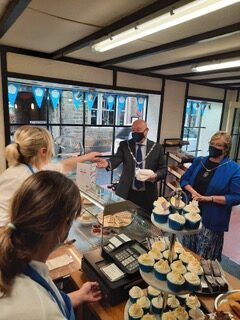
The Mayor and Mayoress of Pateley Bridge Councillor Mike and Dr Janet Holt (pictured above) performed the opening ceremony and were served with the first loaf of bread baked on the premises.
Afterwards, Cllr Holt, said:
“I took the opportunity to thank the Chandlers for the tremendous effort they have made to help the local community over the last five months, and to wish them every success in their new venture.”
During the coronavirus crisis the Spar shop has provided a central hub for free home deliveries made to people living in self-isolation throughout the Pateley Bridge area – a service supported by volunteers, including staff from the Bewerley Park outdoor learning centre.
Lee Chandler, said:
“The number of people in self-isolation has reduced, but we are still handling between 60 and 100 orders a week.”
The Chandler family, who were born, bred and educated in Nidderdale and proud of their Yorkshire roots, clearly don’t mind a challenge.
Tilly, told the Stray Ferret:
“We were all busy with the existing shop, but decided to open the bakery as well and just worked around the clock to make it happen.”