A sword that saw action in the Charge of the Light Brigade will go under the hammer at an antiques and fine art sale in Ripon on Saturday.
The sword was carried by Lieutenant John Chadwick, a troop leader in the charge of British light cavalry led by Lord Cardigan against Russian forces during the Battle of Balaclava on 25 October 1854.
Measuring just over a metre in length, the sword has been put up for sale by Lt Chadwick’s descendants and is expected to fetch between £500 and £700.
Regarded as one of the most infamous days in British military history, the battle lasted only 20 minutes and resulted in the deaths of 110 British soldiers with a further 161 wounded.
The near-suicidal charge was immortalised in Alfred Tennyson’s poem, depicting the plight of the 600-strong cavalry who rode into the ‘Valley of Death’.

Lt John Chadwick was one of only two officers taken prisoner at the battle. He managed to reach the Russian guns but his injured horse was unable to move any further and he was knocked from the saddle by an enemy lance.
The officer was taken prisoner by the Russians and released 12 months later at the end of the Crimean conflict. He died in Liverpool aged 52 in 1869.
Read more:
- 70 pheasants killed in blaze near Ripon
- Drainage channels installed in £10,000 scheme on Ripon street
Made by London firm Firmin & Son, the sword is decorated with an 1847 pattern. It is etched with a crowned VR royal cypher and accompanied by the name XVII Lancers, which is surrounded by scrolling foliage.
It is one of more than 700 lots at Elstob Auctioneers sale in Ripon
Auction house director David Elstob said:
“It is amazing to have an object with such a fascinating backstory.
“The Charge of the Light Brigade is such a well-known event in its own right but the fact that we know such a lot about the sword’s owner adds even more to its appeal.
“Lt Chadwick’s Crimea Medal, with clasps for Alma, Balaclava and Sebastopol were sold for £14,000 at a London auction house in 2020, so we are expecting a considerable amount of interest in the sword.”
The silver, jewellery, antiques and fine art sale features ceramics and glass, metalwork, silver, Asian art, objects of vertu, militaria, textiles, rugs and carpets, clocks and instruments, antique furniture and Yorkshire oak.
Other militaria highlights in the sale include an officer’s full dress sabretache of the 2nd Durham Artillery Volunteers, Seaham – a flat leather pouch with long straps traditionally worn by cavalry officers to the side of the waist belt – and a Victorian officer’s full dress sword belt of the Ordnance Department.
The auction starts at 9.30am on Saturday. All lots can be viewed online at www.elstob.co.uk and bidding on the day of the sale can be made in person, over the telephone or online.
Items can be viewed at the Ripon-based saleroom the day before the sale from 10am until 4pm.
Malcolm Neesam History: the colourful past of what could become Harrogate’s first mosque
Malcolm Neesam
This history is written for The Stray Ferret by celebrated Harrogate historian, Malcolm Neesam.
The first hospital for the people of Harrogate, as distinct from the Bath Hospital in Cornwall Road, was opened in 1870 in three cottages in Tower Street after an appeal by the Vicar of old St. Mary’s Church.
Placed under the supervision of Dr. Loy, patients paid from three shillings to seven and six a week, depending on their means.
Within a space of only two years, the new “Cottage Hospital” was found to be too small, so its governors investigated some property on the opposite side of Tower Street that belonged to a Mr. Hudson, which they purchased for £550, and after refitting, the hospital moved into these new premises in 1873.
The numbers of patients dealt with at the Cottage Hospital increased throughout the decade. During the half year between 13th September 1870 to 14th March 1871, 25 patients were admitted as bed cases and 63 as out patients. During the year 1877-8, the annual total numbered 66 bed cases and 213 out patients.
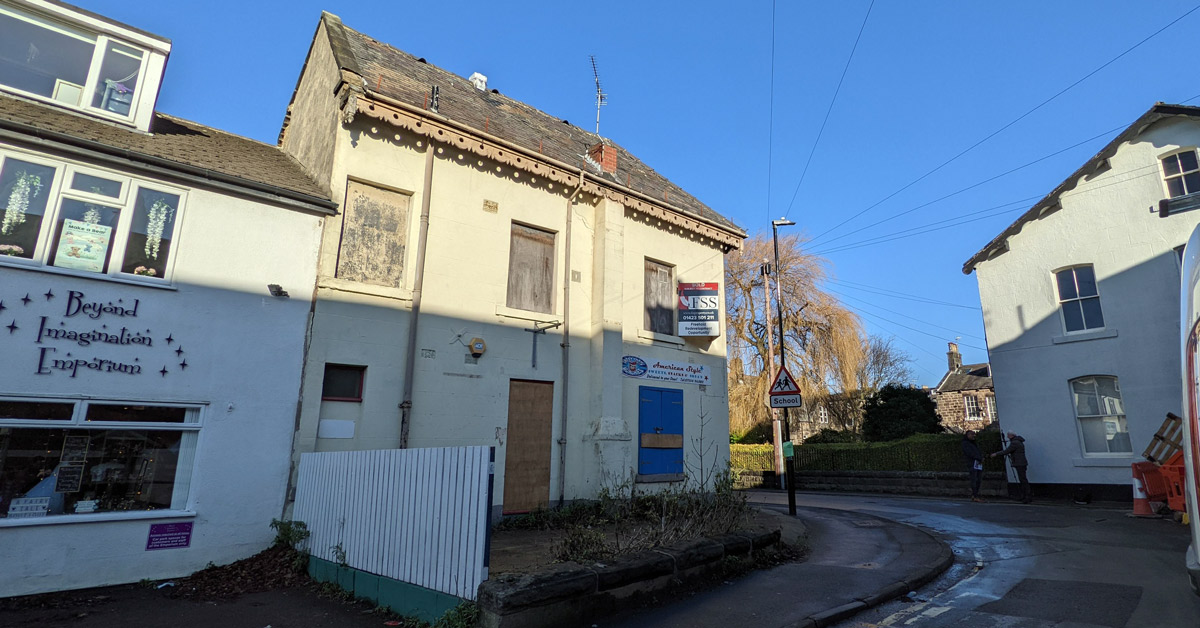
The former Home Guard club and potential mosque.
In June 1878 the highly esteemed Dr. Loy died. His successor was a Mr. Hartley, who did not remain in position for very long. He was succeeded in 1879 by Dr. Neville Williams as the institution’s medical officer. By the end of the decade, patient numbers had increased to 75 bed cases and 292 out patients.
Charge of the Light Brigade
Perhaps the Cottage Hospital’s most famous patient was Sergeant-Major Robert Johnston, who had participated in the infamous Charge of the Light Brigade, consequently receiving the Crimean medal, which later included clasps for his service at the battles of Alma, Balaclava and Inkerman.
In all, Sergeant-Major Johnston served his country for 22 years, 336 days, during which time his health deteriorated, which was probably why he came to the celebrated health resort of Harrogate.
When Sergeant-Major Johnston died at the Cottage Hospital on 28th November 1882, his funeral was attended by an estimated 20,000 people at a time when Harrogate’s population was around 12,000. He is buried in Grove Road cemetery.
Read more:
- Photos reveal hidden history of Harrogate’s abandoned railway tunnel
- Opinion: The big lie
- Malcolm Neesam History: the heyday of Harrogate’s cinemas
The following year, the hospital moved into new, purpose-built premises that now contain St. Peter’s School.
The Masons move in
In December 1883, the press reported that the old hospital premises had been purchased by John Richardson and Moses Perkin on behalf of the Harrogate and Claro Lodge of Freemasons, who paid £560 for the building.
They subsequently doubled the size of the building, adding to the older Tower Street section, which dates from the 1840s, the wing that now stands next to St. Peter’s School.
The Masons remained there until moving into their new Station Avenue building in 1931. A little later, the building at the corner of Tower Street and Belford Road was occupied by the Home Guard Club.
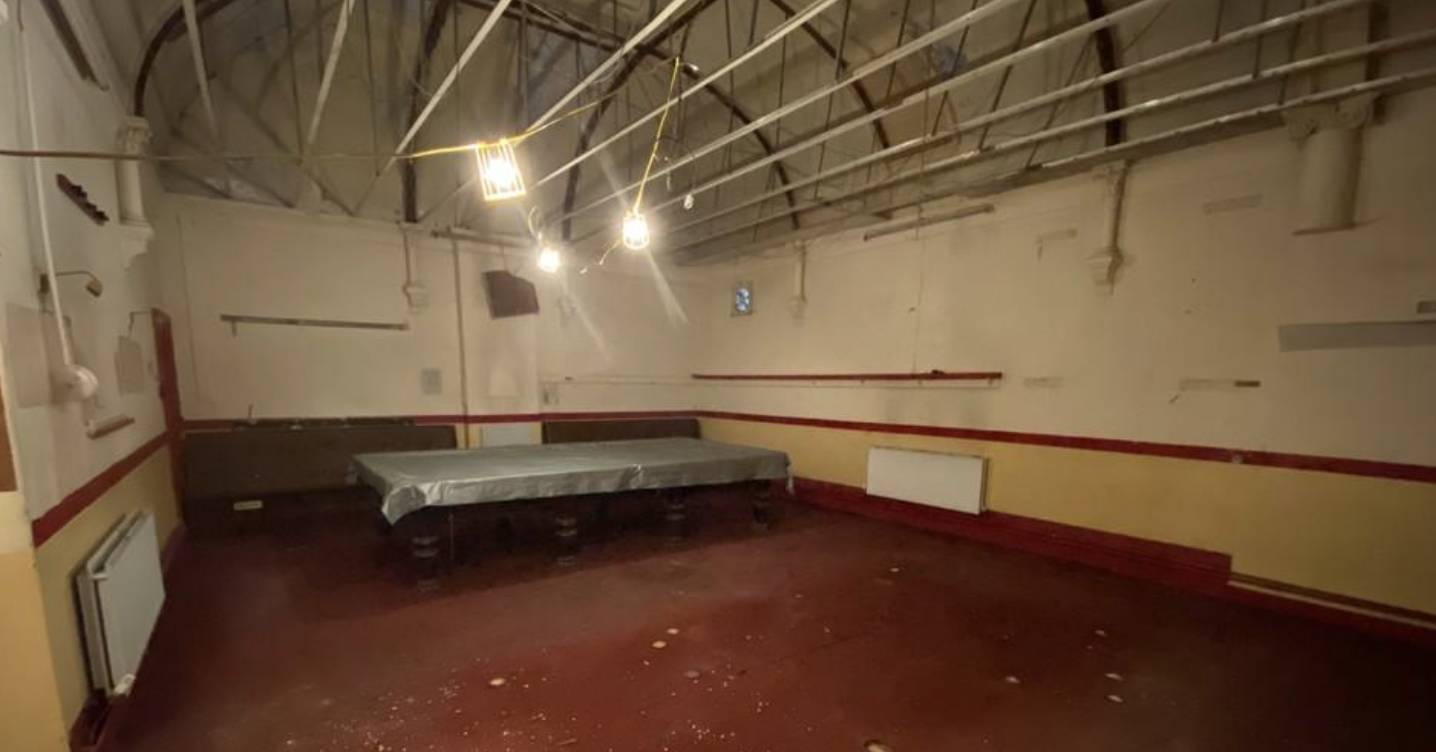
Home Guard members would play snooker at the club.
Today, the building presents a somewhat forlorn appearance to the passer-by, as its windows have been covered, the walls are badly stained, much of the external decoration has vanished, and pigeons have left unmistakable signs of their presence.
I was therefore not surprised to see an application to convert the building. I may be alone in this, but I would be sorry to lose this piece of Harrogate’s medical history, particularly in view of its connection with our Charge of the Light Brigade resident, if demolition occurs.
The building, even in its present condition, is an original feature of an especially delightful Victorian townscape, which if restored — assuming restoration is possible — would enhance, rather than diminish, the whole locality.