 Sue Hartley has a background in psychology and clinical animal behaviour and has been helping cats for over 10 years. Through a successful cat care business, volunteering with Cats Protection, as the Feline Welfare Manager at Battersea Dogs and Cats Home in London and now as a cat behaviourist in Harrogate through her business The Understood Cat.
Contrary to popular belief, training is possible with cats to support their welfare, whilst giving you the opportunity to interact with your cat in a positive, productive way. For example, you can train your cat to come when called, accept being touched or handled for basic health checks, and to help them into their carrier and to feel comfortable in there.
A survey by International Cat Care found that 50% of people struggle to get their cat into a carrier which is likely to be contributing to concern that many cats aren’t receiving the veterinary care they need (PDSA Animal Wellbeing Report, 2020).
At a basic level, cats learn by association. If a cat does something and the outcome makes them feel good, they’re more likely to do it again. The best way to train your cat is through ‘positive reinforcement’ – rewarding your cat for doing a desired behaviour.
With cat training, you’ll most likely be ‘shaping’ their behaviour by rewarding actions that get closer and closer to the end behaviour you want.
With carrier training, the first step is to get a ‘cat friendly’ carrier that looks like this:
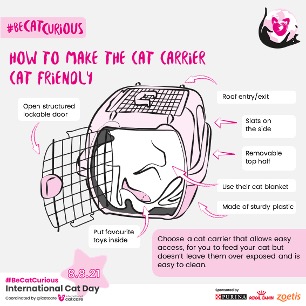
Next, think about where to do training with your cat – you’ll need somewhere quiet and free of distractions (including other animals). Think about how to reward your cat so they’re motivated to learn. People often use food, but some cats may be more motivated by a chin tickle or play. Play involves lots of activity so might not work well if the training lends itself to calm behaviour which is the case with carrier training.
If your cat loves their food and eats quickly, use a portion of their normal daily food allowance. If your cat is less food motivated, try commercial cat treats or small pieces of meat or fish. Each reward should be small – about half the size of your small fingernail or a lick or two of a squeezy treat.
To help your cat learn, check they’re happy, healthy, rested, and hungry (but not ravenous as they may struggle to concentrate on anything but the food!).
I worked with a client whose cat was really frightened of her carrier, so we started with a completely new carrier that looked different to the old one but still had the features of a good carrier. After removing the door and popping a snuggly banket inside, the carrier was placed in a quiet and ‘neutral’ area of the home – not in the room where the cat used to be put in their carrier for vet trips. The client then started leaving regular tasty treats in and around the carrier (e.g. a ‘treat trail’ leading up to it, treats scattered around it or inside). This was repeated in different areas of the home before following International Cat Care’s series of ‘bite-sized’ videos that walk through the carrier training process step by step.
The cat now likes her carrier so much that she’s regularly found catnapping inside it!
Read More:
Stray Mogs: Explaining a cat’s ‘If it fits, I sits’ mentality
Sue Hartley has a background in psychology and clinical animal behaviour and has been helping cats for over 10 years. Through a successful cat care business, volunteering with Cats Protection, as the Feline Welfare Manager at Battersea Dogs and Cats Home in London and now as a cat behaviourist in Harrogate through her business The Understood Cat.
Clients often ask me why cats love cardboard boxes? Scientists have been exploring why our feline friends seem to have a “if it fits, I sits” approach to selecting ‘cat nap’ spots.
The 2017 social media ‘challenge’ #CatSquare saw people sharing photos and videos of felines choosing to sit in masking tape square outlines on the floor. In May 2020, this photo emerged of stray cats in the Philippines spontaneously sitting in circles marked out for social distancing.
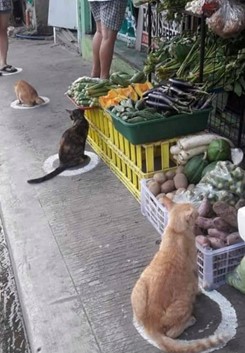
If cats like boxes and shape outlines, would they also sit in a box that’s an illusion? Like people and dogs, cats also get caught out by optical illusions. The Kanizsa square illusion involves a square with the perception of edges that aren’t there. Researchers found that cats opted to sit inside this ‘fake’ square nearly as much as they would a ‘real’ square.
So why do cats like to sit where they fit? Cats seem drawn to enclosed spaces and may reflect how important feeling safe and secure is to them. Research suggests that one of the most important things we can do to help our cats thrive in a busy home is to provide them with places to hide – the more the merrier.
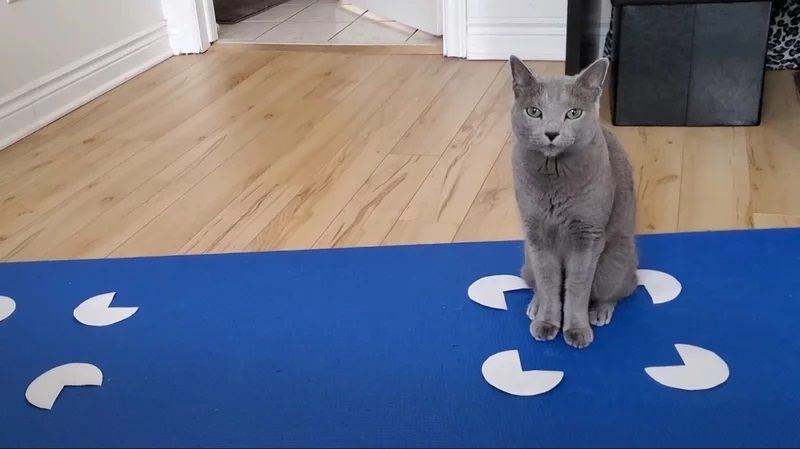
The Kanizsa square illusion
Hiding places should feel private and big enough for your cat to get in to easily and turn around and settle in. I recommend clients offer ‘igloo’ or ‘cat cave’ beds and cardboard boxes on their side with a towel draped over most of the opening.
Create hiding places under beds or by leaving the doors to wardrobes or cupboards open and pop blankets inside – but be careful not to shut your cat in!
Providing high-up ‘hideouts’ (e.g. on the tops of cupboards, wardrobes, shelf units) allowing a cat to survey their surroundings also go down well with our feline companions – check your cat can access them safely using steps, ramps or strategically placed pieces of furniture nearby.
Read More:
- Kim’s Canines: Holidays- fun for you, stressful for your dog
-
Stray Pets Rescue Club: George, Rupert and Biggie need your help
You can even create your own ‘kitty hideaway’ by recycling a large cardboard box and an old t-shirt that smells like home.
Follow ‘cat etiquette’ by not disturbing your cat when they’re in their hiding places as they’re likely to have gone there for some ‘me time’.
Places to hide are also key for cats in rescues helping them to settle allowing their personality to shine through so they can be matched to their forever home.