Ripon’s priceless military heritage assets are under threat once more after an about-turn from the government’s housing and regeneration agency Homes England.
Ripon played a major role in both world wars and the Cold War. The poet Wilfred Owen was among thousands stationed in the city during the First World War and the Laver Banks site played a pioneering role in military bridges. Further details are available here.
Military and civic organisations campaigned to preserve this heritage when plans were revealed to build 1,300 homes at the city’s barracks, which will be the biggest single residential development in Ripon’s history.
They thought the section 106 agreement agreed with developers when the project was approved last year would do this but Jane Furse (pictured below) a trustee of Ripon Military Heritage Trust, told the Stray Ferret:
“Homes England has said that the military heritage aspects of the barracks site has not been included in the section 106 agreement that they have been drawing up with North Yorkshire planners.
“This comes as a massive disappointment after we have fought so hard to ensure that the extremely rare and historically-important assets currently on the proposed housing development site have the legal protection that would be afforded through the 106 agreement.
“Homes England’s actions fly in the face of a democratic decision made at a Harrogate Borough Council meeting last February, when members agreed that a legally-binding agreement needed to be in place to protect the site’s military heritage.”

Ms Furse added:
“Ripon, as a military city played a crucial role in both world wars and the subsequent cold war period in areas ranging from bomb disposal to the development of Bailey Bridges that were used in many different theatres of war.
“Its Royal Engineers received the Freedom of the City in 1949 in thanks for their worldwide service and it is rather ironic, in a year when we will be marking the 80th anniversary of the D-Day landings, to find ourselves in an uncertain position with regard to the heritage that Ripon has built over decades, and which now could be lost to a housing development
“Our fight goes on and we will be pressing North Yorkshire Council to call on Homes England to carry out the wishes of the councillors who represent Ripon and the wider area.”

This heavy girder bridge over the River Laver on the barracks site was the successor to the Bailey Bridge.
At the Harrogate Borough Council planning meeting in February at which Homes England was effectively given the green light for the 1,300-home development to be known as Clotherholme, councillors agreed a clause, referring to: ‘provision within the s106 to secure a strategy to secure military heritage within the site.’
Without this in place any plans to preserve and promote Ripon’s military history and develop a trail that has potential to attract heritage tourists to the city will remain in doubt.
The Stray Ferret is seeking a response from Homes England.
Main image: Rare huts that were home to Second World War soldiers are among the heritage buildings the trust is trying to preserve. Picture RMHT
Read more:
- Ripon’s rich military heritage is under threat
- Council requires heritage assets at Ripon site to have legal protection
Ripon’s rich military history threatened by 1,300-home barracks scheme
Key parts of Ripon’s military past could be demolished to make way for the proposed 1,300-home development at the city’s barracks.
Homes England is seeking outline planning permission for the Clotherholme housing scheme, which would be the biggest single residential development in Ripon’s history.
Ripon Civic Society has now highlighted the potential loss of rare items that are part of Ripon and the UK’s military heritage.
The vital role Ripon’s military establishment played in both world wars and the Cold War has been highlighted in new research by the society.
Christopher Hughes, its chairman of the society, said:
“The site at Laver Banks is important in the history of Ripon’s past and in the defence of Britain in World War II and since.
“We have done detailed work on the Homes England proposals for the whole of the army camp site. We encourage them, and Harrogate Borough Council, to take a revised look at proposals for demolition of some of the structures our research has identified, and to protect them for the future.”
The society has been closely engaged in the planning process and has been keen to stress the importance of the last remaining remnants of the city’s vast World War I camp, in which the poet Wilfred Owen was stationed.
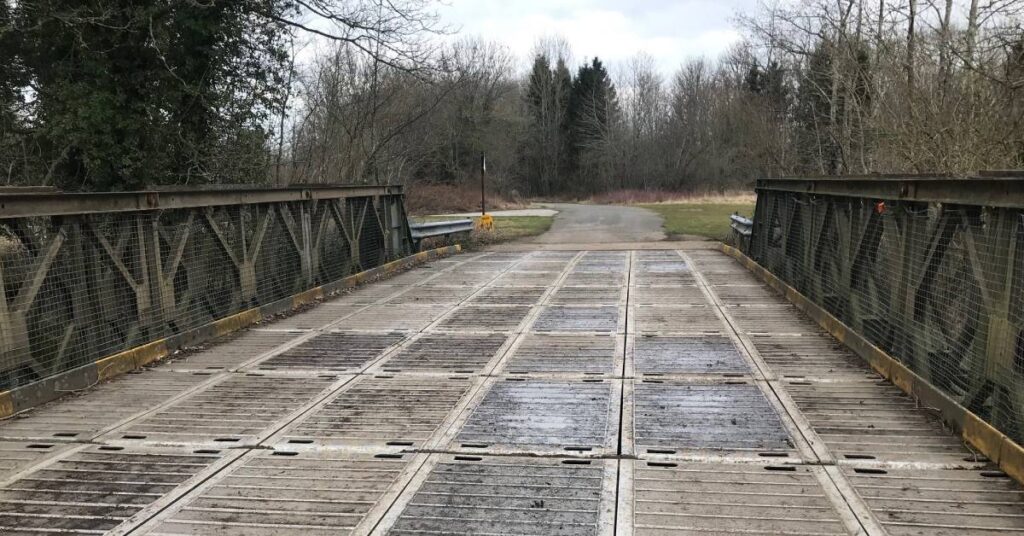
The heavy girder bridge, which crosses the River Laver on the Barracks site, was the next generation of the bridge designed by Sir Donald Bailey.
Setting up Ripon Military Heritage Trust to aid further research, it has now discovered that from the start of World War II the remaining site was the test-bed for developing and trialling demountable bridges, including the world-famous Bailey bridge.
The School of Military Engineering was evacuated from Chatham in Kent to Ripon at the start of the war.
Military heritage structures
Ripon architectural historian, lecturer and writer, David Winpenny, who is a vice-president of the society, said:
“As well as providing training for engineers on the Bailey bridge, the school also developed the massive Bailey Suspension Bridge, capable of spanning up to 400 feet.
“It was tested in Ripon at the Laver Banks site of Ripon Camp by British, Canadian and American troops before being deployed in Burma and other theatres of war.
“From 1946 a new heavy girder bridge was developed; by 1955 60 had been ordered. The first to be put in place was over the River Ure in Ripon. It was mainly used in West Germany as well as in Malaya.
“Development continued in the following decades. The only surviving heavy girder bridge was installed in Ripon as late as 1992.
“Ripon also has the larger of only two surviving k‘demolition’ training bridges, designed with cavities in which explosives could be packed to eliminate the bridges before an enemy assault.
Read more:
- Consultation on 1,300-home Ripon Barracks site closes on Wednesday
- Artworks honour Ripon’s military past
Mr Winpenny added:
“As well as these rare survivals, and the still-extant infrastructure of the testing site, the Ripon Camp also has the last four Twynam Huts remaining; these were the successors to the Nissan Huts and were developed in 1959 for use as accommodations for personnel, offices and stores.
“They were deployed worldwide, including in Cyprus, Aden and Libya, as well as on Ascension Island during the Falklands War and at Long Kesh Camp in Northern Ireland.”
‘Amazing how significant Ripon was’
The society has shared its findings with Homes England, which is responsible for the transition of the site from army camp to housing and employment site, and with Harrogate Borough Council, which will determine the planning application.
It has said that these significant but vulnerable remnants of Ripon’s military past require special protection as part of the planning process. The society wants to work closely with all parties to establish a community legacy for Ripon and the wider area by promoting and interpreting the site.
Guy Wilson, creator of the Royal Armouries museum in Leeds, and one of the Ripon Military Heritage Trust trustees, said:
“It is amazing how significant this quiet part of North Yorkshire was in the Second World War. What was happening in Ripon helped us to win the war and our research has discovered how important Ripon was in the development and perfection of the Bailey bridge and its successors.
“It is a story hitherto unknown but one very worth telling and remembering.”