Read more:
- FunFest brings more free activities for Ripon families this weekend
- Ripon diving hero adds to his golden hoard
A world where everyone’s life must end at the age of 90 is the setting for a Harrogate author’s first novel, due to be published next month.
The action in Deathday, by Colin Philpott, takes place in England in 2045, where euthanasia is not just legal but compulsory, and where severe economic depression in the wake of “the Great Pandemic” and Brexit, a collapse in the care system and inter-generational conflict have changed attitudes to death and old age.
Those people who still accept the law, plan for “Deathday parties”, while “evaders” try to escape abroad and “remainders” – people already over 90 who were spared at the time the law came in – live in colonies in rundown seaside resorts.
Meanwhile, the young King plots with politicians opposed to the laws which are enforced by the sinister National Age Regulation Authority.
The novel, which is published by Fisher King Publishing, is set in several different parts of England, including Yorkshire, Northumberland, Greater Manchester, Cambridgeshire, Norfolk and London, and includes scenes in Harrogate locations such as Brimham Rocks, the Royal Hall, and the Army Foundation College.
Colin Philpott, who lives in Bishop Monkton, said:
“I was inspired to write this novel after witnessing the differing end-of-life experiences of members of my own family, and also my experience as a volunteer with a food delivery and befriending charity.
“I am not advocating compulsory euthanasia, but I do believe society needs to create a higher quality of life in old age and radically rethink our approach to end-of-life care.”
Deathday is Colin Philpott’s first work of fiction. He has previously written three books about 20th-century history: A Place in History, which includes the stories of places in Britain touched by news events; Relics of the Reich, which examines how Germany has dealt with the buildings left by the Nazis; and Secret Wartime Britain, about hidden places in Britain that helped the war effort in the Second World War.
Colin worked for the BBC for 25 years as a journalist and senior executive. Later he was director of the National Media Museum in Bradford.
Rick Armstrong, managing director of Fisher King Publishing, said:
“We’re delighted to be publishing Colin Philpott’s debut novel. When I first read the manuscript, it was clear that the basis of the narrative is highly thought-provoking, tackling very pressing contemporary issues in an interesting and clever way.”
Deathday will be published on April 24 and will be available in print and digital versions worldwide.
Harrogate’s ex-Cold Bath Deli owner publishes first novel
A BAFTA-nominated investigations journalist who lives in Harrogate has published his first novel.
Peter Woolrich, who along with his wife Tracey used to run Cold Bath Deli on Cold Bath Road, spent 12 years working on A Corroded Soul.
The novel is based on his own life as it tells the story of a 50-year-old journalist with questionable character traits who evaluates himself after his mother’s death.
Mr Woolrich said:
“During my career I had guns, knives and a samurai sword pulled on me. I’ve worked for national newspapers, magazines and television.
“In writing my book, you might say I’ve turned the spotlight on myself rather than criminals.”

Peter Woolrich
The novel is set in a fictional village similar to the one Mr Woolrich grew up in and is the first in a planned trilogy.
A Corroded Soul‘s main character, Daniel Connah, uses his difficult relationship with his mother as justification for multiple character flaws, including stealing and being a social misfit and sex addict.
Mr Woolrich, along with Daniel, said he also felt unloved by his mother. When Mr Woolrich’s mother died after a car crash, he was consumed with anger, abandonment and feeling bereft and the book explores whether emotional neglect can be as damaging as physical.
He said:
“Don’t get me wrong, I wasn’t beaten or sexually abused in horrific circumstances like many youngsters, but it’s amazing how many people feel damaged by being raised in an unloving environment.
“Some readers have said Prince Harry expresses similar sentiments in his book. Perhaps it’s a question of where we think individual responsibility begins and ends.”
A Corroded Soul is available in bookshops and can be viewed/ordered here.
The book launch, which is open to everyone, is being held upstairs at North Bar in Harrogate at 7pm on April 6.
Ripon author wins Swanwick short story competition
Prolific Ripon author Ian Gouge, is joining a distinguished group of UK writers after being selected as the 2022 winner of the Swanwick Short Story Competition.
The sought-after annual literary prize attracts hundreds of entries and his story titled Park’n’Ride caught they eye of the judging panel.
In addition to the prestige of winning the competition, his award includes a week-long place at the famous Swanwick Writers Summer School in Derbyshire.
He will also gain wide exposure through the publication of his story in Writing Magazine.
Ian, who has recently been appointed as the Author in Residence at Ripon Library, told the Stray Ferret:
“This is the first time that I have entered the Swanwick and I was both surprised and delighted when I received an email saying that I had won.”
His 900-word story drew on the experience of overheard conversations on tram journeys that he took while working in the IT industry in Nottinghamshire.
Ian, who is also a publisher and acts as a mentor to fellow creative writers and poets, said:
“If you are a good listener, you will gain a wealth of material that can provide the inspiration for stories and poems that reflect real-life situations.”
His imagination has enabled him to develop characters and storylines from the age of five, when he wrote about a boy who went into space. He also produced accompanying illustrations.
More than 50 years later and with the IT career behind him, Ian has a growing portfolio of published works including six novels, three short story collections, eight poetry and four non-fiction books.
Working with American poets, most of whom live in California, he leads a virtual Transatlantic reading group and has published four international anthologies and a further anthology featuring the poems of Yorkshire-based poets.
With the Swanwick prize now added to his CV, the versatile and experienced author and publisher, has another novel and short story collection in the pipeline and, will continue to help other creative writers to achieve the dream of seeing their name in print.
Newcastle novelist Mick Herron has won the Theakston Old Peculier Crime Novel of the Year 2022, presented by Harrogate International Festivals, for his crime novel Slough House.
The announcement was made at The Old Swan Hotel in Harrogate last night during the opening ceremony of the Theakston Old Peculier Crime Writing Festival, which runs until Sunday.
The book, which is the seventh installment in the bestselling series of the same name, follows a band of failed spies.
This year marks Herron’s first time winning the award after five appearances on the shortlist in just six years.
The author received a £3,000 prize, as well as a handmade, engraved beer barrel provided by T&R Theakston Ltd.
Mick Herron said:
“This is the most coveted trophy in the crime writing community and I couldn’t be more thrilled to have won it.”
Sharon Canavar, chief executive of Harrogate International Festivals, said there was “an incredibly strong shortlist”.
The festival will see crime fiction icons including Kathy Reichs, Tess Gerritsen, Denise Mina, Lynda La Plante, Mark Billingham, Ann Cleeves and more take to the stage to discuss all things crime fiction at the world’s biggest celebration of the genre.
For more information on the line up and tickets, visit here.
Obituary: Malcolm Neesam 1946-2022It is doubtful whether anyone has known more about Harrogate’s people and places than Malcolm Neesam, who died on his 76th birthday this week.
Malcolm, who wrote about a dozen books and numerous other publications about the town, dedicated much of his life to telling Harrogate’s story. He did it better than anyone and will be remembered as the town’s greatest historian.
He had an encyclopedic knowledge of the buildings and people that shaped Harrogate but he was also gentle and modest, and never boastful or condescending in print or real life.
Underpinning it all was a deep love for the town, and in particular the Stray.
Born in a nursing home on Ripon Road in Harrogate on June 28, 1946, Malcolm’s father worked for a rubber company that manufactured soles for footwear.
Sunday afternoon walks with his mother stimulated his interest in history at the age of six or seven. She would often talk about things they passed. “I didn’t need a playground,” he once said. “I had the Stray.”
He attended St Peter’s Church of England Primary School, “a very happy little school”, as he described it, and then Christ Church Secondary School for Boys. The school, which was situated between the Empress roundabout and Christ Church on the Stray, amalgamated with St Peter’s Secondary School for Girls to create St Aidan’s Church of England High School more than 50 years ago. Retirement flats now occupy the site.
In his last year at Christ Church, Malcolm’s parents noticed an advert for an assistant at Harrogate library and thought his developing interest in history would make him suitable.
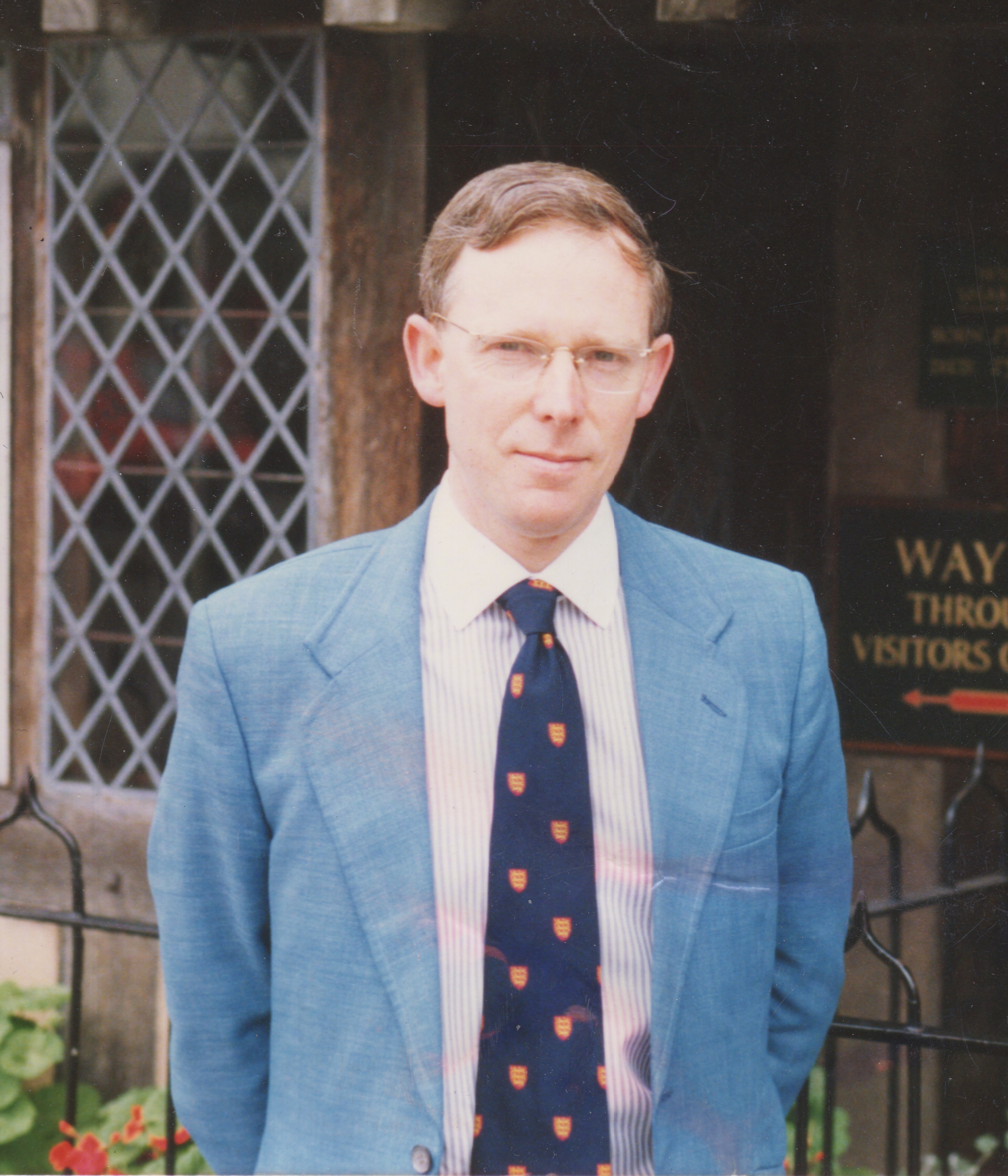
Photographed in London in 1988. Pic by Benedict Hess
After three years in that role he accepted a post at Leeds University studying archives and librarianship. He later attributed his thoroughness at gathering source material for books to his training as an archivist.
Malcolm then moved to Hereford for four-and-a-half years to set-up the city’s first children’s library service before moving further south to Northwood, in the London borough of Hillingdon close to the Metropolitan line, to work as an archivist for the Duchy of Lancaster.
He did this for three years before going to York, shortly before local government reorganisation in 1974, to become city music librarian.
But when reorganisation changed everything, Malcolm was offered a post by the new local authority as county music librarian, which involved buying music for county library services. Being a great lover of classical music, he was perfectly suited.
He stayed in York until 1996, overseeing new methods of administration, storage and repairs as technology changed and vinyl was replaced by cassettes and then CDs in North Yorkshire libraries. All the time he commuted from Harrogate.
He admired York’s decision to effectively pull out of North Yorkshire local government and become independent in the 1990s. Malcolm hated the trend towards ever more remote forms of local government, which will culminate in the creation of North Yorkshire Council next year and the abolition of seven district councils, including Harrogate Borough Council. He felt the more decision-making left Harrogate, the more the town lost control of its wealth and character.
In 1996 he received an offer to work for an American company called Alumni Holidays, which arranged holidays for former university students.
He had done some guiding in York, which proved useful in his new role in which he gave lectures on subjects such as Scarborough, York and the Yorkshire Dales, Yorkshire architecture and Yorkshire literature. Alumni Holidays was horrified by his initial omission of James Herriot so the author was eventually added to his list of topics.
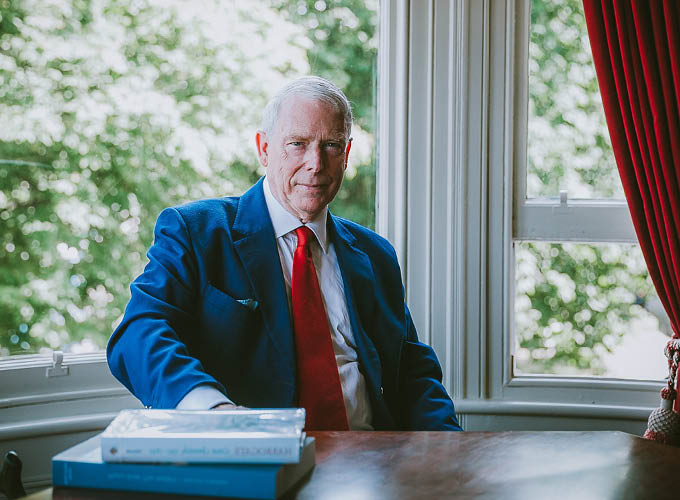
Malcolm worked for the company on a freelance basis for 10 years but the Madrid train bombing in 2004 severely disrupted business by leaving many Americans too afraid to travel to Europe.
In 2006 he decided to concentrate on writing full-time. He had written short stories at school but didn’t let anyone see them. His writing career had begun in 1973 when the Library Association commissioned him to write a guide to children’s sci-fi called Into Space. It went to nearly every library in the country.
A founding member of the Harrogate Society, which later became Harrogate Civic Society, he was asked by local firms such as Ogden, Raworths and William Woods to write books for them. He also undertook research for plaques. His writing career, he said, “grew in stages”.
Harrogate in Old Picture Postcards was published in 1992, followed by Exclusively Harrogate in 1994 and Harrogate: A History of the English Spa from the Earliest Times to the Present in 2001. His works also included a centennial history of Harrogate Grammar School in 2003.
During this time he became, in the words of Harrogate and Knaresborough MP Andrew Jones, “the chronicler of our town”.
The two books of which Malcolm was proudest are Harrogate Great Chronicle 1332-1841, which was the product of 40 years work, and Wells and Swells: The Golden Age of Harrogate Spa, 1842–1923, which was published in April this year. His beloved Harrogate Club named its dining room in his honour at the book launch. By then, Malcolm was in the advanced stages of the cancer that would claim his life and it was a deeply emotional occasion at a place that meant so much to him.
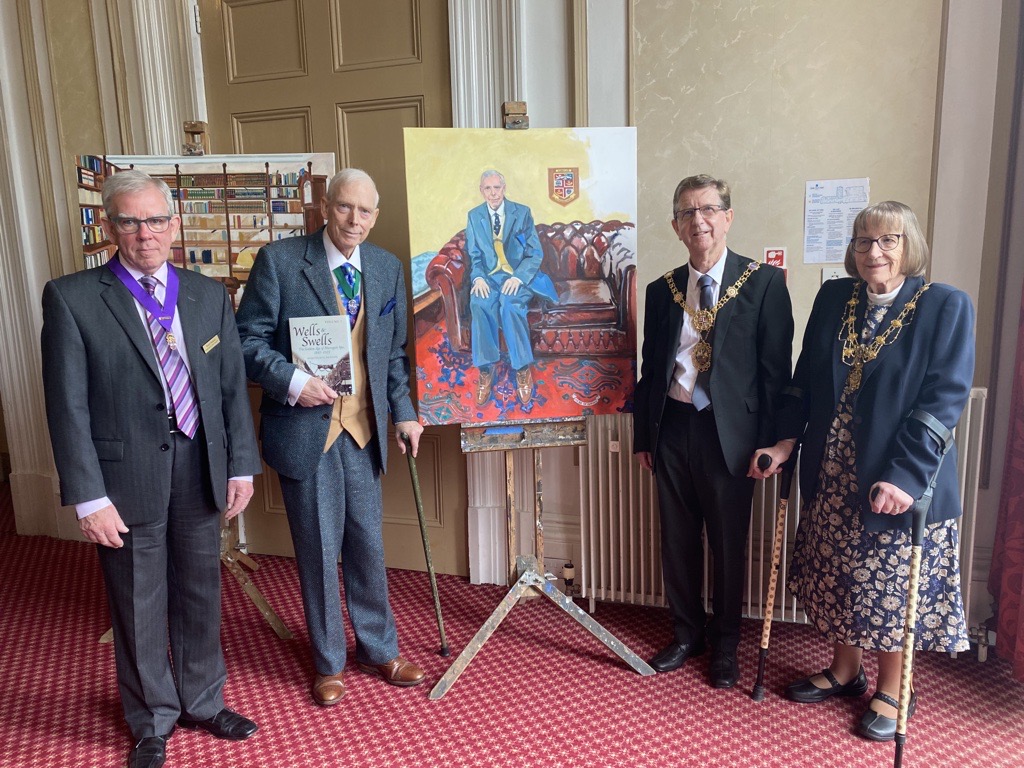
Malcolm Neesam at the launch of his final book, Wells and Swells.
He started work on a third volume, covering Harrogate’s history since 1923, fully aware he was unlikely to finish it.
Before Malcolm, William Grainge, who died in 1895, was considered to be Harrogate’s foremost historian. Grainge had published books and short publications about the town in the 1860s and 1870s, but nothing substantial. Malcolm described Grainge’s style as “too chatty” whereas he focused more on the history.
He and the late Harold Walker, a historian and one-time editor of the Harrogate Herald, set up the Walker-Neesam archive, ensuring their collective research could stay for ever within the town.
His vast collection of papers and photo library will go to Harrogate’s Mercer Art Gallery. Organising them won’t be an easy task: thousands of brown envelopes assigned alphabetically by subject took up an entire room at his home.
Malcolm gave a typically modest answer when asked why he only wrote about Harrogate, saying: “Some writers can turn to anything. I can only write about things that interest me.”
Malcolm was instrumental in establishing the listing of many buildings in the town and in establishing the first conservation area. He was also the founder historian of the Harrogate Brown Plaque scheme.
He was a member of the Harrogate Club from the 1990s and adored the place and its history. Arthur Conan Doyle once played billiards there.
Harrogate Borough Council awarded him the Freedom of the Borough in 1996 for his services as a historian. He supported numerous local organisations, including Harrogate Dramatic Society and Harrogate Theatre, often sitting on their committees.
Unfailingly polite, he was nevertheless often reserved and diffident in public. He rarely talked about his private life but close friends say he had a keen sense of humour, which could border on the macabre at times, and was an excellent cook.
Besides music, he had a passion for reading, especially non-fiction history and Victorian fiction, such as Dickens, Thackeray and Jane Austin.
But his lifelong passion was Harrogate. He loved its wide streets, the Stray and shops, and felt the population was just about ideal.
He never married. His elder sister, Shirley, who had two sons, died three years ago. Malcolm’s two nephews live in Burnley and East Sussex.
Asked where he was happiest, he said: “It may seem obvious but just sitting on the Stray under a tree.”
Malcolm Neesam, historian and author, born June 28, 1946, died June 28, 2022
Harrogate mum ‘excited’ to appear on Masterchef tonightA Harrogate mum has spoken of her excitement at being chosen to appear as a contestant on MasterChef.
HR Project Manager Olayemi ‘Yemi’ Adelekan, 51, will show off her culinary skills on the popular BBC cooking show tonight at 8pm.
The married mum who has two children says she “loves cooking”. She grew up in Nigeria and has lived in Harrogate for the past nine years.
She told her Facebook followers:
“This is such an incredible and amazing opportunity for me and I’m so excited to go on this journey.
“Let’s just have some fun with food.”
Yemi, who is also a blogger, motivational speaker and author, will champion traditional Nigerian cuisine in the competition. However, her journey from Nigeria to the West Indies in 1995, then to the UK in 1997, has also had a major influence on her cooking style.
Speaking about why she applied to go on MasterChef, she said:
“My boys are now grown up and moved out, so it’s time for new challenges in my life. MasterChef is one of them.”
Tonight’s episode on BBC One kicks off the third week of MasterChef and it is coming up to the halfway point of the heats.
This year the judges are mixing it up. They are introducing a whole new set of challenges that the passionate amateurs must complete to progress in the competition.
Knaresborough sci-fi author tells kids ‘Asperger’s does not define you’A Knaresborough writer with Asperger’s Syndrome and attention-deficit disorder wants to show young people diagnosed with similar conditions that they will not stop them achieving their dreams.
Matt Wilkinson was only diagnosed with Asperger’s, a form of autism, in recent years.
He had always struggling academically but said his disorder never stopped him working towards his goal of becoming a writer.
Mr Wilkinson fell in love with writing at a young age whilst watching cult science fiction films, such as Back to the Future and Ghostbusters. They inspired him to write his first science fiction novel in 2017 called Drive Time.
It tells the story of three friends who invent a machine to send messages back in time in the hope of saving humanity from itself.
Mr Wilkinson is now working on a second novel, which he hopes to finish by the end of the year.
He said:
“I’ve always loved writing, I remember in primary school we’d be asked to write a story and I would make mine the most extravagant I could. At school I was always difficult, I was really clever but I struggle to focus.
“I think it’s good for younger people to see that just because they may have autism it doesn’t mean they can’t succeed doing what they love.”
Mr Wilkinson works with APM UK as part of a government’s work and health programme to help people improve their employment skills.
He hopes it will help him find work writing for TV and film companies that understand his needs.