A cascading installation of ceramic Himalayan blue poppies has been installed at the Himalayan Garden and Sculpture Park near Ripon.
More than 1,300 of the clay poppies have been installed on a banking at the park to create an 80 square metre sculpture called ‘bursting from the slumber’.
Harrogate-based artist Anna Whitehouse was commissioned in 2019 but due to the pandemic has only been able to install the poppies in the past two weeks.
The poppies have been handmade with the help of local schools, colleges and public workshops. Each poppy has been personalised with messages about the pandemic or the names of family and friends they lost.
Ms Waterhouse said:
“This project was designed in 2019, when the idea of a global pandemic shutting down the world was still only found in the pages of a sci fi novel. As such, the sculpture has taken on a greater meaning than I could have ever imagined, a symbol of re-emergence and the power of community, with tactile clay workshops providing space for people to relax and socialise again.”
The blue poppy, known as Meconopsis, is very rare but due to the microclimate of the park it manages to grow there. The park also houses the North’s largest collection of rhododendrons, azaleas and magnolias.
Read more:
- From the Valley Gardens to owning her own art gallery: Claire Baxter’s road to success
- Stray Gardener: The golden rules to growing tomatoes
Will Roberts, owner of the Himalayan Garden & Sculpture Park said:
“We are more than excited to be seeing this project come to fruition after a two-year delay due to covid. Anna has done the most amazing job designing, creating and coordinating this large installation and we want to say a huge thank you to all those who contributed to deliver such an incredible piece of art.”
The park reopens next Tuesday, April 12, until October 30.
Artworks honour Ripon’s military pastSoldiers from Ripon were involved in an art installation yesterday that provides an echo of the city’s military past going back 107 years.
Members of 21 Engineer Regiment helped with ground preparation before three metal silhouettes, depicting soldiers of World War I, were put in place at Hell Wath.
The works, created by artists Dan Metcalfe and Jeanne Mundy, in collaboration with Ripon Cathedral’s visual media artist and photographer Joe Priestley, replicate pieces from previous installations produced by the trio for the project ‘Fields of Mud, Seeds of Hope’
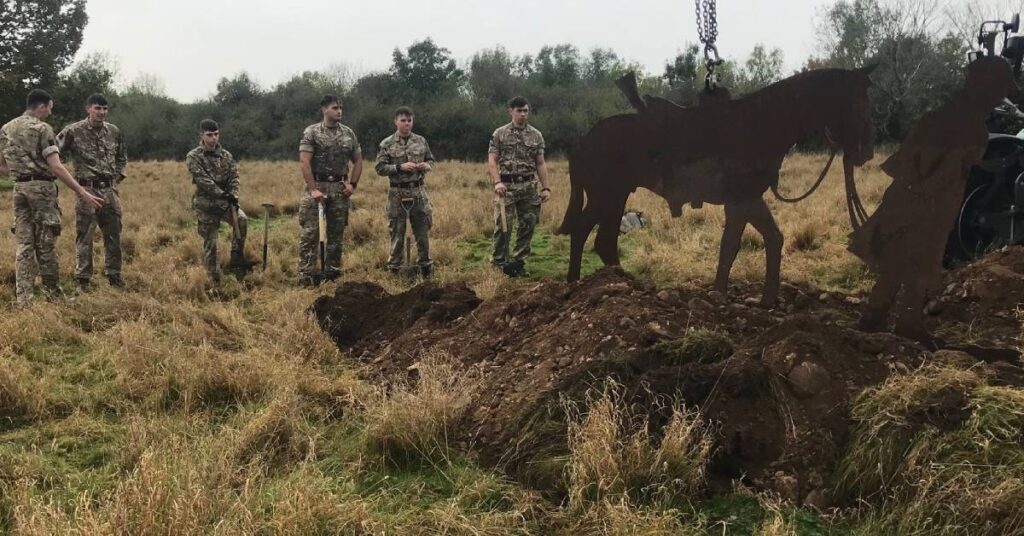
Members of the 21 Engineer Regiment did the spade work
Figures from that project can be seen near the cathedral and around the city as part of the Wilfred Owen memorial walk, created in honour the famous war poet who was based briefly at Ripon Army Camp from March 1918 and died in action in northern France just seven days before peace was declared.
Mr Metcalfe told the Stray Ferret:
“During World War I, this area was the southern half of a huge camp that at any time was providing temporary accommodation for upwards of 30,000 troops.
“When you consider that the population of the city was around 8,000 before the camp arrived, it makes you realise how dominant it was and the impact it would have had.
“I hope that these works serve as a permanent reminder for generations to come of the part that Ripon played in the war and those who never returned.”
The logistics of the installation have been led by Ripon Community Poppy Project, which is also involved in producing the annual remembrance displays in the city centre.
Councillor Stuart Martin, who was one of the founders of the project, said:
“This has happened thanks to a massive collaborative effort, with support from Econ Engineering, Ripon Farm Services, Harrogate Borough Council, the Royal Engineers and Tarmac, which owns the land.
“Thanks to their assistance, combined with donations of materials, time and labour, they have enabled the creation of this stunning installation that underlines the historical significance of Ripon’s military roots, which go back many years.”
The photograph shows artist Dan Metcalfe (front, left) with Councillor Stuart Martin, of Ripon Community Poppy Project, and soldiers from the 21 Engineer Regiment.
Read more: