Residents have been urged to give their views on revised plans for a new town the size of Thirsk seven miles from Knaresborough.
Yorkshire developers Caddick Group, which applied for outline planning permission in 2019, plans to build up to 4,000 homes near Kirk Hammerton, Cattal and Green Hammerton.
Caddick held a public consultation at Kirk Hammerton Village Hall on Tuesday (May 7) to share its updated plans for the settlement known as Maltkiln.
The town will include affordable and eco-friendly houses, as well as two primary schools, a mixed-use local centre, a sports hub and green spaces.
The changes announced included moving the site boundary to the north east and east to provide access into the first phase of development from the A59.
The two roundabouts proposed to access the site have also been moved, with one on the east and one on the west of the site along the A59.
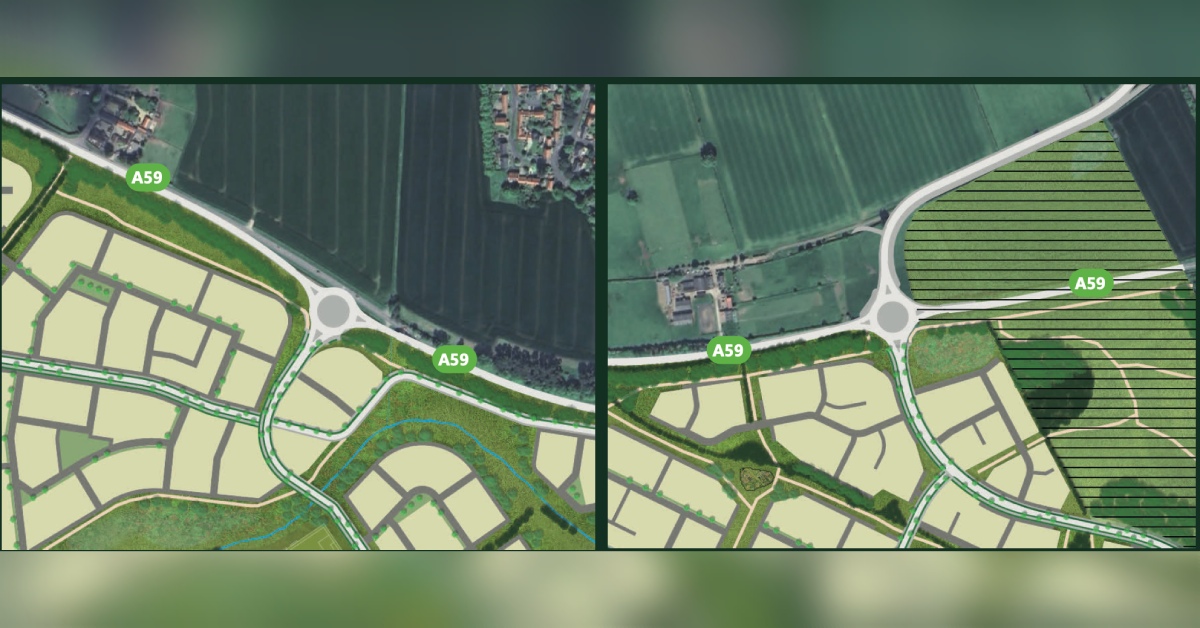
The amended locations of the two roundabouts. Pic: Maltkiln Consultation
There is also set to be an additional new road bridge over the railway line on the eastern edge of the site.
The firm added plans for the mixed-use local centre had extended east of Station Road and north of the railway station. In addition, the proposed location of the northern primary school has been amended.
Caddick also said delivery of the development will now start with a first phase in the north east and continue in a clockwise direction.
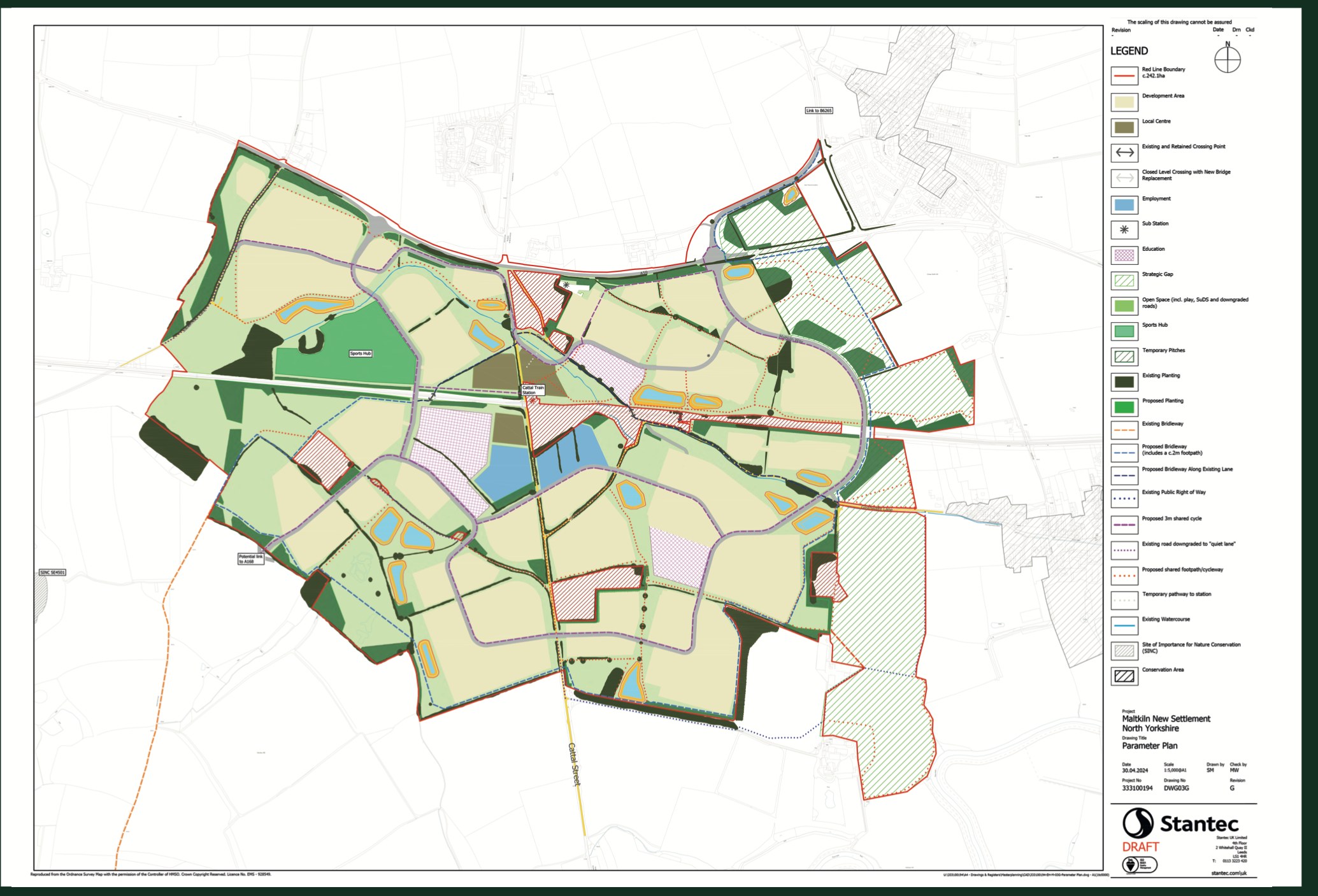
The revised plans and key. Pic: Stantec / Maltkiln Consultation
The scheme has faced backlash from some nearby residents since its inception and progress remains uncertain since the council threatened to compulsory purchase land for the new town.
Rural feel
The Stray Ferret attended the consultation event to speak to residents and Caddick representatives.
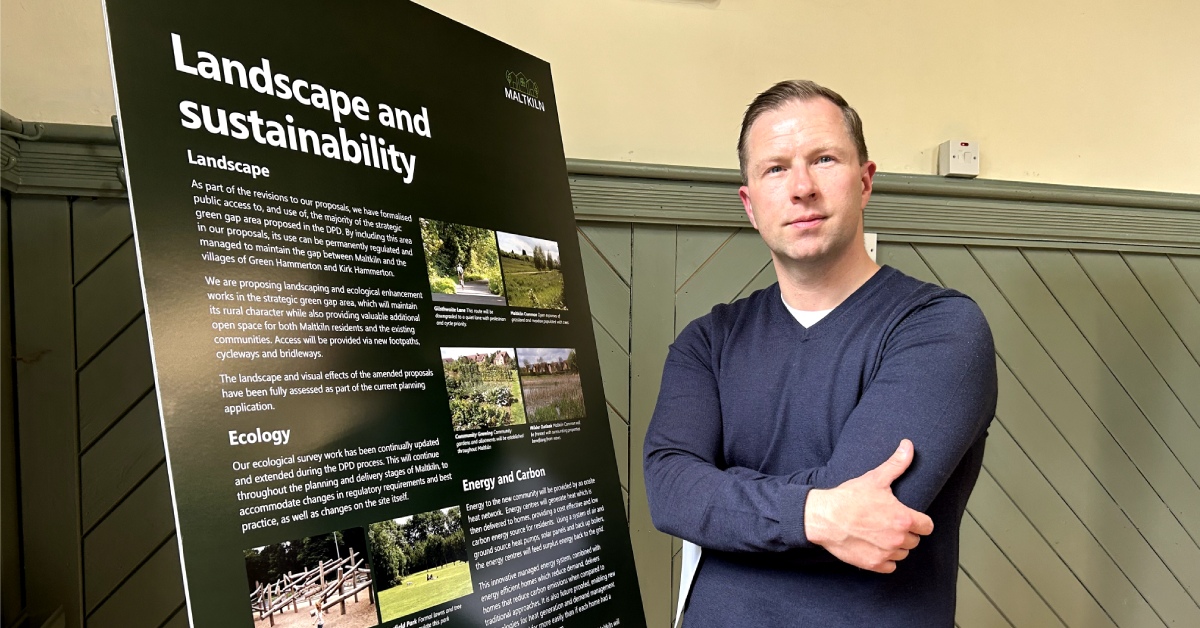
Kirk Hammerton resident James Browne (pictured above) told us people needed to have a “balanced approached” to the proposal.
He said:
“I share others’ concerns. I hope the amount of tension around the development means that things will be done in the right manner and not disrupt the rural feel around here.”
Mr Brown told the Stray Ferret he hopes, if the development goes ahead, there would be “benefits to amenities, cyclists, roads, shops and education” in what is a relatively “isolated area”.
He added:
“I’m hoping if it does go ahead, it would be delivered sympathetically, but once plans are approved, would it just become a case of delivering sheer volume?”
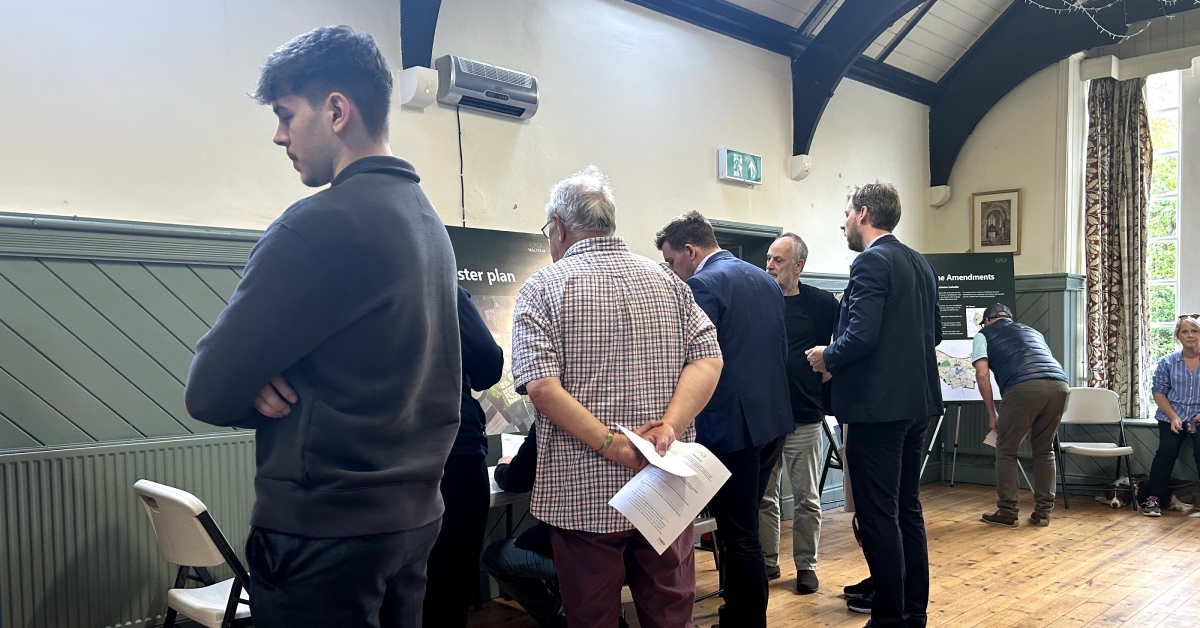
People at the consultation event.
Sue Husband, another nearby resident, questioned whether the potential number of houses was “really necessary”.
She told the Stray Ferret:
“We do need some housing – I get that. My preference is that it’s ecological housing that supports climate change, rather than just luxury homes. We also need a wider community. But do we actually need this number of houses?
“If the plans were to create a small village and there was the potential to expand it gradually, I think people would be able to accept it more. But because it’s this big, sudden expansion people can’t necessarily adjust to it.”
Ms Husband also said she would “consider moving house” if the plans were approved. She added:
“I moved here because it’s so peaceful and quiet.”
Read more:
- Questions over affordable housing at 4,000-home Matkiln scheme
- North Yorkshire combined authority advertises for £125,000 chief executive
Infrastructure fears
The Stray Ferret also contacted Green Party councillor for Ouseburn, Arnold Warneken, about the new plans.
He said the “biggest concerns from residents in his inbox” included the infrastructure of the existing roads and drainage systems.
Cllr Warneken said:
“People feel there could, in reality, be thousands of additional cars around the settlement and they are concerned about the existing road networks.
“They’re also worried about existing sewage systems. Residents have contacted me to say they don’t feel the sewage system can cope as it is, let alone with new houses being built.”
Cllr Warneken said residents also expressed concerns about a GP practice not being included in phase one of the development process, particularly as Springbank Surgery in Green Hammerton is “already oversubscribed”.
Developer wants community to ‘shape masterplan’
The consultation comes after North Yorkshire Council submitted the Maltkiln development plan document to the Department for Levelling Up, Housing and Communities for independent examination.
People now have the opportunity to give feedback on Caddick’s revised plans.
Chris Procter, director at Caddick Group, said in a statement:
“We’re particularly keen for communities in the area to shape key areas of the masterplan, including the design of the local centre, as well as the upcoming residential design code.
“All the information for the consultation is available on the Maltkiln website and we would really like people to get involved and give us their views. All feedback will be analysed and considered as part of our application for the first stage of the project, which we are anticipating submitting later this year.”
You can give your view on the refreshed plans and leave feedback here until Friday, May 27.
Six newt ponds to be created on Ouseburn councillor’s land
Six ponds for the under-threat great crested newt will be created on land owned by Green Party councillor for Ouseburn Arnold Warneken.
The amphibian is protected under law and is recognised in the UK as an ‘at risk’ species, in part due to the loss of habitat through the impact of development such as housebuilding and farming.
It’s believed that 50% of the UK’s ponds were lost during the 20th century, whilst the majority of the remaining ponds are classed as being in a poor state.
Sheffield-based community interest company Wildscapes submitted a planning application to North Yorkshire Council for six ponds on land near Cowthorpe owned by Cllr Warneken.
Five of them will be sited at Goosemoor Nature Reserve.
Wildscapes has created around 200 similar ponds in the last three years across Yorkshire and it has submitted a flurry of similar applications for ponds in Nidderdale over the last few months.
Cllr Warneken spoke at Selby and Ainsty’s planning committee this week which voted to approve the plans.
He said:
“We underestimate how important it is to protect species under threat. The nature reserve provides educational support to schools, scout troops etc and helps adults with learning difficulties and adults with mental health problems.
“There’s a huge benefit in getting them out to nature. Without a doubt, it’s only a small scheme but small is beautiful when it comes to nature. Lots of small schemes end up becoming a big scheme.”
Cllr Bob Packham, the Labour councillor for Sherburn in Elmet, described the plans as a “no-brainer”. He added:
“This is ideal for looking after newts. We all like newts and this has other benefits.”
Read more:
- The Stray Ferret Business Awards 2024: meet the winners
- Huge response to Harrogate walking group for single people
Electric vehicles charging points in Knaresborough car park causing ‘significant harm’
A Knaresborough business owner has claimed 10 electric vehicle charging points installed in a car park have caused “significant harm” to the town and are driving shoppers away.
A petition signed by over 500 people protesting against how EV infrastructure has been introduced in Knaresborough was debated by North Yorkshire Council‘s Harrogate and Knaresborough area constituency committee in Harrogate today.
Ten of the 56 regular parking bays in the town centre Chapel Street car park were turned into electric vehicle-only spaces with charge points at the end of 2022 by Harrogate Borough Council.
A further 12 spaces were given over to EVs in Conyngham Hall’s car park on the outskirts of the town centre but the charge points there have not yet been switched on.
However, at Chapel Street there have been reports of the spaces reserved for EVs laying empty, which has caused consternation to traders particularly on market days.

A statement was read out to councillors on behalf of hairdresser Kelly Teggin who launched the petition. The statement said:
“Like any market town there’s a recognition of the need for transition and charging points are attractive to residents and tourists if introduced at the right time and place.
“However, in this case, implementation of changing points at Chapel Street car park and at Conyngham Hall have been badly-handled in terms of consultation and choices made. They’ve caused significant negative impact on traders in the town centre, attractiveness to visitors and increased congestion.”
Read more:
- Knaresborough survey calls for phased introduction of electric vehicle chargers
- Knaresborough businesses prepare for glittering awards night
A report prepared by officers ahead of the meeting said just five vehicles a day were using the charging spaces at Chapel Street.
But the council forecasts that after five years this will have increased to 22 cars a day and by year eight it will be 30 cars.
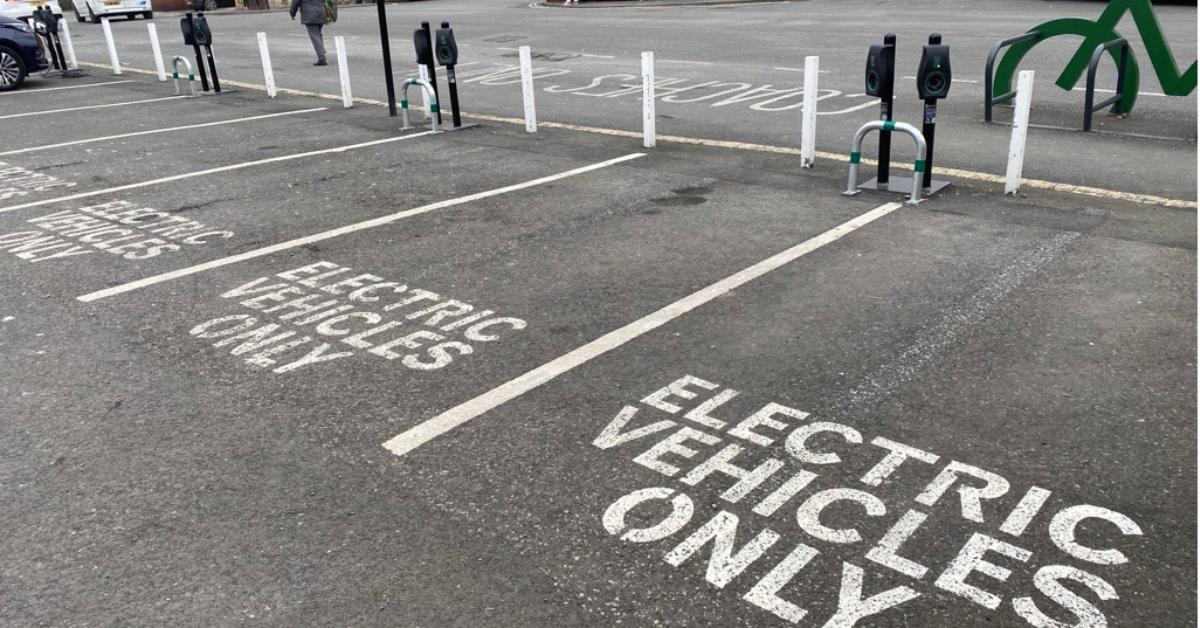
Electric vehicle charging bays in Chapel Street car park.
Dedicated EV bays require traffic regulation orders to restrict access to EVs only, which according to reports the spaces at Chapel Street do not have.
Matt Walker, the Liberal Democrat councillor for Knaresborough West who supports the petition, said any non-EV motorist who had received a ticket for parking in the reserved spaces should contact him as he would be “happy to defend and get those revoked”.
Arnold Warneken, the Green Party councillor for Ouseburn and an EV driver, said he was “shocked and surprised” the council decided to put the spaces in Chapel Street, which is one of the town’s busiest car parks.
But he warned against an increasingly hostile movement against EVs on social media. He added:
“I’m totally behind having EV charging points. There’s an anxiety that infrastructure is not in place for people that drive EVs but there’s a movement out there that’s anti-EV”.
Paul Haslam, the Conservative councillor for Bilton and Nidd Gorge, said there was a “lack of understanding” about EVs but he hoped North Yorkshire Council used the changes in Knaresborough as a “learning opportunity on how we can do it better next time”.
Cllr Walker proposed a motion with nine different points, including a call for a full review into parking in Knaresborough and an assertion that the EV infrastructure had been implemented poorly in the town. It passed by six votes to four.
The area constituency committee is, however, only an advisory body to the Conservative-controlled council.
North Yorkshire 20mph policy ‘not based on evidence’, say councillorsCouncillors have rejected a claim that the decision to undertake a six-month review into speeding was based on insufficient evidence about the benefits of 20mph zones.
At a specially arranged meeting in Northallerton yesterday, Andy Brown, Green Party councillor for Aire Valley, requested a “call in” of the Conservative executive’s decision to begin the review into how it tackles speeding across North Yorkshire.
The executive said the review will lead to a speed management strategy and a rolling pipeline of safety improvement schemes, but it fell short of the demands of campaigners who want widespread 20mph speed limits implemented as soon as possible.
Cllr Brown said a report that underpinned North Yorkshire Council’s decision to undertake the review underestimated the benefits of 20mph speed limits and overestimated how difficult they are to implement.
He said:
“This is not a political issue, go to Cornwall and the Conservatives there got themselves elected and promised 20mph zones where residents support it. We should be thinking about this whatever our politics are.”
The 20’s Plenty campaign has the backing of more 150 parish councils, and campaigners met at County Hall in Northallerton yesterday with several making passionate pleas about why they want action on speeding now.
A statement was read out on behalf of Pam Fawcett, who said she had lived in Beverley for more than 50 years but is now worried about the speed of traffic. She said:
“I’m afraid to cross the road in the village and I must get somebody else to collect my pension. I have great-grandchildren living in the village, they must cross the road to get the school bus and I’m genuinely frightened they’ll be hit by a speeding car.”
Read more:
- Counci’s 20mph review ‘kicking can down the road’
- Trial scheme will ban school run cars from Harrogate street
Both the Green Party councillor for Ouseburn, Arnold Warneken, and Liberal Democrat councillor for Knaresborough East, Hannah Gostlow, queried why the report rejected calls to have a 20mph pilot in Harrogate and Knaresborough despite it being backed by local councillors. Cllr Gostlow said:
“Where was the consultation regarding local communities? We can’t just mention active travel in our strategies, we have to take action. Our goal won’t be reached by words alone.”
However, several Conservative councillors spoke to say they backed the review, including the councillor for Bentham and Ingleton, David Ireton, who said:
“This is not about whether we like speed limits, it’s about whether the executive’s decision was made correctly. I do believe they had sufficient evidence in front of them. I feel that it was a sound decision that was made.”
Alan McVeigh, the council’s head of highways network strategy, defended the council’s approach to speeding in the chamber, as did Cllr Keane Duncan, the Conservative executive member for transport, who spoke through a video link.
Mr McVeigh said:
“We’ve heard a lot, quite rightly, about the benefits of 20mph zones. None of that is in dispute. But a one size all default risks imposing speed limits on communities that may not want them.”
Cllr Duncan that parish councils will still be able to ask for 20mph zones and the strategy should speed up the process for these requests. He added:
“We will be communicating with all parish councils in North Yorkshire to explain the policy and how they can shape proposals. I’ll make sure every councillor gets that in advance. We’re working with communities and I think we can make a positive difference over time.”
Councillors ultimately voted by nine to six to back the executive’s initial decision to undertake the review.
Selby and Ainsty by-election candidates have their say – Part 5This article is the fifth of a series of six.
Voters across parts of the district will be heading to the polls on Thursday (July 20), when Selby and Ainsty holds a by-election triggered by the dramatic resignation last month of MP Nigel Adams.
Most of the Selby and Ainsty constituency lies beyond our district’s borders – it stretches almost as far as Goole and Doncaster – but its northern end does encompass Huby, Follifoot, Spofforth and some of the villages in the Vale of York, such as Tockwith, Green Hammerton and Long Marston.
There’s a broad field to choose from – there are 13 candidates – but who are they, and what do they believe?
In the lead-up to the by-election, we’re spotlighting two or three each day, giving constituents the opportunity to read about the people who wish to represent them at Westminster – in their own words.
So far, we’ve featured Andrew Gray (independent), Claire Holmes (Conservative), Mike Jordan (Yorkshire Party), Dave Kent (Reform UK), Keir Mather (Labour), Nick Palmer (independent), Guy Phoenix (Heritage Party), Sir Archibald Stanton (Official Monster Raving Loony Party), and Matt Walker (Liberal Democrats).
Continuing to take their surnames in alphabetical order, today’s candidates are Arnold Warneken of the Green Party, and John Waterston of the Social Democratic Party.
Tomorrow: Luke Wellock (Climate Party), and Tyler Callum Wilson-Kerr (independent).
Arnold Warneken, Green Party
A progressive, left-wing environmentalist party that has been campaigning for environmental approach to legislation since it was founded in 1990.
“I’ve lived and worked in the Ainsty area for nearly 40 years. Back in the 1990s I was branded ‘Harrogate council’s conscience’ by the then chief executive. I still have a reputation for getting things done, and I work hard for residents all year round, not just at election time.
“I currently sit on Selby planning committee, Ainsty drainage board, and North Yorkshire Moors National Park Authority, so I have considerable experience of decision-making in local government.
“I am already campaigning on 20’s Plenty to cut speed limits, and on river quality at North Yorkshire Council.
“I am free to speak up in Westminster for this constituency, because I’m not told how to vote by Green Party bosses.
“But being a candidate for a small party does not mean that I am a lone force. I lead a skilled team with wide expertise, and I could not be an effective MP without this team.
“If you are usually a Labour vote, by voting Green you are telling Labour to put proportional representation in their manifesto, re-instate their green funding, and cancel new oil.
“If you are usually a Conservative voter, by voting Green you are telling the Tories to allow onshore wind, fund the NHS, and stop dumping sewage.
“The Green Party already has a well-respected MP, two members of the House of Lords, over 750 elected councillors, and four local parish/town councillors.
“Greens have solutions which marry environmental and social justice, enabling lower energy bills AND saving the planet, by investment in renewables and home insulation. We believe in universal basic income, renationalising public utilities, a minimum wage of £15/hour, and ending NHS privatisation.
“Drax must move from ‘burning stuff’ to become a genuinely renewable energy supplier, with long-term employment prospects. Drax’s current subsidy of £1.7m/day could power a resilient carbon-neutral future.
“Farming payments need switching to nature-friendly systems to reduce reliance on fossil fuels, encourage wildlife, and end factory farming.
“Voting Labour or Conservative won’t change this government yet, but another Green MP will make a huge difference in Parliament, so please give me that opportunity.”
John Waterston, Social Democratic Party
A Eurosceptic, socially conservative party that espouses centre-left economic policy and supports a social market economy.
“I have lived here for 31 years and raised two children alongside my wife, Ruth, and we have both worked in the area all of that time.
“I believe the role of a constituency MP is exactly that – a representative for constituents and an influencer on their behalf.
“Crime and Justice: I want to help address the inefficiencies in local policing who deal with public nuisance and anti-social behaviour. I live in the centre of Selby and witness how it strangles the activity and economic success of the town.
“Youth: There is very little to interest, stimulate or engage them. I grew up in a community that had similar challenges and have a range of ideas that could meet this challenge, which directly links with the public nuisance concerns.
“Transport: The bus services post-lockdown have essentially collapsed, from a position that was already inadequate.
“Communities are left with one or two routes per week, restricting movement to daytime hours. It restricts the economy, and crucially, employment opportunities are lost, because without a car, it is impossible to get to work for most shifts. I want to address this urgently.
“Failure to support our economy: There has been no effort and no imagination in how to stimulate a new economy for the 21st century. Tourism could be a key asset. Making connections in Asia and elsewhere, if coordinated with more quality hotel accommodation, would pay great dividends.
“We are a hub for the boating community and that needs to be supported and encouraged. We are geographically blessed by way of transport links to Manchester, Edinburgh and London, all within two hours. The A1(M) is 10 minutes away, providing access to the M62 and the M18. We are the gateway to the North Yorkshire coast. It is a tremendous place to set up a business or set up a home, as I discovered 31 years ago, and the people here deserve better support than they are getting.
“This is why the people of Selby and Ainsty should vote for me.”
Read more:
- Selby and Ainsty by-election candidates have their say – Part 4
- Selby and Ainsty by-election candidates have their say – Part 3
- Selby and Ainsty by-election candidates have their say – Part 2
- Selby and Ainsty by-election candidates have their say – Part 1
Outrage over water firm’s response to concerns over quality of River Nidd
Yorkshire Water has sparked outrage by appearing to suggest pollution in rivers such as the Nidd was partly down to a “change in expectations” from residents.
A study by Professor Peter Hammond revealed the equivalent of 317 Olympic pools of raw sewage were discharged into the Nidd at four sewage treatment works in 2020.
Prof Hammond said the sewage was released into the river at Pateley Bridge, Harrogate, Darley and Kirk Hammerton.
Nidd Action Group and Harrogate and Knaresborough Conservative MP Andrew Jones are campaigning for a stretch of the Nidd at Knaresborough to be granted bathing water status, as part of a drive to clean up the watercourse.
The figures prompted Ouseburn Green Party councillor Arnold Warneken to say water companies should be obliged to produce accurate figures on sewage discharge or face prosecution.
The Nidd saw 870 sewage dump incidents last year, according to Environment Agency figures. Recent testing of water pollution in the river has shown the harmful bacteria E. coli is at “concerningly high” levels.
Yorkshire Water’s chief executive apologised last month for sewage being discharged into the region’s rivers and promised to invest £180m in reducing leaks from storm overflows.
However, councillors told a North Yorkshire Council meeting in Skipton on Thursday that Yorkshire Water’s response to water quality concerns raised by Skipton and Ripon Conservative MP Julian Smith had been “profoundly inadequate”.
The firm wrote:
“Whilst storm overflows have been in use for many decades, since well before the sewer network entered private ownership, society is no longer content with their use and government, regulators and the water sector have responded to that change in expectations.”
Councillors said the firm was blaming the apparent lack of sewage infrastructure near waterways “on the fact that people’s standards had increased and the firm’s monitoring processes improving”.
Flooding concerns
In a separate response, to Harrogate and Knaresborough councillors, Yorkshire Water said “climate change and changes in land use have had a huge impact” on the sewage network.
The firm wrote:
“There is a misapprehension that discharges from overflows have increased dramatically in recent years. Instead, the recording of discharges has increased as we have installed event duration monitoring devices on our network.”
Nevertheless, many North Yorkshire councillors say they have been inundated with sewage-related complaints, with Bishop Monkton Conservative councillor Nick Brown saying Yorkshire Water had promised an action plan to stop sewage flooding in six of his parishes.
Read more:
- 317 Olympic pools of raw sewage pumped into River Nidd, study claims
- Yorkshire Water chief executive apologises for sewage failures
Aire Valley Green Party councillor Andy Brown told Mr Smith there had been “a gradual drift towards releasing sewage when the weather isn’t particularly bad”.
He added:
“The law is very clear. You cannot release sewage unless there is exceptional weather. I have photographs of sewage being released into the Aire on dry days.”
When asked about who should pay for extra sewage infrastructure, Mr Smith replied:
“Inevitably, the cost does have to be borne somewhere, and I accept the point, but the huge cost of fixing this problem is a challenge.”
Councillors told Mr Smith the government should be pressuring water firms to spend more of their profits on improving infrastructure.
Sick after swimming
The firm did not directly respond to Prof Hammond’s findings or claims made by councillors that children have become sick with suspected E coli after swimming in the Nidd.
Instead, Yorkshire Water stated storm overflows had not been identified by the Environment Agency as the reason why the ecological status of the river is poor.
It stated:
North Yorkshire County Council issued legal warning over opposing fracking“Where Yorkshire Water can make a difference is in reducing phosphorus from all final effluent wastewater and that is why we are investing £790m by 2025 in phosphorus removal as part of our overall investment programme which has been in place for some time.
“Our shareholders are funding the majority of our plans for a £180 investment in storm overflow improvements in the next two years. They are supportive of our environmental commitments and this latest funding announcement takes our total investment in river water quality between 2020-2025 to almost £1bn.
“The additional national investment of £10bn announced recently by Water UK will be paid by shareholders up front, with the costs then paid back in tiny increments each year through bills. We won’t know the precise impact on bills for some time. It is clear that huge investment is needed, but precise levels are for the regulator to determine.”
North Yorkshire County Council has been warned its decisions over some major developments could be ruled invalid if it approves an opposition move to brand fracking as “inappropriate”.
Senior council legal officers have issued the advice to its decision-making executive ahead of it on Tuesday considering notices of motion tabled by Liberal, Liberal Democrat and Green councillors over potential fracking schemes.
The motions call for the council to agree fracking activities are inappropriate where a council has declared a climate emergency.
The Green motion says fracking would be in direct conflict with the council’s high-profile carbon reduction plan and its emerging climate change strategy.
The motions, which were tabled in November, follows City of York Council, with which North Yorkshire Council is set to form a combined authority to lead major decisions, voting unanimously that fracking “poses unacceptable risks to people, livestock, wildlife, the climate and the environment”.
In October, another neighbouring authority, East Riding of Yorkshire Council, voted to oppose fracking in its jurisdiction.
Prime Minister Rishi Sunak declared his support for a moratorium on fracking in October and while there are no active planning applications to frack in North Yorkshire, energy companies have numerous licences to explore for oil and gas in the county.
Read more:
- Harrogate and Knaresborough MP denies voting in favour of fracking
- North Yorkshire County Council finally declares climate emergency
- Call for council to oppose fracking in North Yorkshire
However, an officer’s report to the executive meeting highlights legal implications of a council stating its opposition to fracking.
It states while the council has declared a climate emergency, it has a statutory duty to consider any applications for fracking in the county and be seen to act fairly in the decision-making process.
The report adds, if approved, the motions could give the impression that the council and its members have a pre-determined view or are biased in dealing with planning applications for fracking.”

Green Party Cllr Arnold Warneken.
The officer’s report warns planning decisions could be ruled invalid “by reason of pre-determination”.
It says:
“A resolution of the council reflecting the terms of the proposed motion would be a public declaration of the council’s over all position on the issue of fracking.
“When members are sitting in a quasi-judicial role as they are with planning decisions, they have to be alert to how any views expressed by them individually or a collective view of the authority could impact their position.
“It is not just about being fair and impartial, but being seen to be so. The legal test when considering bias is not whether there is actual bias, but whether a fair-minded observer aware of all the facts would conclude there was a real possibility of bias.”
Green councillor Arnold Warneken, who proposed one of the motions, said if councils such as East Riding could put its opposition to fracking in place, so could North Yorkshire.
He said:
Councillor ‘absolutely amazed’ Maltkiln landowner able to pull out“It could be done in general terms rather than planning terms. You could apply the pre-determination reasoning to anything, such as statements to cut carbon. This would be a policy statement rather than a planning statement.
“We want to move away from the extraction of any fossil fuels in our county. This is about making a statement about the council’s commitment to having an impact on climate change.
“The major impact the council can have on climate change is influencing third parties who we deal with. The council could say it would not support fracking because it goes against our strategy to reduce carbon.”
A councillor whose division could be transformed by thousands of new homes says he is “absolutely amazed” that a landowner was able to pull out of the Maltkiln scheme at the 11th hour.
Last week, Harrogate Borough Council revealed a landowner had decided against selling a parcel of land that would have formed part of a 3,000 to 4,000-home settlement called Maltkiln.
The potential town, which includes two primary schools, would be built off the A59 towards York near the villages of Cattal, Green Hammerton and Kirk Hammerton.
The news came as a blow to Wetherby-based Caddick Group, which has been developing plans for several years.
The developer called the decision by the landowner “regrettable” but said it was confident the scheme would continue.
The broad location for Maltkiln is allocated for development in the council’s Harrogate district Local Plan 2014-35, which maps out where housebuilding can take place.
Read more:
- New settlement plans ‘paused’ after land withdrawn near Cattal
- Concern over lack of secondary school at new Harrogate district town
Planning permission for Maltkiln is yet to be granted but a development plan document has been painstakingly prepared by the council over the last two years and was close to being submitted to the government for approval.
The council has said work on the development plan has now been “paused”.
Cllr Arnold Warneken, Green Party councillor for Ouseburn division on North Yorkshire County Council, described the situation as “a bit of a mess”.
Cllr Warneken told the Local Democracy Reporting Service:
“How did Harrogate Borough Council and the developer not tie-up people to legal agreements for the sale of land? I’m absolutely amazed they didn’t tie-up all these options.
“They are back to the drawing board and I wouldn’t want to be paying for this. The development plan document goes back on hold and will need to be redrafted. It almost starts again.”
Cllr Warneken said he understood the parcel of land formed a significant part of the overall masterplan.
He described an initial celebratory mood in the affected villages after the council released its statement, with residents hoping it could throw the whole project into doubt.
Now the dust has settled, he fears it could mean the developer will have to reduce its ambitions for the scheme in order to make it financially viable.
He said:
“The viability will have to be adjusted and could mean a change in the nature of properties. There might be higher density, bigger properties, and they could build one primary school instead of two. I wanted this to be an ecologically exemplar development but I’m concerned they will chip away at that.”
Responding, a spokesperson for Caddick Group said:
Ouseburn Green councillor calls for greater climate focus on agriculture“It is usual for landowners to want differing terms when entering into agreements to sell their land and all such agreements are only for a specific period. In this particular case, the family concerned were previously willing to sell but wished to limit their legal agreement to a shorter period of time than the other landowners and subsequently decided not to extend or renew their agreement.
“Our proposals include innovative approaches to reducing both energy and vehicle use which will still apply to an updated new settlement boundary, which will also now incorporate a significant element of renewable energy generation.
“We are now in the early stages of reviewing our draft masterplan for Maltkiln in consultation with Harrogate Borough Council and North Yorkshire County Council, both of which will need to decide how best to advance the new settlement from this point on.
“Once we know how the councils wish to approach the change in land area, and we have explored how our proposals could be best aligned with their intended process, we will engage with the community and key stakeholders once again.”
An Ouseburn councillor has said a new North Yorkshire County Council strategy to tackle carbon emissions and climate change should focus more on agriculture.
Senior councillors are expected next week to approve opening a public consultation on a draft climate change strategy.
The strategy aims to make North Yorkshire the first carbon negative region in the country, meaning more carbon dioxide emissions would be removed from the atmosphere than emitted.
The document sets out how the new North Yorkshire Council, which will launch on April 1, will develop work already underway to reduce carbon emissions.
Initiatives include producing more renewable energy, reducing the use of fossil fuels, improving insulation in homes, encouraging the use of low-emission vehicles and promoting more active travel such as cycling and walking.
However, Cllr Arnold Warneken, a Green Party member who represents Ouseburn on the council, said the strategy proposed little on how to tackle emissions from the agriculture sector.
Figures show North Yorkshire produced 5,829 kilotonnes of carbon dioxide equivalents (kt co2e) in 2020, with agriculture equating to a third of the total, transport responsible for 28% and 19% coming from homes.
Cllr Warneken said:
“While the plan is claimed to be ambitious we seem unwilling to address the issue of agriculture and cite what other organisations are doing as opposed to what we propose to do, as at the moment that is nothing.
“We could at least start by looking at the farms we own and then move on to working with likes of the National Farmers Union who have their own targets and strategy which we could work with. For example being more supportive of applications for renewables on farms that wish to produce energy for their own use and that of the local communities.”
Read more:
- Calls for council to go ‘further and faster’ on climate change in North Yorkshire
- Rain highlights concerns about state of Harrogate district drains and gullies
Work already undertaken in the county to tackle carbon emissions includes the installation of energy-saving LED street lighting, energy efficient improvements to buildings and trialling the use of electric vehicles.
The route map for the region to become carbon negative by 2040 has been spearheaded by the York and North Yorkshire Local Enterprise Partnership and has seen a plan drawn up to involve the public sector, businesses and communities.
Conservative Cllr Greg White, executive councillor for climate change on the council, said:
“Climate change is without question the greatest threat that the world faces, and is already impacting on communities across the globe.
“We have seen an increasing frequency of extreme weather conditions here in North Yorkshire and across the UK as a whole, which scientists tell us is clear evidence of significant changes in our climate.
“Without clear and decisive action, the situation will only get worse. However, we are committed to ensuring that we have a comprehensive strategy in North Yorkshire, especially as we look towards the launch of the new authority this spring.”