Anyone walking around Knaresborough could hardly fail to notice it’s a beautiful and historic place. But trying to find out more about its rich past isn’t easy.
The town’s first community archaeological festival, which begins today (Saturday), aims to shine some light — and the organisers hope it will be the start of a long-term drive to tell Knaresborough’s story.
Hundreds of people are expected at the free festival, which takes place from 10am to 4pm today and tomorrow and at the same times next weekend at the Centre-on-Gracious Street.
A 4,000-year-old ceremonial axe found at Hopperton will be among the star attractions. People can bring along their own artefacts for experts to examine and Nun Tabbetha will provide some half-term fun by writing medieval pardons for naughty visitors.
Knaresborough Museum Association, which has organised the festival, hopes the event will prove a springboard for further study into the town’s past.
Chair Kathy Allday said:
“There is so much out there that we don’t know much about. Knaresborough remains a bit of a mystery in many ways.
“We hope the festival will create more interest in the archeology of Knaresborough, generate local pride and raise awareness of how fantastic Knaresborough is.”

Knaresborough Museum Association volunteers at a dig.
Former archaeologist Kathy is passionate about Knaresborough and full of tantalising tales, many of which remain shrouded in secrets.
For example, she says a washing tunnel is believed to have existed in a medieval hospital in Spitalcroft. The tunnel in a swollen pool naturally filled with pure, clean water but the site is now part of a private garden. The Trinitarian Priory, which was dissolved by Henry VIII, is known to have been a regional mother church but its full size and significance needs further research.
Two Roman hordes have been discovered in the area. Viking straps and Saxon pins will be on display this weekend. But Knaresborough’s golden age was the medieval period, when Kathy says Abbey Road “was like Piccadilly Circus” because so many people flocked to St Robert’s Cave, the Trinitarian Priory and Knaresborough Castle.
Nidd Gorge is a key area of historical interest. Kathy says:
“Because we have an ice age gorge that has been cut through we have layers from the past all revealing different artefacts.
“There is evidence of people living there for thousands of years. There are bones and teeth of prehistoric animals. Think Woolly Mammoths.”
A mudlarker called Steve has spent 20 years extracting items from the Nidd. His finds include medieval pottery, a Victorian doll and a jug inscribed with the name John Ingleby, from the family that owns Ripley Castle.
Kathy wants to know more about the Iron Age fort that existed at Nidd Gorge and talks excitedly about the possibility of bringing home Knaresborough treasures currently housed elsewhere, including the Brotherton Library in Leeds and the nomadic Harrison Collection.

For that to happen, Knaresborough needs a larger museum.
The association currently operates Knaresborough Museum at 8 York Place, which is open on Wednesdays and Saturdays. It has served the town well but the ground floor of a house was never likely to be an adequate long-term solution and there are plans to move to larger premises after a bid to use the former Castle girls school fell through.
Kathy is quick to pay tribute to the work of other local groups, including Knaresborough Castle and Courthouse Museum, Claro Community Archaeology Group and Bilton Conservation Group for their work in specific fields.
But she hopes the museum can become the overarching focal point for telling Knaresborough’s story — not only a place to go but also a hub to conduct further research and hold events, including more festivals, that take the town’s story to community groups and schools.
It’s a long-term mission — but few would doubt Knaresborough has a story worth telling.
Read more:
- Knaresborough scarecrow trail to begin on Saturday
- Knaresborough to hold first community archeology festival
Comedian Hugh Dennis to reveal Studley Roger’s secrets on TV this week
Comedian and presenter Hugh Dennis will be on TV revealing the archaeological secrets of a lost mansion at Studley Royal on Thursday (June 22).
The Great British Dig episode, which was filmed over five days last September in the deer park next to Fountains Abbey, follows the show’s resident experts as they learn more about a mansion that stood there until 1946, when it burned down.
The gutted house was demolished, and it was only years later, during Storm Arwen in 2021, that a tree on the site of the former mansion was blown down and its roots exposed some interesting masonry.
The episode Studley Royal – the Missing Georgian Mansion will be aired for the first time on Thursday, June 22 at 9pm on More 4.
Mark Newman, National Trust archaeologist, said:
“There has been National Trust archaeological research at Fountains Abbey and Studley Royal for 37 years, but no matter how much we discover there always seems to be more to find. It’s a rare and exciting opportunity to have a programme like The Great British Dig getting involved with our archaeological research. Understanding the detailed history of our properties, and the archaeological riches they conceal, is undoubtedly a ‘long game’.
“The discoveries we made were extremely exciting and moved on our understanding of a number of Studley Royal’s mysteries considerably. We really look forward to them being revealed on air on 22 June, and to further explorations that will no doubt tell us even more.”
The Studley Royal episode is followed on Thursday, June 29 at 9pm by The Great British Dig at National Trust Cherryburn in Northumberland, The Birthplace of a Celebrity Illustrator.
The Great British Dig presenter Hugh Dennis, whose father John was Bishop of Knaresborough from 1979 to 1986, said:
“It was a genuine treat to be able to dig at not just one, but two National Trust properties at Studley Royal and Cherryburn. We unearthed some amazing finds, met some great volunteer staff who were more than happy to get their hands dirty, and ate our fair share of scones too.”
Read more:
- Repairs planned for listed weir at risk of collapse at Studley Royal
- National Trust plans major £3.6m building project at Fountains Abbey
- Studley Royal’s slavery links revealed in report
English Civil War soldiers’ mass graves ‘revealed’ by drone technology
The final resting place of thousands of Royalist soldiers killed in the English Civil War may have been revealed using new drone technology.
Amateur archaeologist Tony Hunt found the mass graves at White Sike Close, near the A59 between Harrogate and York, using drones equipped with infrared and thermal imaging cameras.
He said:
“The great thing about this site is that we know exactly where the bodies are supposed to be – the pits are very well attested by historical accounts – and we know that there has been no development here, only agriculture, since the battle. When we do a wider survey, the surrounding area looks very homogeneous – these are the only anomalies.
“So we have the right size, the right location, written records and even different growth patterns in vegetation growing here. I’m as sure as I can be that these are the burial pits for the Royalist dead.”
The soldiers were killed making a last stand at the Battle of Marston Moor, which was fought on July 2, 1644. The battle was the largest of the English Civil War, and the Parliamentarians’ victory effectively ended Royalist influence in the North of England. King Charles I was beheaded less than five years later.
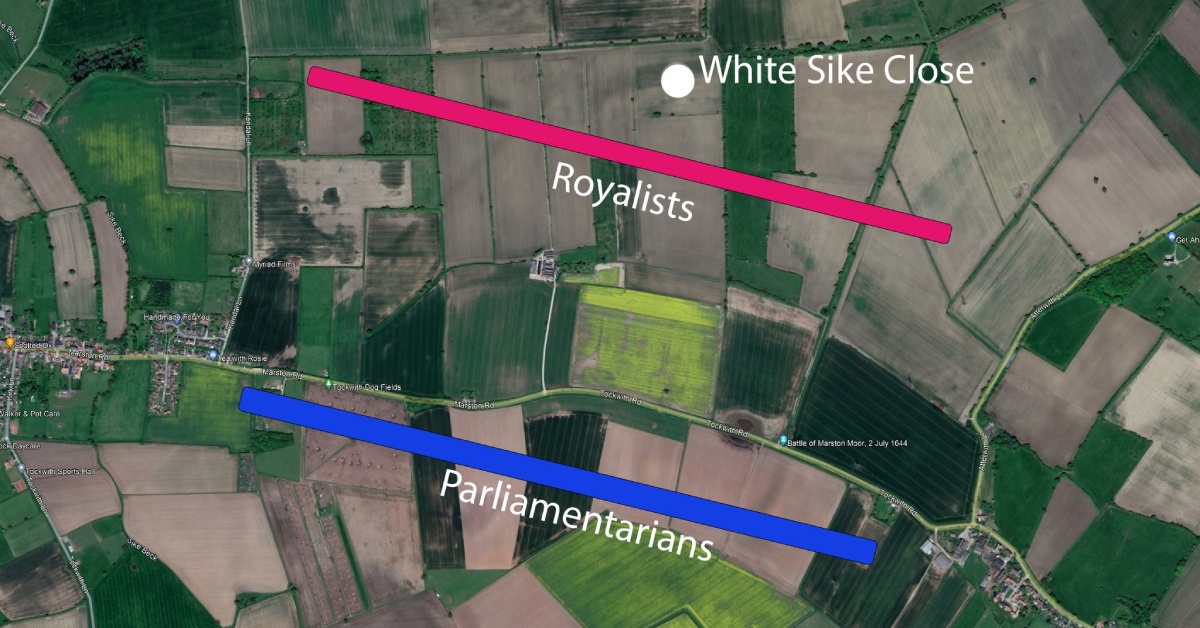
Satellite map with battle lines overlaid showing the disposition of forces at the Battle of Marston Moor in 1644.
Estimates of casualties vary, but it is believed that at least 300 Parliamentarians and 4,000 Royalists were killed at the battle.
The battlefield site, which is registered on the National Heritage List for England, lies within the boundaries of the Harrogate district.
Chris Rock, Yorkshire regional chair of the Battlefields Trust, said:
“The Battlefields Trust is always interested in any possible evidence of the conflict sites in the country. Despite being a registered battle site with Historic England, this does not automatically give it protected status, and is thus open to illegal activity.
“Only by working closely with those who used the land or are landowners can we hope to protect and preserve any possible battle proof. We look forward to any future excavation work if allowed and will always work in partnership with those who have the same aims of preserving our history.”
But Mr Hunt says he doesn’t want to investigate further. He said:
“Just knowing they’re there is enough for me. I can’t see any benefit in opening up the poor lads’ graves.”
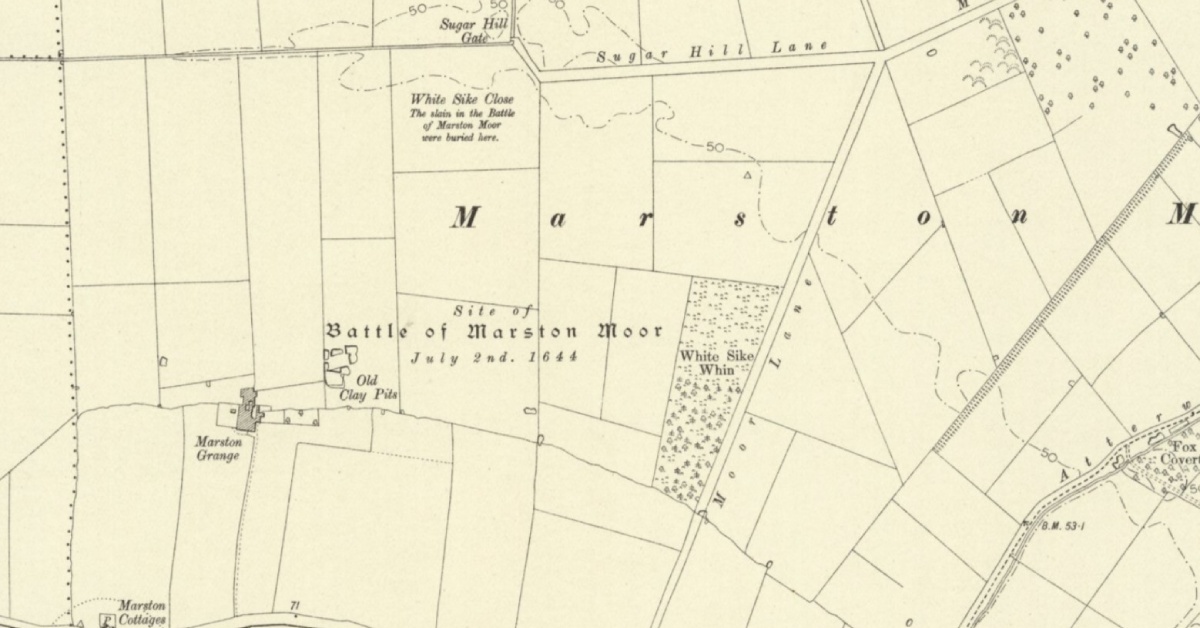
Detail of a 19th-century map, showing the location of White Sike Close, where Royalist soldiers are believed to have made a last stand – and been buried.
The English Civil Wars were fought between 1642 and 1652 and pitted King Charles I and his Royalists against the Parliamentarians, led by Oliver Cromwell, who generally believed in the primacy of Parliament over the monarch. It resulted in the execution of the king and the establishment of the Commonwealth of England.
Mr Hunt has a degree in archaeological sciences from Bradford University and is currently managing director of DJ Assembly, a York-based micro-electronics company. He also runs Yorkshire Aerial Archaeological Mapping, whose thermal and infrared imaging technology revealed the burial pits.
He has previously used his drone technology to locate many other sites of historic interest. Last summer, he found a missing section of Roman road, and early this year he discovered a suspected prehistoric henge under the village of Kirk Hammerton.
Read more:
- New Harrogate district henge could be ‘nationally significant’
- Missing section of main Roman road found at Green Hammerton
- Calls for archeological survey into Knaresborough’s Roman past
Angry Minskip villagers fight developer over possible Roman site
Angry villagers in Minskip, near Boroughbridge, are joining forces to fight against an industrial development which they say could endanger a Roman mosaic.
They also say the development at Hazeldene Fold, an otherwise residential cul-de-sac, is out of character with the village and does not comply with the Harrogate district Local Plan 2014-35, which outlines where development can take place.
Local resident Lynne Scott said:
“The mood here is very angry, because the developer hasn’t made any effort to interact with us or tell us what’s going on. They’ve already done massive groundworks without even having planning permission yet, and we just don’t know if there’s been any damage to the archaeology there.”
The developer, Harrogate-based Forward Investment Properties, has applied to Harrogate Borough Council for retrospective planning permission to demolish some Nissen huts on the site, and build four light industrial units, a car-park and a turning circle for goods vehicles.
But campaigners believe the existing buildings may well conceal Roman remains. According to local resident Tony Hunt, a Roman mosaic floor is reported to have been discovered when the huts were built in 1970 but covered over with a layer of sand and plastic to preserve it. The location cross-references on Ordnance Survey maps with a square-shaped earthwork, and a Roman coin hoard was found nearby in the 19th century.
Mr Hunt said:
“My conclusion is that the data confirms that the ‘Ancient Enclosure’ at the top of Hazeldene Fold is the site of the Roman encampment which served the Roman fort at Aldborough”.
Forward Investment Properties has agreed to an “appropriate scheme of archaeological investigation and recording” as part of a planning condition to be applied if planning permission is granted, but residents say the groundworks could have done damage already, even before any such investigation has taken place.
2017 application rejected
Campaigners point to a 2017 application to build five houses on the site, which was rejected. Planning officers said then that the development would tower over neighbouring properties, create noise and disturbance, lack an adoptable highway, and be “out of keeping with the acknowledged linear form of the village”. They say the current proposals should be rejected for the same reasons.
Forward Investment Properties says its application should be approved because there is a shortage in the Harrogate district of employment sites of the type being proposed, and points out that the site has long been used for commercial purposes.
Read more:
- Missing section of main Roman road found at Green Hammerton
- Calls for archeological survey into Knaresborough’s Roman past
- Thieves steal 10 motorbikes in Minskip
Access to the site is via Hazeldene Fold, a private residential road managed by Hazeldene Fold Management Company Ltd. On formation, the company was made up of one representative from each of the eight homes on the road, plus one from the original developer of the houses. Each of these nine members has a single vote on communal matters, including those involving planning permission.
Residents believe the developer’s vote should pass automatically to the new owner of the site, but the new owner, Forward Investment Properties, has not so far contacted the company or its individual members.
Ms Scott said:
“It makes you feel suspicious. If someone is upfront with you and you can ask them questions, you can have a conversation and iron things out. But if you have a body you can’t get hold of, you feel you have no control.”
Forward Investment Properties is registered with Companies House as a limited liability partnership and its three members are believed to be brothers. One of them, Daniel Ward, was approached by the Stray Ferret, but declined to comment.