A brown plaque is to be erected outside one of Harrogate’s oldest and best-known clothes shops.
Property expert Alex Goldstein, with the support of local historian Malcolm Neesam, successfully applied to erect the plaque outside gentlemen’s outfitters Rhodes Wood. on Parliament Street.
The shop used to belong to Mr Goldstein’s great grandfather Louis Copé, a fashion designer whose female emporium opened on the site in 1922.
Mr Copé was a Polish designer whose high society customers over the years included Queen Mary, her daughter Princess Mary and Agatha Christie. The shop operated under royal patronage.
The store itself featured in the film Agatha, starring Dustin Hoffman and Vanessa Redgrave.
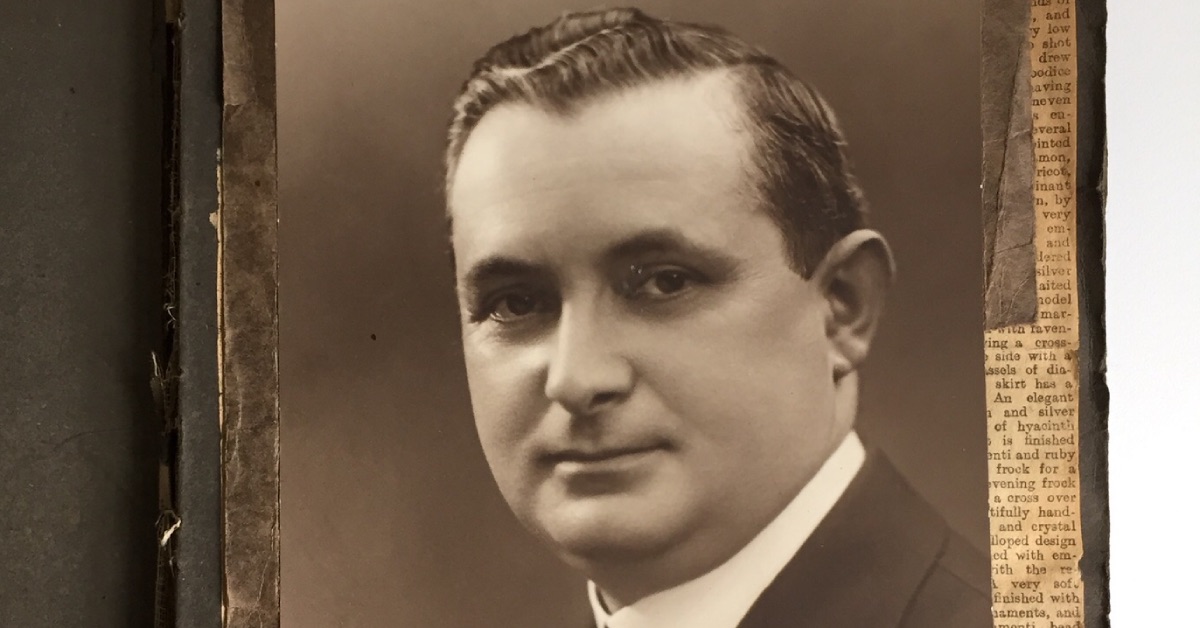
Louis Copé
Mr Copé moved to Harrogate because he believed the pure air would help his asthma. Mr Goldstein, who still lives in the area, said:
“I am so pleased to have been able to mark the history and story of my great grandfather, whose fashion house spanned decades and formed important memories for so many people in and around Harrogate.
“It has been lovely hearing people’s memories and visiting the Pump Rooms to actually see some of the garments that were made in his sewing rooms which are stored there.”
Read more:
- Knaresborough unveils blue plaque to celebrate its ancient market
- Amazing aerial photos of Harrogate, Ripon and Knaresborough from 100 years ago
Jeremy Beaumont, who owns Rhodes Wood, has been supportive of preserving the history of the building.
“When we took over the store in 1997, there were still many of the original features and cabinets in the shop, in such good quality and condition, that we still have them in the store to this day, literally 100 years later. The quality of the store fittings must have been superb, and to a very high standard.
“It is our pleasure to recognise the past history of the building, and we are delighted to host the plaque outside for everyone to see”.
The plaque is due to go up any day now.
Mr Goldstein is asking for anyone with memories from Louis Copé, or even items of clothing and hats etc, to contact him at alex@alexgoldstein.co.uk.
Property Gold: What next for the phenomenal Yorkshire property market?
 Property Gold is a monthly column written by independent property consultant, Alex Goldstein. With more than 17 years’ experience, Alex helps his clients to buy and sell residential property in some of the most desirable locations in Yorkshire and beyond. This month, Alex discusses buoyant Yorkshire property market – and what might happen next.
There have been moments nothing short of insanity in the Yorkshire market recently, with exceptionally high prices being achieved, sealed bids, jaw-dropping competition and no let up.
As we exited the lockdown earlier in the year, the market very quickly (and as predicted) got instantly back up to speed. We then had the Chancellor’s ‘brain wave’ of overlaying a SDLT holiday – sending market activity through the roof. I have never experienced anything like it during my 19 years in the industry.
However, whilst the SDLT break provided a sharp shock to the market, the pace wasn’t just down to this. A positive from Covid (yes there are some!), was that it forced buyers to really analyse what they wanted. Companies realised that they could make substantial staff savings by having a remote workforce, family-work balance became more prominent and those in the cities realised they could be based further away from the office. As a result, Yorkshire has taken advantage.
Whilst we always had a strong local market, we now have large amounts of money being poured into the area from those relocating from London and the Home Counties, but also those based internationally. As I write, I have clients based in Singapore, the US and France – they are all Yorkshire ex-pats looking to ‘come home’ having been couped up in city environments.
Read More:
- Property Gold: The empty homes scandal – who’s the fool?
- Property Gold: The butchered landscapes of PLC developments – who’s to blame?
So with all this recent activity, what do I think the market landscape looks like into the near future? Most importantly, myself and no one I have spoken with is predicting a price crash or correction. I have long said that the gap between the North and South was closing and this is proof. The prices we have seen, now provide a new benchmark for the area and I feel that we will now see a steady and reassured step forward onwards from this.
Currently there is a shortage of stock in the market, however this is down to the school holidays and people quite understandably wanting a break. Come early September I feel the market will be back on and whilst not at the same raucous pace, the outlook only looks positive.
However, in order to secure your next home, everything comes down to your buying position – and being ‘Under Offer’ doesn’t have the same clout it once did. With legals and banks taking ever longer, vendors and estate agents are shying away from the associated risk and delays, to opt for buyers that are ready to go. The only question you need to ask yourself is when you are going to join the foray.
It’s an exciting time to be in the Yorkshire property market and this is the start of the wave!
If you have any comments or questions for Alex, please feel free to contact him on alex@alexgoldstein.co.uk
‘Crazy’ rush to buy homes in Harrogate as stamp duty holiday endsEstate agents in Harrogate experienced a “crazy rush” to complete home purchases this week before the end of the stamp duty holiday.
One estate agent told the Stray Ferret yesterday was their busiest day in the last two years while a property expert said the government should have never imposed the holiday.
Completion day is always fraught for prospective home buyers and sellers. However, many will have been particularly nervous this week with £15,000 in stamp duty savings on the line.
From today, the tax free threshold falls from £500,000 to £250,000 and will drop again to the usual rate of £125,000 on October 1.
Read more:
- Employee stole from Harrogate garden centre for more than a year
- Harrogate Parish Council could be created after devolution shake-up
Richard Smailes, a partner at Feather Smailes Scales, told the Stray Ferret:
“There was a mad rush to get everything completed by the end of play yesterday. We are still seeing plenty of interest and demand.
“Just because the deadline has gone it does not mean that the reasons for moving have gone away. People want more from their homes because they are spending more time there.
“FSS was very busy yesterday, we had an awful lot of completions on the books. We were geared up for it but it was our busiest day in the last couple of years.”
Harrogate Borough Council has also experienced a surge in search requests in recent months.
The local authority has struggled to cope with the demand at times but the situation has improved and the average wait is currently three weeks.
Alex Goldstein, an independent property expert in Harrogate, told the Stray Ferret:
“I said from the outset that we did not need the stamp duty holiday. We already had a very strong market before the tax break came into play.
“So what we have seen over the last year is prices go up significantly in the area. It seems the stamp duty was just added as part of the price of the property.
“This is what happens when the government tries to intervene in the market, it just creates a bigger problem for people.”
What has been your experience? Reach out to tell us your story by sending an email to contact@thestrayferret.co.uk.
Property Gold: Are leasehold properties just modern day slavery?Property Gold is a monthly column written by independent bespoke property consultant, Alex Goldstein. With over 17 years’ experience, Alex helps his clients to buy and sell residential property in some of the most desirable locations in Yorkshire and beyond.
This week Alex looks at why leasehold property purchases are so controversial.
Leasehold reforms seem to be here, with the Government now intervening and yet again the PLC developers are in the news for all the wrong reasons.
In September, the four largest house builders were investigated after ‘troubling evidence’ was uncovered about how leasehold properties were being sold.
The CMA (Competition and Markets Authority) found that some leasehold buyers were being hit with ground rents that doubled every decade, pressurised selling tactics and informing buyers they could buy the freehold for a small sum, only to find out latterly this cost had increased significantly. This left many people in a position of never being able to sell – a modern day slave to leasehold ownership, you might say.
Whilst the Government took action last year against the developers, the ban was not retrospective. This left many stuck in unsellable homes with crippling ground rents. Too little, too late for them unfortunately.
How then has this all come about?
Be under no illusions, the PLC developers are all about money and profit margins. Ethics and morals aside, selling a leasehold house gave a PLC developer more angles to make money.
They could sell the freehold to an investor, who in turn could ratchet up ground rents and the developer doesn’t get their hands dirty. This would provide (up until now) a useful additional income stream and was all legal.
How, then, have people managed to buy such properties and be unaware of the pitfalls? Could it be that some PLC developers had a monetary referral system with a panel of ‘recommended’ conveyancing solicitors, who then overlooked updating buyers on the finer detail?
It’s easy money with limited input required – keep ground rents high for additional income (which also commonly had annual percentage hikes) and charge leaseholders to alter their homes. Combine these with poor building management and these properties become even harder to sell – hence the birth of the ‘fleecehold’ movement.
Now that the Government claim they want to resolve matters, will leaseholders have the opportunity to retrospectively claim their costs back for lease extensions or purchasing the freeholds? Equally, could this now open the floodgates for legal cases against the PLC developers?
What is clear, is that the PLC developers created various angles to squeeze more money out of a deal, meaning higher share prices, happier stockholders and bigger executive salaries.
Whilst the Government have promised that leasehold reforms are coming, there’s no reason to celebrate just yet. All eyes are on the detail, which will do little for those owners who have been already hoodwinked and are now enslaved to their properties. Thank your lucky stars you have read this and won’t fall for the same tricks!
Property Gold: why I’d never buy a PLC New HomeProperty Gold is a monthly column written by independent bespoke property consultant, Alex Goldstein. With over 17 years’ experience, Alex helps his clients to buy and sell residential property in some of the most desirable locations in Yorkshire and beyond.
This week Alex highlights some of the problems with New Homes sold by Private Listed Companies – and why he would never buy one.
Apples – sometimes you bite into one and what lies beneath the pristine surface, is nothing but a floury, rotten core. You could say this is like buying a new build home from a PLC developer (i.e. one who is listed on the stock exchange), where their sprawling mass-volume schemes continue to plague Yorkshire. But what exactly is my issue with them and why would I never buy one?
Let’s start with one of my biggest issues – build quality. There are consistent reports in the media about sub-standard practices and corners being cut – all with the sole aim of maximising profit margins. PLC developers are not charities and are there to support their shareholders and to maintain stock position. PLC developers usually want 25-30% profit margin on each unit they sell, but they still need to install the glamorous kitchens and bathrooms as buyers can see and touch these. Therefore areas can be overlooked on items one can’t see behind the scenes such as cavity wall insulation, fire barriers, plumbing, wiring, roofing etc to get the profit. It’s not exactly ethical.
Many buyers then say, don’t worry we have all the guarantees and warranties, so we’re covered if something goes wrong. Well I would turn this around and ask – have you actually tried to make a claim on said warranty? Good luck!
It’s all about secondary and tertiary locations – after all, the only land available for the size of schemes that PLC developers want, lie on the outer fringes of already existing conurbations. So where is the upside when property is all about location? Lack of supporting infrastructure, traffic problems, shortage of school places and GP surgeries – the list goes on.
In these uninspiring, soulless Stepford streets, one can rarely add value as the developer has already maxed out the angles so their profit is amplified. In addition, buyers seem to sleepwalk into paying an excessively high price from the outset due to the glossy marketing and commission hungry sales staff. Therefore new owners are solely relying on the market to increase their home’s value during their time in ownership. So what happens if the market doesn’t go up and/or you fall into negative equity?
With the continued decline of the High Street, isn’t it about time we reinvigorated these areas. I firmly believe there is no need to build on open green space. Instead the Government needs to incentivise PLC developers to refurbish what we have and to help bring communities back together.
In conclusion, I did a quick straw poll of 20 estate agents and solicitors that I work alongside. Not a single one owned a PLC new home. And that’s all you need to know.
If you have any comments or questions for Alex, please feel free to contact him on alex@alexgoldstein.co.uk.
Read More:
- Property Gold: Virtual Tours – are they worth it?
- County council housing company accused of avoiding building affordable homes